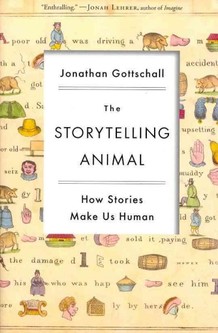
A great conversation with the author of this book is podcast here thanks to PBS and its contributors. In the current issue of American Scientist, a review:
Gottschall clearly considers it safe to say that storytelling has something to do with helping us navigate our social worlds, since we are such thoroughly social animals: “We are attracted to fiction not because of an evolutionary glitch, but because fiction is, on the whole, good for us. This is because human life, especially social life, is intensely complicated and the stakes are high.”
Innocuous as this conclusion sounds, there are some serious problems lurking here. The first, which Gottschall readily acknowledges, is that some fictions are very bad for us, encouraging us to identify strongly with one human subgroup at the expense of all others; he adduces a few obvious examples, such as the silent film The Birth of a Nation, which aided the reemergence of the Ku Klux Klan, and the inspiration Richard Wagner’s operas provided for a young man named Hitler. Still, Gottschall insists that on the whole, fiction has a generally moral effect on us, creating communities not unlike those formed by religious belief, which in turn rests on the power of stories. But then, how is this understanding of literature any better than that proposed by Matthew Arnold long before the advent of neuroscience? Likewise, Gottschall rightly suggests that humans need a sense of order and coherence that only narrative can provide. But then, how is this understanding of narrative any better than that proposed by Frank Kermode in The Sense of an Ending (1966)?
 Organikos