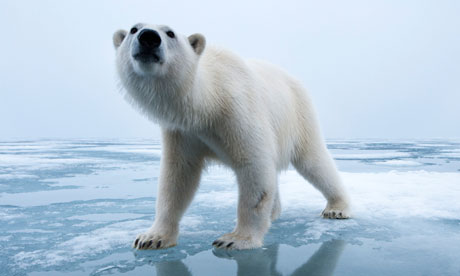
Some polar bears may have to be placed in temporary holding compounds until it is cold enough for them to go back on to the sea ice, say scientists. Photograph: Paul Souders/Corbis
This story in the Guardian‘s Environment section, one of the longest stories that section has ever run, is worth the time to read. It raises a kind of semi-doomsday scenario, and in the process heightens sensitivity to this particular magnificent charismatic megafauna. Decades back, WWF leveraged the Panda into a strong iconic hot-button for the need of donations to conservation NGOs. This article got us thinking whether the polar bear is now the hot button icon for increasing the sense of urgency needed to do something about climate change:
The day may soon come when some of the 19 polar bear populations in Canada, Alaska, Greenland, Norway, and Russia will have to be fed by humans in order to keep them alive during an extended ice-free season or prevent them from roaming into northern communities. Some bears may have to be placed in temporary holding compounds until it is cold enough for them to go back onto the sea ice. In worst-case scenarios, polar bears from southern regions may have to be relocated to more northerly climes that have sufficient sea ice cover.
Far-fetched, draconian, and unlikely as some of these scenarios may sound, 12 scientists from Arctic countries are, for the first time, suggesting that the five nations with polar bear populations need to start considering these and other management strategies now that sea ice retreat is posing serious challenges to the bears’ survival. In worst-case scenarios, the scientists say that polar bears with little chance of being rehabilitated or relocated may have to euthanized. Zoos, which are currently having a difficult time acquiring polar bears because of stringent regulations that prevent them from doing so, will at some point likely be offered as many animals as they can handle, according to the scientists.
This crisis management plan for polar bears as Arctic sea ice disappears is laid out this week in an article in Conservation Letters, the journal of the Society for Conservation Biology. Polar bear experts Andrew Derocher, Steve Amstrup, Ian Stirling, and nine others say that with Arctic sea ice disappearing far faster than originally estimated, it’s time for Arctic nations to begin making detailed plans to save as many of the world’s 20,000 to 25,000 polar bears as possible.
“We really never have been here before,” says Amstrup, chief scientist for Polar Bears International and a lead author of a landmark U.S. government-appointed panel that predicted in 2008 that two-thirds of the polar bears in the world could disappear by mid-century.
The University of Alberta’s Derocher added, “We have covered the science side of the issue very well, but the policy and management aspects are locked in the past. We still manage polar bears in Canada like nothing has changed. Other countries are moving on some aspects of future polar bear management, but it is glacial compared to the actual changes we’re seeing in sea ice and the bears themselves.”
The alien-sounding concepts presented in this week’s paper — with names like supplemental feeding, diversionary feeding, translocation, and intentional population reduction — may become increasingly put into practics as Arctic sea ice, continues to disappear in spring, summer, and fall. Forty years ago, when the first International Polar Bear Agreement was ratified, the threats facing polar bears were chiefly hunting and mining and oil development. But the overriding threat now is climate change.
Without adequate sea ice for enough of the year, many bears will not be able to use the ice as a feeding platform to hunt their favored prey, ringed seals. As a consequence, polar bears will be forced to spend more time fasting on land, where they pose a greater risk to human populations in the Arctic. The International Union for the Conservation of Nature’s Polar Bear Specialist Group recently concluded that only one of the 19 polar bear subpopulations is currently increasing. Three are stable and eight are declining. For the remaining seven subpopulations, there is insufficient data to provide an assessment of current trends.
Read the rest of the story here.
 Organikos
Pingback: Charisma & Conservation |
Pingback: A New Break for Alaska’s Bristol Bay | Raxa Collective