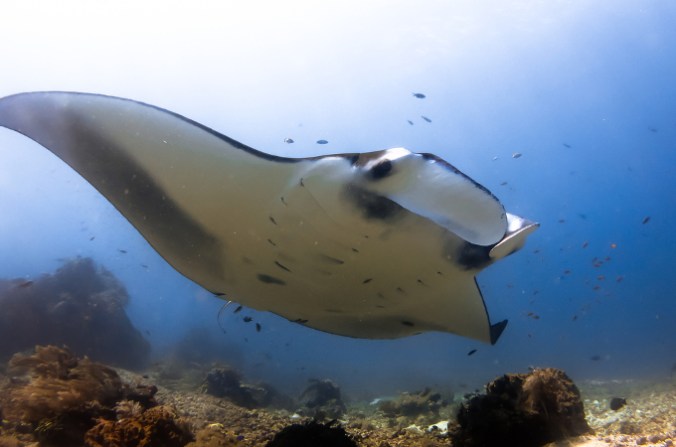
Click the image above or the title below to go to the article:
WANDERING MANTA RAYS HIGHLIGHT GAPS IN MARINE CONSERVATION
Earlier this year we showcased a study showing how reef fish don’t exactly pay much attention to where humans draw conservation lines. Just because a Marine Protected Area, or MPA, exists, doesn’t mean a species we might be keen on saving will stay inside its borders. Manta rays, a charismatic and threatened group of animals, are now showing us how understanding and targeting certain species may help improve ocean conservation.
A new study by researchers from the Marine Megafauna Foundation in California used a database called “Manta Matcher” to look at photographs of 2,604 manta ray encounters (specifically, Manta alfredi, which is listed as vulnerable) in Indonesia, one of the main homes of a burgeoning “manta tourism” industry. The photographs come from amateur divers and dive operators, and together show a species that, again, doesn’t much care where we say they should live.
“The photo-ID comparisons revealed long-range and inter-regional movements of individual manta rays,” the authors wrote. Indonesia has three separate manta ray sanctuaries, totaling almost 19,000 square kilometers of safe haven. The photographed rays were often spotted at more than one of these, with total distances traveled sometimes crossing 400 kilometers for a single ray within the nine-year study period. One ray traveled at least 48 kilometers, in and out of the sanctuaries, within only eight days. The authors noted that other research supports this sort of movement, with one ray even spotted moving 650 kilometers over six months.
Leaving the sanctuaries often means crossing areas of ocean where the rays could be hit by boats, or fall victim to fishermen. The authors wrote that in 2012 Indonesia ranked as the third most aggressive fishing nation for manta rays; one of the most productive manta fishing ports, Tanjung Luar, happens to lie directly between some of the MPAs. Though the Indonesian government has taken steps to try and ban manta fishing, realistically that won’t take hold for some time.
It is an obvious win-win, though, to adjust conservation techniques to make up for those big migrations of manta rays. The fisheries of these animals bring in about $442,000 per year, compared to more than $15 million in manta ray tourism. “Given the economic opportunities and benefits it is recommended that a national management strategy for this species be drafted immediately to protect remaining populations within the country,” the authors wrote.
MPAs can be a great thing; and the bigger and more ambitious we make them, the more chance we have of actually protecting the animals we’re aiming to protect. Take President Obama’s recent announcement increasing the size of the Pacific Remote Islands Marine National Monument; the largest sanctuary in the world, all of Indonesia’s manta ray protected zones could fit inside this MPA 67 times over. It may not always be possible to simply make all of a given area off limits to fishing, mining, and so on, but it’s clear that watching where our targeted species actually move should be a precursor to assigning them safe havens. – Dave Levitan | November 4 2014
Source: Germanov ES, Marshall AD (2014). Running the gauntlet: Regional movement patterns of Manta alfredi through a complex of parks and fisheries, PLoS One, 9 (10) e110071. DOI: 10.1371/journal.pone.0110071
 Organikos
Pingback: The Unexpected Manta Rays | Raxa Collective