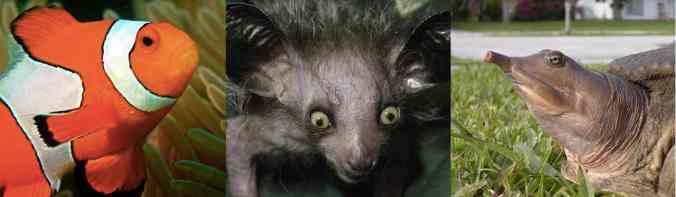
Life is not fair. Sometimes it is really unfair, especially when it comes to entire lifeforms disappearing, or not disappearing, subject to choices we humans make, with all our inherent biases. Thanks to Nautilus for bringing this research to our attention:
Which Endangered Species Would You Save?
Conservation is in the eye of the beholder.
BY CARRIE ARNOLD
You have just been appointed Conservation Czar. But there is a catch. You can only save three animals. Look at the 12 animals below and click on the three that you would save. After you make your choices, you will learn about the endangered status of each animal.

If you chose to save the cuter animals rather than those less attractive, you are not alone. You are part of a conservation trend spotted by Simon Watt, a British evolutionary biologist, science writer, and founder of the Ugly Animal Preservation Society, a regular comedy show “dedicated to raising the profile of some of Mother Nature’s more aesthetically challenged children.” When it comes to saving species, Watt has found, humans choose the cute ones over the ugly ones, the panda over the stick insect, the tiger over the blobfish. While Watt has given conservation an injection of humor, the numbers support his message.
According to the International Union for the Conservation of Nature (IUCN), there are over 1,200 threatened mammalian species in the world, and over 300 are near threatened. But only 80 species are used by conservation organizations to raise funds and nearly all of them can be described as large, furry, and cute, according to a 2012 analysis by Bob Smith at the University of Kent in the United Kingdom.1
Cute species get more research attention—and more studies are published about them. Between 1994 and 2008 over 100 studies were published on the cute and cuddly meerkat, but only 14 studies were published on the less cute African manatee, found ecologists Rudi van Aarde and Morgan Trimble.2 Maria Diekmann, founder and director of Namibia’s REST (Rare and Endangered Species Trust), whose conservation efforts focus on non-charismatic animals such as the Cape Griffon vulture and ground pangolin, says it’s hard to compete with the more majestic rivals for money. “These aren’t the dynamic, large, fundraising-appealing animals,” she says. “I wouldn’t say that other conservation organizations are rolling in money, but in general, if you’re working to save elephants or rhinos, you’re doing okay.”
Human impulse to preserve animals based on their aesthetic appearance is not a frivolous choice driven by an overload of panda posters and Facebook leopard pictures. Our desire to save the cuter creatures is caused by the illusion that we are assuring our own species’ survival. “The reason we are so attracted to cute animals appears to be the same mechanism that drives us to protect our babies,” says Janek Lobmaier, a psychologist at the University of Bern in Switzerland.
Zoologist Konrad Lorenz found that animals we consider cute share several features with human infants: large heads and eyes, a small nose and chin, and a round forehead. Lorenz named this set of features a kindenschema, or baby schema. For human infants, profoundly dependent on their parents’ arduous care, these features are crucial for survival, says Daniel Langleben of the University of Pennsylvania. Cuter babies engender a stronger caretaking response in their parents and even in strangers. Using photos of human infants, which had been manipulated to show varying levels of cuteness, Langleben and colleagues surveyed a group of 122 undergraduate students, and found that they preferred to care for the cutest babies.
Infants use their cuteness to entice us to take care of them, but why do we fall for the trick? When Langleben’s team did a similar experiment using an fMRI scanner, they were able to see which neural pathways activated in the brain in response to seeing cute babies. They found that the cuter the baby pictures were, the more activity they generated in the nucleus accumbens, part of the brain’s reward system.
“Seeing something cute activates the brain’s reward system,” says Lobmaier, likening the feeling to how a drug addict finds drugs rewarding. “This same system is activated by drugs and by erotic images.” The perception of what’s cute or aesthetically pleasing appears to be cross-cultural. When Daniel Frynta, a biologist at Charles University in Prague, asked people from the Czech Republic and villagers from Papua New Guinea to rate the beauty of six different snake species, he found that their rankings were highly similar, despite cultural differences.
There’s an evolutionary reason for that, Lobmaier believes. “I think the prioritizing of cute babies comes from the fact that it does correlate with health,” he says. For our ancestors, an infant’s cuteness was a sign that investing in that baby’s care would result in a viable offspring, while a defect like a cleft lip may have been associated with a disease, causing parents to abandon him or her. That mentality still prevails in some hunter-gatherer societies, Lobmaier says. “For remote people living somewhere in Papua New Guinea or somewhere where they haven’t got the same possibilities we have, I think that’s still an issue,” he says.
Read the whole article here.
 Organikos
Pingback: If You Happen To Be In London | Raxa Collective