Source: BBC.com
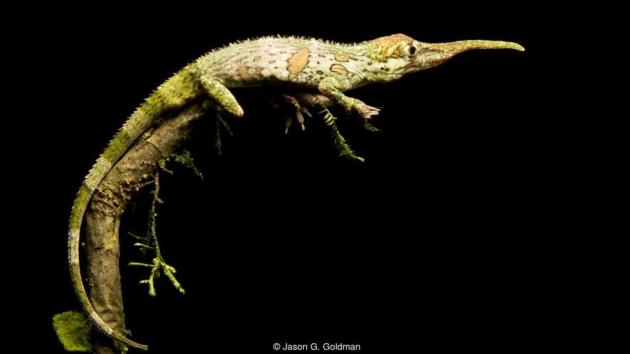
Eccentric and alien-like creatures abound on Earth, but often times these species are found in very remote and small areas. The Ecuadorian horned anole, also known as the “Pinocchio lizard,” is a species that would likely appear in Discovery Channel’s TV series Life (if it has not done so already). This curious lizard with a long, malleable nose was found in the Mindo cloud forests of Ecuador’s Pichincha Province in the 50’s. Aside from its peculiar nose, what makes the story more intriguing is that it ‘disappeared’ from human research world for almost 40 years until it was rediscovered by a group of birders (hurray birders!) in 2005. The purpose of the horn and how it moves are still a mystery, but Jason Goldman has written an article for the BBC Earth website that elucidates some of the rare reptile’s habits:
Lucas Bustamante carefully aims his laser pointer at a small branch some 50ft (15m) above the ground. The green spot of light is clearly visible, but I just cannot see the lizard he has spotted: just branches, leaves and moss.
If there is indeed a lizard there, it is incredibly well camouflaged against the forest canopy it calls home. Without a second thought, Bustamante begins scaling the trunk of the tree to take a better look.
Within minutes, Bustamante returns to ground level, holding in his hands the lizard we had traveled all this way to find: a sleepy Ecuadorian horned anole, also known as the “Pinocchio lizard”.
The Pinocchio lizard is a zoological mystery. It is not the only horned anole (Brazil also has one) but it is the most famous, perhaps owing to its memorable moniker. Yet despite its fame, nobody knows very much about this unique species. Until a decade ago, nobody even knew it was still alive.
Scientists first formally described the Ecuadorian horned anole in 1956.
Over the next few years, herpetologists rounded up another six specimens, all males. By the end of the decade, everything known about this charismatic reptile came from just those seven lizards.
“And then for almost forty years, no one ever saw one,” says zoologist Jonathan Losos of Harvard University. “People were beginning to think that maybe they’d gone extinct.”
The species was only found in Ecuador’s Pichincha Province, home to the Mindo cloud forest, an area just over 250 square kilometers.
Having faced serious deforestation, it was reasonable to suspect that the species had gone extinct before scientists had even gotten to know it.
But then in 2005, a group of birdwatchers happened to pass through the Mindo area.
Despite its incredible herpetological biodiversity, the region is perhaps best known as prime birdwatching habitat, especially for hummingbirds. Someone in the group noticed a lizard crossing the road, which is odd for a tree-dwelling species. Their guide was savvy enough to know that they had seen something significant.
Read the rest of the article here.
 Organikos
That’s such a fascinating story. I love the name too! Thanks for sharing.