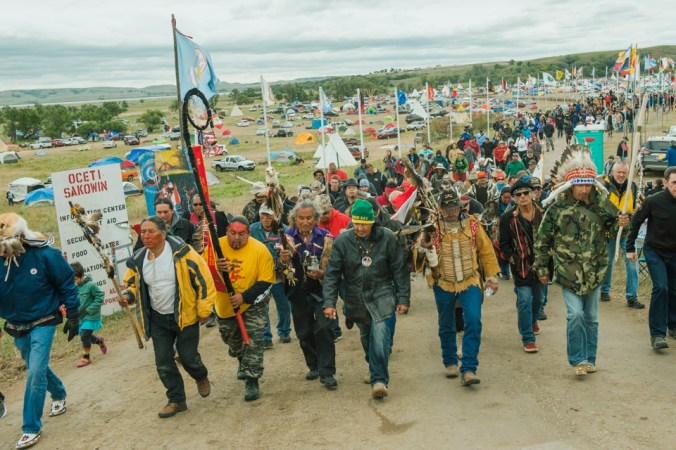
Protesters demonstrate against the Energy Transfer Partners’ Dakota Access oil pipeline near the Standing Rock Sioux reservation in Cannon Ball, North Dakota, U.S. September 9, 2016. REUTERS/Andrew Cullen
We are happy that the trouble-maker who brought this to our attention, and those pictured above are heard by the Trouble-Maker-In-Chief of the USA (who we hope uses his remaining four months in that office to similar good effect):
The Obama Administration Temporarily Blocks the Dakota Access Pipeline
The surprise move came after a federal judge declined to stop the 1,100-mile fossil fuel project’s construction.
The Standing Rock Sioux Tribe and the hundreds of Native protestors who have joined them in rural North Dakota won a huge but provisional victory in their quest to stop the Dakota Access pipeline, as the U.S. government announced late on Friday afternoon that it was voluntarily halting work on the project.
The triumph tasted all the sweeter because it had followed so closely after a seemingly immense defeat. Mere minutes after a federal judge declined the Tribe’s request for an injunction to stop construction on the pipeline, the Obama administration made a surprise announcement that it would not permit the project to continue for now.
“Construction of the pipeline on Army Corps land bordering or under Lake Oahe will not go forward at this time,” said a joint statement from the Department of Justice, the Department of the Interior, and the U.S. Army. “We request that the pipeline company voluntarily pause all construction activity within 20 miles east or west of Lake Oahe.”
The Army will now move to “reconsider any of its previous decisions” regarding whether the pipeline respects federal law, especially the National Environmental Policy Act, the statement said.
As planned, the Dakota Access pipeline would run 1,100 miles from oil fields in northwest North Dakota to a refinery and port in Illinois. Hundreds of people, many of them from Native communities or nations, have gathered on tribal land near the Missouri River since April to protest the pipeline’s construction. The camps are one of the largest Native protests in decades.
In July, the Standing Rock Tribe sued the Army Corps of Engineers, the federal agency which approved the pipeline. The tribe claimed that the pipeline’s construction would destroy nearby sacred and burial sites, and that, if the pipeline ever leaked or failed, it would pollute the tribe’s drinking water. It sought a temporary injunction to halt its construction. I wrote about the tribe’s case this week.
On Friday, the court declined that injunction request with a 58-page ruling. (The Department of Justice, apparently waiting for the decision, issued its own statement blocking the pipeline minutes later.)…
Read the whole article here.
 Organikos