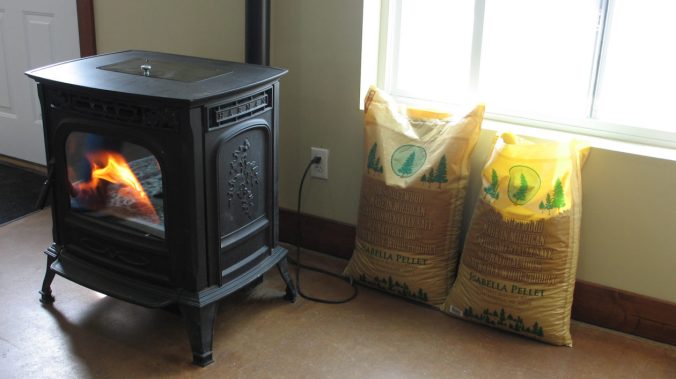
A wood stove burns with pellet fuel. Photo © U.S. Department of Agriculture / Flickr through a CC BY 2.0 license
Thanks to Cool Green Science for this reminder about the use of wood and related biomass as fuel throughout human history, and its implications for today’s climate change challenges:
As long as the Clean Power Plan is still in place, electric utilities are looking for ways to clean up their carbon dioxide emissions to the atmosphere and prevent global changes in climate. Some utilities are switching to natural gas, which emits lower amounts of carbon dioxide (CO2) per unit of energy generated. However, natural gas is not without its own problems.
Humans used firewood for thousands of years, during a period with little change in the concentration of CO2 in the atmosphere. So some utilities are looking toward the burning of wood, also known as biomass or biogenic energy, to generate power. This is an interesting “throw back” to an earlier time when firewood was used widely for heat, light, and early industrial processes. But, there is a reason why we switched to coal, which has greater energy content per unit weight.
It is natural to think that burning firewood would have a minor effect on atmospheric CO2.After all, as trees grow back, they remove CO2 from the atmosphere. Thus, unlike fossil fuels, trees might be regarded as “carbon-neutral.” The regionally moribund forest products industry sees biomass as a way to recreate jobs and profits, and a trove of biomass energy companies has a lot at stake financially.
However, there are several fundamental misunderstandings about the carbon neutrality of biomass. The first is that the CO2 released from the burning of biomass is somehow “different” from the CO2 from fossil fuels. This is not at all true: the CO2 molecule from both sources has identical structure, mixes into the atmosphere with other CO2, and easily circulates from pole to pole and ground to stratosphere during its 3-year residence time in the atmosphere.
The argument that the CO2 from biogenic fuels has no impact on the concentration of atmospheric CO2 is also untrue. When biomass is burned, it emits CO2 immediately. If a lot of it is burned, it emits a lot of CO2. That is why we keep track of tropical deforestation and add its CO2 emissions to the inventories of emissions from various nations. Deforestation currently contributes about 30% to the rising concentrations of CO2 in the atmosphere. In contrast, the uptake of CO2 by regenerating forests is long-term and not guaranteed…
Read the whole article here.
 Organikos