Robin Schwartz for The New York Times
We have rarely written about zoos because they are simultaneously depressing and yet have had an important influence on most contributors to our pages. Thanks to the New York Times and Charles Siebert for this article raising questions about elephants in particular at the zoo:
Zoos Called It a ‘Rescue.’ But Are the Elephants Really Better Off?
Despite mounting evidence that elephants find captivity torturous, some American zoos still acquire them from Africa — aided by a tall tale about why they needed to leave home.
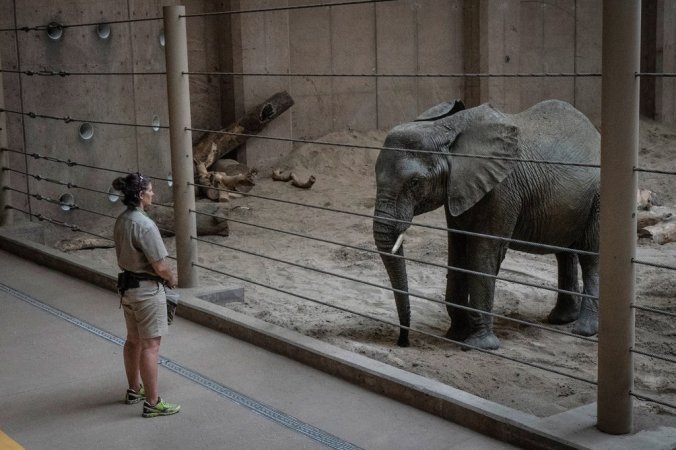
Arusi, one of the six Swaziland elephants at the Sedgwick County Zoo in Wichita, Kan.CreditCreditRobin Schwartz for The New York Times
The “Elephants of the Zambezi River Valley” enclosure at the Sedgwick County Zoo in Wichita, Kan., is a dreamscape idyll of an elephant’s natural home: five and a half sprawling acres of tree-dotted mock savanna and a 550,000-gallon pond where boated people and wading pachyderms can nearly meet on opposite sides of a discreetly submerged barrier. All eight of the zoo’s elephants were visible when I visited on Memorial Day 2018, two years after the habitat’s grand opening, including six recent arrivals from the tiny southern African kingdom eSwatini (formerly Swaziland), the lot of them moving about with the same slow, tensile synchrony of larger wild elephant herds. Only the background flicker of cars on Interstate 235 disrupted the tableau, as well as my own occasional thoughts of far less accommodated zoo and circus elephant captives over the years, right back to the very first elephant brought to the United States.

Robin Schwartz for The New York Times
According to historical records, it was in the early spring of 1796 that the America, a sailing vessel captained by Jacob Crowninshield, arrived in New York Harbor from Calcutta. As emphatically noted in the ship’s log kept by one of its officers, Nathaniel Hathorne (whose author son would soon add the “w” to the family name), there was an “ELEPHANT ON BOARD.” A 2-year-old female originally purchased by Crowninshield in Bengal for the bargain price of $450, she was immediately sold in New York for $10,000. Continue reading
 Organikos