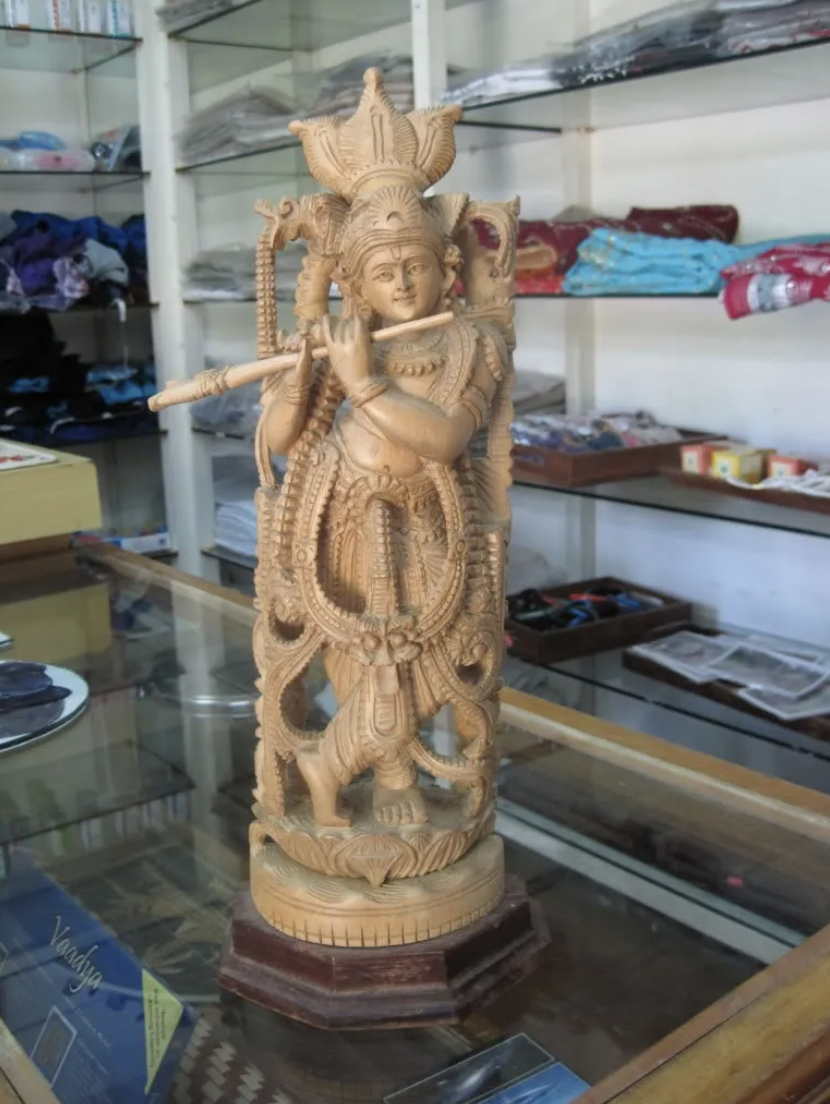
The other day I was working in the Ants gift shop with its manager Manoj, who also represents the helm of the guest relations experience department. When I began asking about the various products offered in the gift shop ranging from vibrant dhotis and saris to spice and herb books as well as delicately carved houseboat models, I noticed two sculptures of what appeared to me to be Hindu gods. It turns out the first god was Krishna, the young boy playing a flute. The second was the well-known elephant headed god, Ganesha. If you’re not yet aware, Hinduism is a polytheistic religion. And by polytheistic that means there are over a whopping 330 million different gods in Hinduism.
I asked naively if Krishna and Ganesha were the two “main” or most revered gods of Hinduism, but Manoj calmly and kindly explained to me that in fact the three most powerful are Lord Brahma, Vishnu, Shiva, who together encompass an interesting cycle of life. Lord Brahma is the creator of all, Vishnu the all-pervasive protector of life, and Shiva, the divine destroyer and transformer.
Manoj also explained to me that he takes great interest in the many stories of the many different gods of Hinduism. He also said he likes to pass on his information to friends because when they learn the stories they can spread the knowledge further. Just one of Hinduism’s many fascinating stories I heard was one of the stories of the 5 sons or Pandavas vs. the 100 sons or Kauravas from the Mahabarata, which has the honor of being the longest epic in world literature, 100,000 2-line stanzas (although the most recent critical edition edits this down to about 88,000), making it eight times as long as Homer’s Iliad and Odyssey together, and over 3 times as long as the Bible. In the story, the highly specialized Pandavas defeated the brute force of the Kauravas in a territorial war which Vishnu attempted to mediate unsuccessfully.
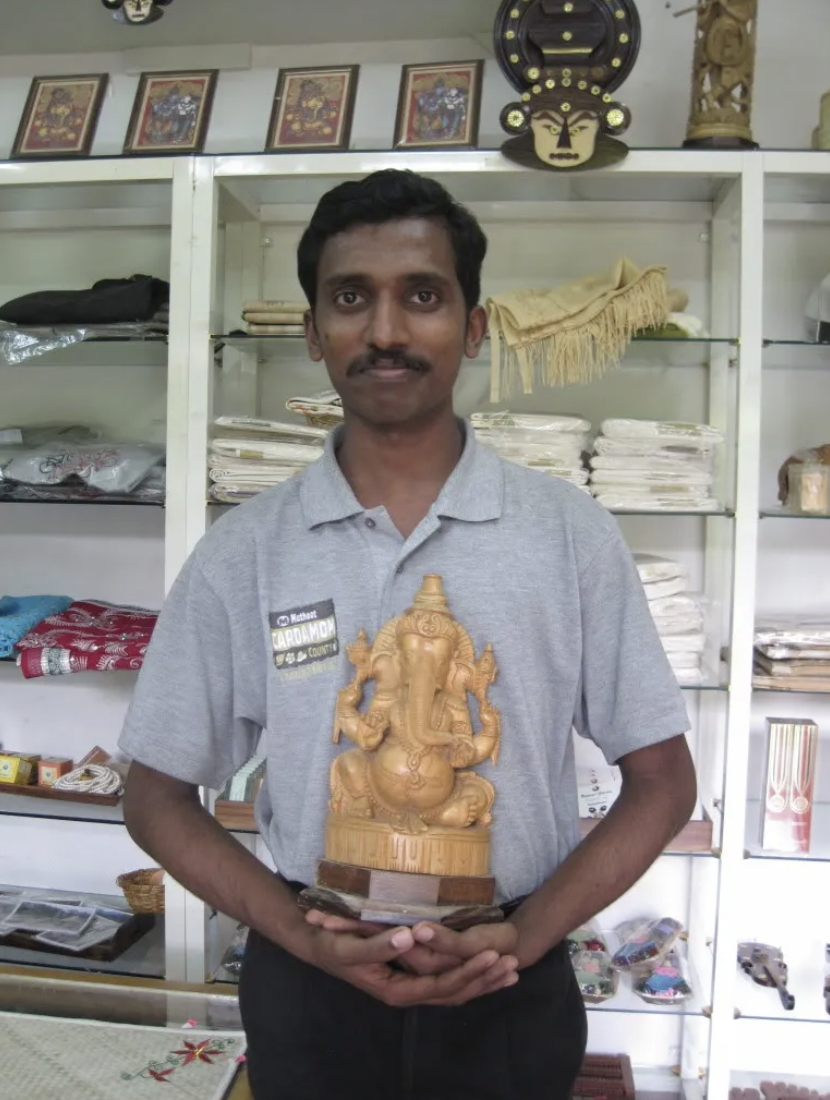
I have always wondered why Ganesha had the head of an elephant so I decided to ask how it became so. Manoj told me that one of the three wives of Shiva, Parvati who was also a Hindu goddess, animated a statue of a human child to protect her palace, giving it divine powers to ward off everyone, including Shiva if possible. However, Shiva was unrelenting and sent many soldiers and forces that were all defeated by Ganesha’s extraordinary divine power, including the power to shoot one arrow that expands into 100 when shot. Thus, Shiva came about behind the palace and took off Ganesha’s head. Parvati was so distraught that Brahma, the creator, allowed the boy another chance with the same head of first animal they found. So, of course, a baby elephant was the animal that was stumbled upon in the forest, giving Ganesha his famous and distinctive appearance in the pantheon of Hindu Gods.
And the next time you wonder why Indians do not have an equivalent of “God Bless You” when somebody sneezes consider the thought: Which god!?
Side Note:
I also learned from guest relations trainee Manu how to count to ten in Malayalam.
In case you wanted to learn it, numbers 1 to 10 go as so:
1 – Una
2 – Rande
3 – Munna
4 – Nala
5 – Unja
6 – Ahrai
7 – Ehrai
8 – Itta
9 – Oombuthai
10 – Pathai
Another very useful term is “Sugoo Mano?” which translates to “How are you?” in English. The response received is of often a slight alteration of the phrase, “Sugoo Manai” meaning “All is well”. Then of course is the all-purpose “Nanni” which is “Thank you” in English.
 Organikos
Pingback: The Other Side « Raxa Collective