On its face, there is nothing remarkable about a company picnic. If what I’ve learned from media representations and other secondhand reports stands up, it seems that they happen just about everyday in some part or another of the world, and that they all involve a bit of hair-letting, whether with ice-cooler beer at the neighborhood park or mini-fridge delectables in Vegas. It is this understood relaxation—or evisceration—of daily norms, of one’s decorum, coupled with the acceptance of its temporality—because of course, work does go on the next day, and you must confront those who yesterday saw you transformed—that gives these professional gatherings their almost sacred quality in the religion of the workplace. Whether mentioned in hushed tones or all too self-consciously laughed off, the company picnic/outing/soiree is, in the daily grind’s cosmology, the potential site of the divine, of the disclosure of truth and the unmasking of custom.
So I don’t think I overstate it when I say that yesterday I bore witness to (and, yes, sometimes partook in) culture. Twenty hours in a bus through the hills of Tamil Nadu is culture, and my inability to draw from my fellow travelers a suitable translation of its subtleties (I mean, who can speak fluently about his own culture?) made it that much more profound. No, this may not have been ‘culture’ in the sense that the Martial Arts show down the street purports to be, nor is it ‘culture’ in the same way that the locally-inspired cuisine at Cardamom County’s All-Spice Restaurant is.
This was culture in the minute, unsalable sense. This is that culture which happens in the infinite, petty moments between friends. It’s what happens when an esteemed Chef sleeps on your shoulder for four hours, or when you hold your mate’s back while he hangs his head from the bus window, desperately seeking fresh air a thousand miles from his Nepali home. And when your olfactics register the redolent detritus of the day—the sweat, the seeping of sweet rum and 7up. And you hear the whooshes and bangs and histrionic chatter you can’t understand from pounding speakers, themselves indefatigable, and try to keep your eyes on the brightly lit film that gives the cacophony some meaning. While from the corner of your eye you catch stolid and broad-faced older men, middle-aged men, imbibe with seasoned understatement and show no signs of an altered mood.
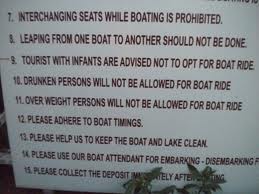
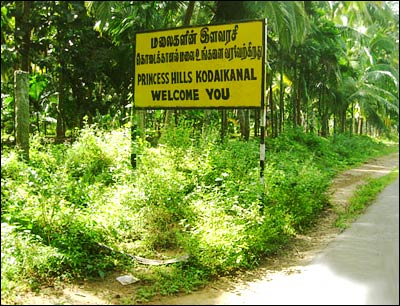
Culture happens when you pay 50 rupees to hop on a mangy horse with sticks for legs who takes you less than half a kilometer at a run that can only mean let’s make this quick. And a picture costs 10 rupees. It happens when an eager crew member hollers ‘View point!’ and a cry goes up through the ranks and we shuffle off the bus, past guardian merchants and their carts, purveyors of plush dolls, hot chai and soda pop, of wooden crocodiles with tails that bend, into a pine forest, the extent of which I do not know because we go in only a few meters, just far enough for some agreeable group photos and various snapshots. Culture happens when a man in his mid-twenties buys a plush duck that quacks when you whack its behind; he calls it his baby. And culture happens standing near but not seeing Guna Cave, made famous by the movie that bears its name. And culture happens when you drive past the resorts and several-storied apartment buildings built into the slopes of Kodaikanal and think of Los Angeles. Culture is a bedazzled cowboy hat passed from head to head, up and down the aisle where grinding and weaving and shaking young men in Dionysian brilliance throb to the 4/4 bass beat of their pop muzak. And in the hours of chants and in the jackfruit fries and in the eight-hour spell between our launch and our first arrival during which the dance is unceasing. Indefatigable, I think.
But the fatigue does settle in, and though there are some who casually but valiantly will it on, the dancing dies and the sleepers, men once on the front lines, do crash. The bus returns—a shattered glass here, torn and sullied cardboard there; scattered soda bottles and seats at different angles left for the bus drivers to remember us by.
And the next day the awkward giggles and leading questions, the earnest desire to hear that I had a good time. But I saw the time that they had. And maybe, like when you accidentally walk in on someone gazing in the mirror, we’ll be closer now, more empathetic. And maybe our halting conversations are no longer only attempts to overcome our differences, but also the fumbling, routine communication between conspirators who share a secret. In this case the secret seems to be: Can you believe we were allowed to have so much fun?
 Organikos