When I lived in Singapore to do an internship aimed at rolling out the sustainability road-map of a major service solutions and facilities management company, my building neighbored “Singapore’s first eco-mall,” a beacon of consumerism just like any other mall, but with one main difference: an exclamation point punctuating its statement of eco-friendliness.

A true comrade of the Earth according to its interior walls and eco-kiosks, this mall was built with technologies that will likely soon become architectural norms. Its urinals are water-free, its windows let in natural light but with minimal heat, its roof harnesses solar power and rainwater, its lighting uses minimal wattage, it is constructed of environmentally safe materials, the list goes on and on… and is painted all over the walls. You get priority check-out if you bring your own bag and priority parking if your car is a hybrid. But for some it’s not clear whether the priority really lies in being an eco-mall, or in making sure you know it’s an eco-mall.
One of the challenges that experts and champions in the field of sustainability and corporate citizenship face is resistance from the public to really “buy it.” When it comes to the perception of a company’s social or ecological efforts, especially if that company’s core competencies lie in an unrelated sector, most consumers are simply not convinced. Even associates within a company that practices CSR efforts often write those efforts off as a marketing ploy or an attempt to keep up with the fashion trend. After all, everyone knows green is in this season.
So do the mall’s educational elevator banks complement its solar-activated window shades, or is it perceived as a bit too much? The fact is: it doesn’t matter. As long as the sustainability features are working, the results in the long run will speak for themselves.

As I learned in my internship as a Sustainability and Corporate Social Responsibility Coordinator, transparency is a key element in any corporate citizenship endeavor. Sure, high visibility of our eco-messages might come off as contrived, but it keeps us honest. If a company claims to reduce its carbon footprint, it better be ready to wear a tighter CO-shoe.
In addition to accountability, organizations are noble in their over-communication of their greenness insomuch as it raises public awareness. The average Singaporean shopper can think what he wants about the genuineness of City Square’s conservation efforts while relieving himself into the water-free urinal, but at least it gets his mills turning. He might even go home resolved to fix the leaky faucet.
While public skepticism will likely be an obstacle for years to come, it is a worthwhile price to pay for the benefits of hyper-exposure. Non-participating organizations will feel pressured to engage more earnestly in sustainable initiatives and the average consumer will be more accustomed to messages of citizenship and conservation. Inciting a change in behavior and beliefs is never a quick or easy process, but exposure and habituation are valid first steps.
At the very least, a bit of skepticism can be healthy. If a shopper is asking, “Is this mall really an eco-mall,” then irrespective of his or her conviction with regard to ecology, there is still that something inside of them that is looking for results. Then it’s up to the eco-mall to prove that it deserves its trendy prefix.
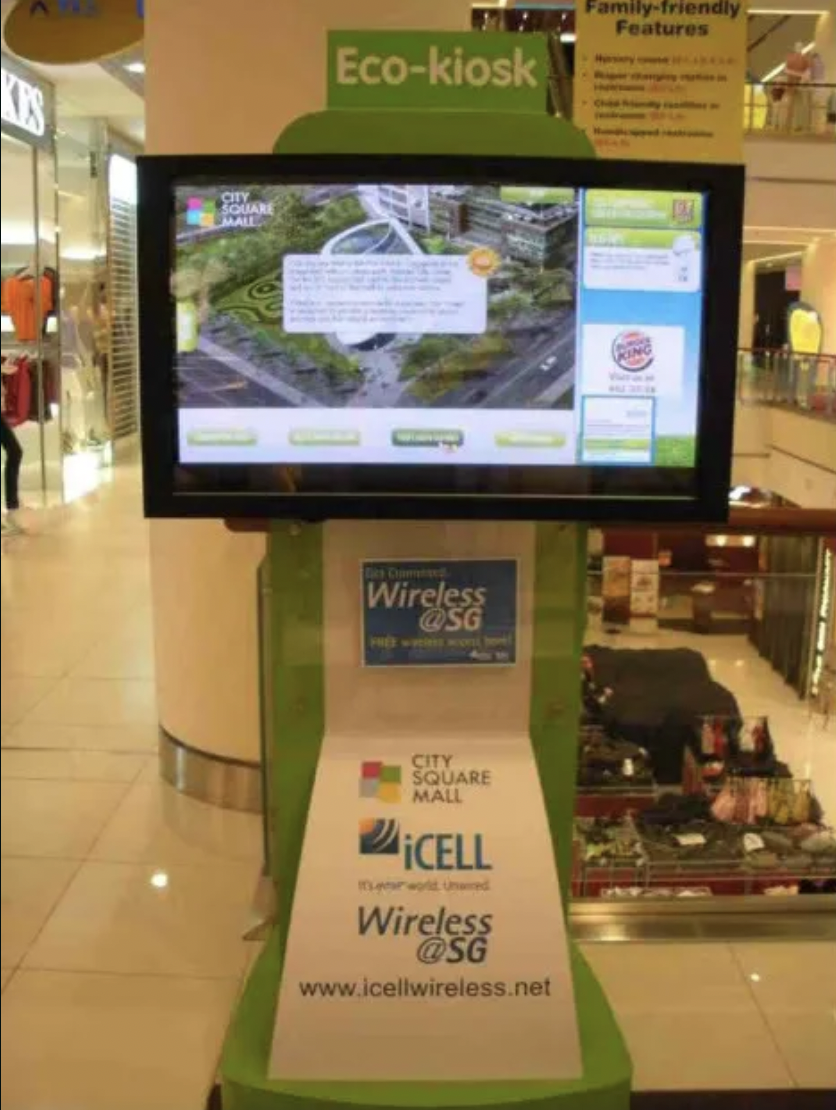
These touch-screen stations are scattered throughout the shopping center to educate interested shoppers about the green features of the mall and the adjacent park.
 Organikos