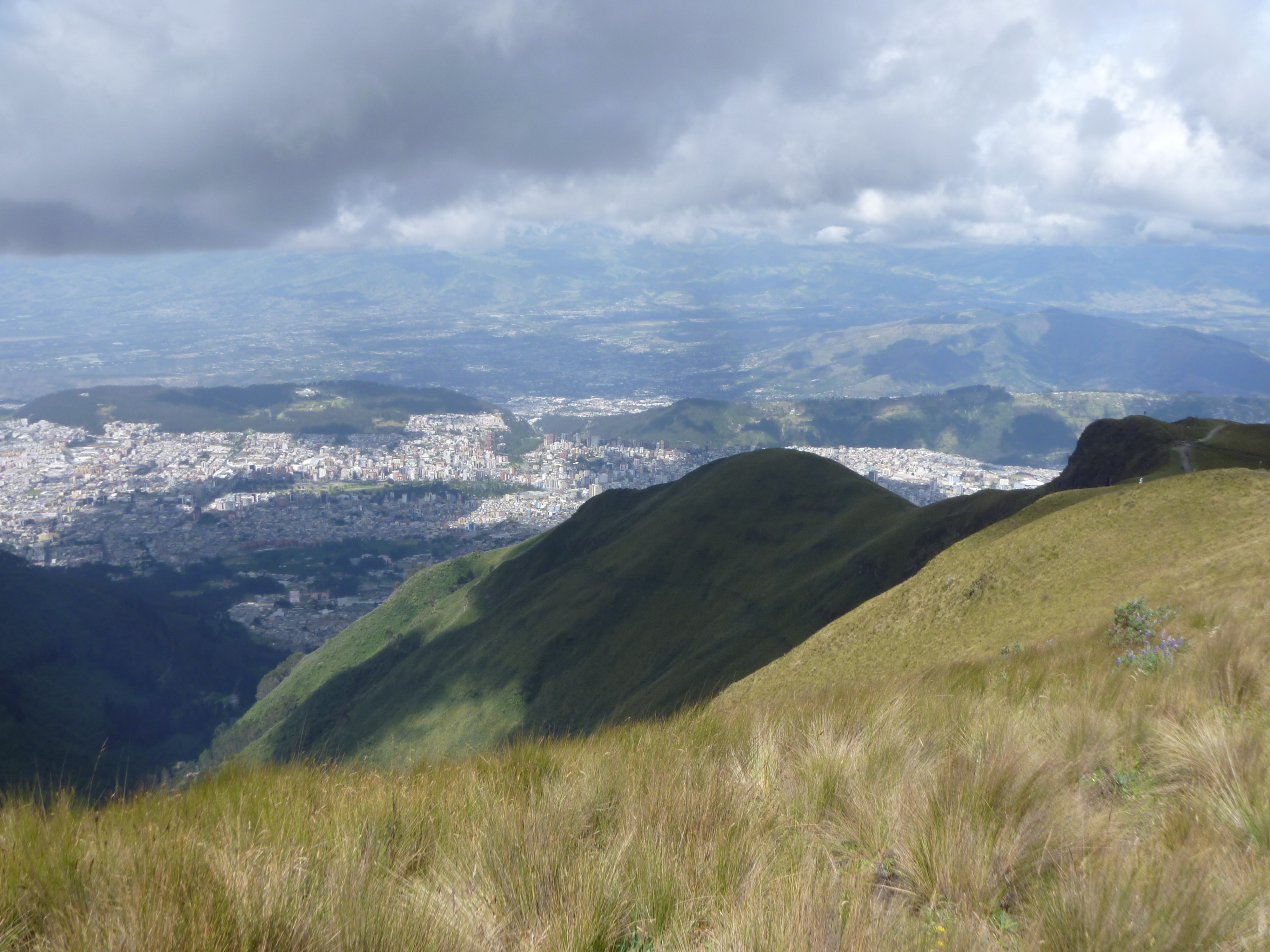
For now, I live in New York City and my brother lives in Quito, Ecuador. A visit to his new apartment last month near Parque Metropolitano, and our subsequent hike up Volcán Pichincha, led to the biggest obvious and most profound difference between Quito and New York: Quito has big mountains and volcanoes and New York doesn’t. Seemingly obvious and superficial (and of course topographical), the reasons started to form in my head while watching the clouds form around me.
We were taken near the top of Pichincha by the TelefériQo, the teleférico (I don’t think I actually ever use a word for this in English) that takes people up to 4,100 meters (from 2,800 down below in the west side of Quito). At the top you can connect with some of the trails that wind around, up, and down Pichincha.
This was my second trip up the TelefériQo. Please excuse the goofy capital Q, but that’s it’s branding and serves a point in my blog a few paragraphs down. The first time I was there was in the summer of 2005, just after it had opened. A large-scale tourist and commercial development undertaken by the municipality of Quito, and the overall product included a children’s amusement park at the bottom, followed by a series of boutique and souvenir stores, and restaurants slightly further up toward the ticket counter to go up. At the top were more snacks shops, souvenirs, and even a gimmick of hooking up to breathe some flavored oxygen in case the altitude got to you. The restaurants were upscale, and you could enjoy a robust fondue in addition to the traditional canelazo to help cope with any altitude and sunset chill.
Fast-forward 6 years later to the summer of 2011. Most of the shops are abandoned, maintenance is needed on buildings and in the landscaping, and the escalators servicing the shops at tiered levels don’t work anymore. The children’s park down below is still hopping on the weekend, but the traffic of affluent locals and consumptive tourists spending money at the shops didn’t seem to be feasible. Stores couldn’t pay the concessions, and the place was noticeably run down. No more oxygen upstairs, and the entire second floor is now closed off. Canelazos are still in effect and refreshing before and after hiking around, and a small non-electrified stand selling pinchos and choclo outside is the best spot for food on that side of the mountain (yes it’s technically a volcano but I like that word better here). No credit cards accepted.
In principal, the TeleferiQo set out for a good concept. Play off the breathtaking views from Pichincha and the awe of going up a mountain, and get people to think of it as a mountain-side shopping mall. Use it to promote and preserve Pichincha.
But that didn’t seem to work and now the city doesn’t have the Qash flows it expeQted. The rusted buildings and empty shopping center below however are completely forgotten once you hike up this beautiful piece of the Andes. We hiked up determined to get up among the cloud and see if the peak would clear up for a second and let us get a last-chance glimpse of its snow. Around the turns, different views of the mountain, rolling hills, landscape and city Quito below, from norte to sur, are really fascinating. And though the shops weren’t serenely bustling like a 3rd floor of some Latin American shopping malls, the TeleferiQo had traffic. Why? Because people still want to get up and see the view, and contemplate the volcano for its own natural beauty.
And it is this contemplation that makes the $8.50 foreigner, $4.50 resident/national trip fee worth it, for those who don’t have all day to hike up to that point.
The view is calm and serene. One slope looks like it was too steep to ever be farmed. And I am thankful for such jutting inclines that make any form of development unfeasible. There is a big, noisy city below. But looking at it from 1,200 meters above, the perspective changes. Here, in a matter of an hour, I can escape the city and get a cloud’s-eye view of the world below and realize how it’s part of something much bigger. How no matter what venture fails on the bottom, the top is still amazing and has people coming back. Because that’s what we want: to enjoy the altitude air, the views, and the challenge of walking around while short of breath. We stop and sit and enjoy what would have been complete silence, if it weren’t for the residual ringing in my ears from being too close to last night’s live Colombian band while jangueando con los primazos. Right now I can’t hear anything below, and that’s what’s important. Wind has noise again, and the sun peaks out after a moment watching water climb upward and rain feel like it’s around you but not falling. Peace of mind returns.
So the attempt at pairing Pichincha with a shopping center was unfeasible. But for those who want to enjoy the peace and invigoration that Pichincha can provide, then that should be the focus of the development. Get people up there, manage the trails and services better atop, and market the benefits of escaping the city for a half a day. Play to the benefits and attractiveness of that experience, and ensure that the tranquility is not compromised by the numbers. Obviously all easier said than done, and obviously seems like a clearer thought while looking down on the failed facilities below. But the key takeaway remains for me, a lesson learned over a decade ago with a wise Mexican entrepreneurial conservationist: if you are working with natural wonders as tourism attractions, just give people the opportunity to enjoy them better. Don’t go adding your own sauce.
Anyway, it’s a quick escape that I don’t seem to get in Manhattan. On this island, I never get to step back and contemplate the immensity and beauty of the natural world. All the awe is man-made, and nature is nicely groomed. I’m not trying to hate, as for some people that type of awe is most important. But for those who appreciate the relaxation and peace that a nature walk can provide on your day off, it’s great to be in a city with a mountain chilling next to you. And afterward down below, Pichincha is always in the backdrop, across the Parque Metropolitano as a constant reminder that at least the possibility of peace of mind exists. And sorry to throw in the buzz term, but “sense of place” really is much easier when a volcano is always the “anchor store.”
 Organikos
Pingback: Meet Arun « Raxa Collective