
Pierre and I took a walk around Granada today with Mombotour guide Gustavo, a native of the colonial city. Our first stop was the San Francisco Monastery and Church, the oldest church in Central America, which has been converted (aha) into a museum of colonial and pre-Colombian history. Probably built on the site of an indigenous temple, the monastery later became a school, then the museum. It also recently underwent a restoration project, since earthquakes have especially strong effects on such old architecture as Granada’s churches.
Gustavo led us through each of the rooms containing an exhibit, such as ancient pottery, contemporary art replicating historical or cultural scenes, and zoomorphic stone statues. He explained some of the beliefs held by the indigenous groups, which were often influenced by northern tribes (Mayans, Toltecs, and Aztecs) and South American indigenous nations, as well as the Spaniards’ opinions of them. For example, the rain god was considered to have four sons at the cardinal points. Ritual offerings such as those depicted in this painting were thought to bring fertility to the soils. Spaniards were also quite surprised to see the symbol at the base of this statue, not knowing that it represented the cardinal points and not the savior.
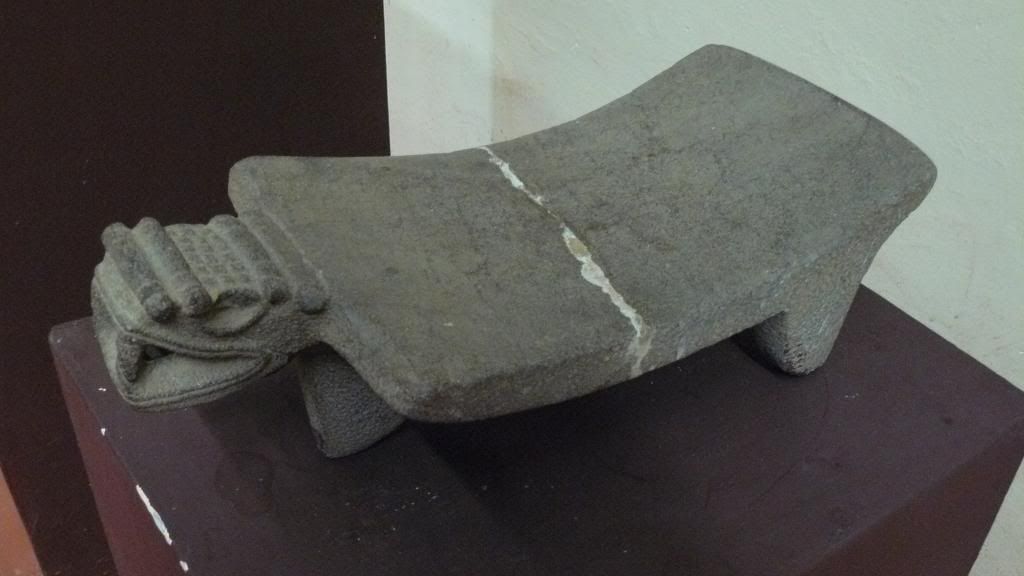
This stone grinder includes the ornamental head of Quetzalcoatl, the Mesoamerican feathered serpent god. It was tradition to break an ornamental grinder when its user (who was in an important position) died, so that the part of his spirit within the grinder could move on.
We visited a couple other beautiful churches/cathedrals in the city, all of which reinforce the historical Spanish roots in Nicaragua, which is predominantly Catholic (along with most of Central America). When we reached Xalteva (HAL-teh-va) Church, a funeral was underway, so we did not enter the building but admired the outer facades and then headed to the cemetery. On the way, we stopped at a chichería and got some chicha, which in this case was mashed corn, sugar, some raspberry oil, and water. I especially enjoyed chewing on the corn bits at the bottom of the bags, which felt sort of like the tapioca jelly in Asian bubble tea.
We passed by a fortress known as “Fort Gunpowder” and then went to the cemetery, which is full of marble ornaments on detailed mausoleums and graves. Some family names are common throughout the cemetery, such as Chamorro, that of the first Nicaraguan president (who was “Granadino” and buried here along with several future presidents). Family names extend through lineages very easily given the Latin American way of transferring names, so it is not too unusual that five other presidents, including the first female president, also had this last name. We passed by several marble decorations that had the letters X and P on them, and I was very curious to learn how the gravestones could be related (my only guesses were something Latin or St./Pope Pius X), so I looked it up and learned that they are Greek letters Chi and Rho, which would be the two first letters to spell Christ in Greek. Mystery solved.
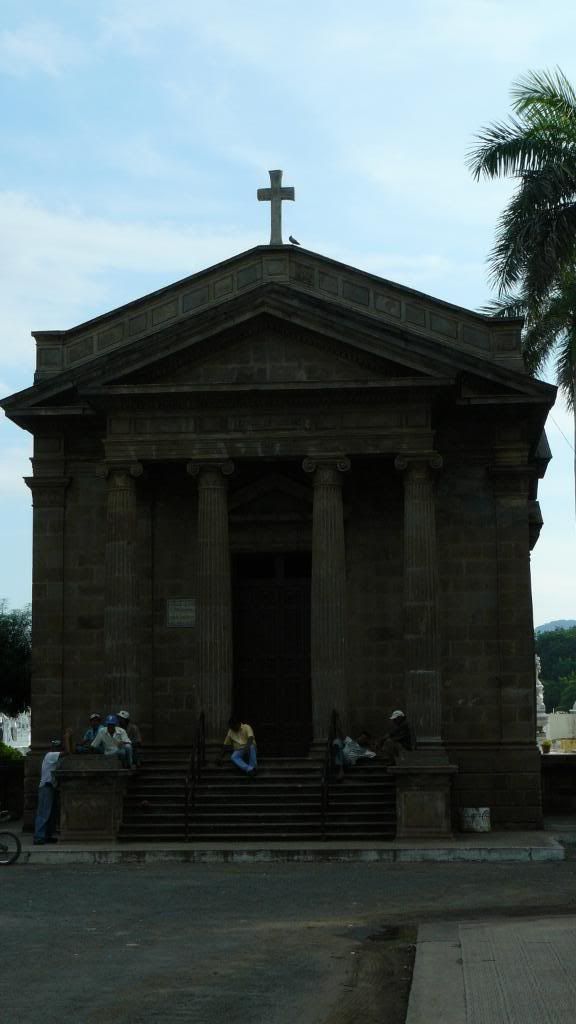
Men with brooms and machetes are hired by families to maintain the cleanliness of certain graves or mausoleums.
On the way back to Casona de los Estrada, we passed by a show of children displaying talents they’d learned at Casa de los Tres Mundos, a foundation that supports education—especially in the arts—for lower-income communities in Nicaragua and Central America. We watched a bit of the juggling and dancing (as well as a nearby soccer game with backpacks and bicycles for goals), thanked Gustavo for sharing his extensive knowledge of the city, and headed back to the small luxury hostel.
 Organikos
this looks amazing, and i just stumbled across your blog but im going to go back and read some of the other posts.
http://sandbetweentoes.wordpress.com/
Thanks! Hope you enjoy the posts.
Pingback: Historian Cross-overs |