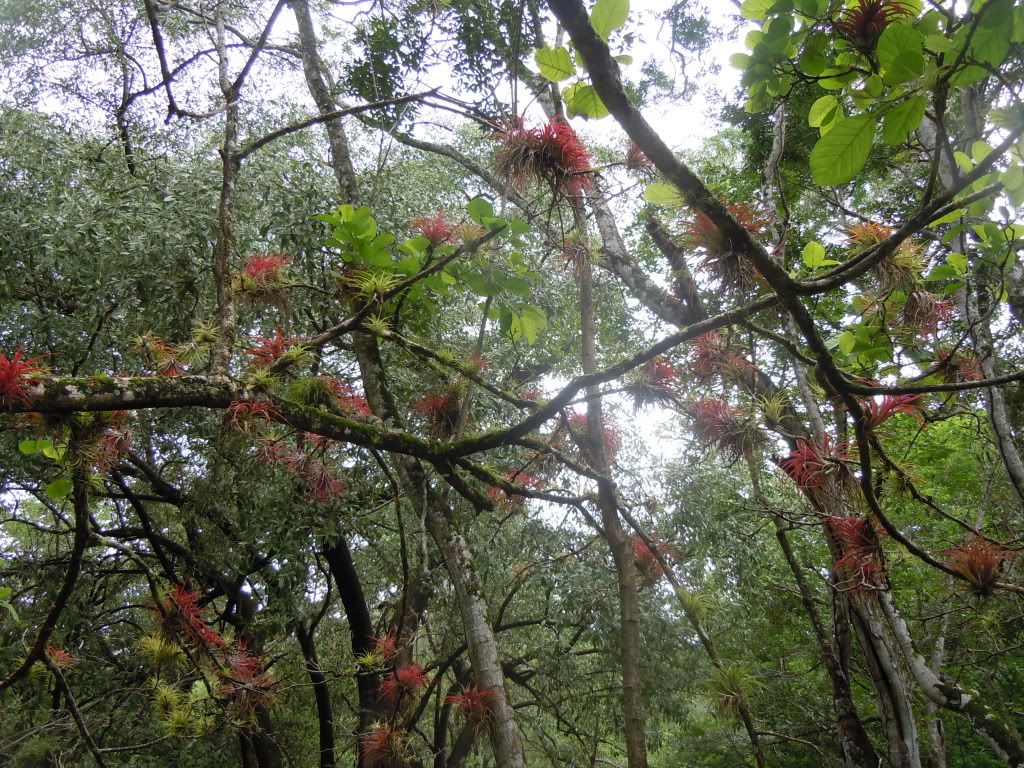
A Primeval Jungle
Imagine, for a moment, that you are stalking the primeval jungles that covered earth’s surfaces millions of years ago. Stalking—or being stalked. Light from a younger sun is filtered through the leafy green foliage above you, and a rivulet of sweat makes its way down your back. Bushes rustle around you as the odd cries of birds, ground-dwelling mammals, and things more sinister drift by above the dense underbrush of the jungle floor. You nervously shift your wooden spear with fire-hardened tip from left to right hand, adrenaline coursing through your body and causing your reflexes to become hypersensitive. There! A pair of malicious glowing orange eyes peers out at you from a dark hollow formed by a fallen old master of a tree. You know these eyes; something lunges from underneath the tree as you turn and sprint away. Once the hunter, you are now the hunted, legs pumping furiously as thin branches whip your forearms pushing aside the dense underbrush. You leap over mossy rocks, scatter the smaller creatures in your path in your mad frenzy to escape whatever looks from out of those orange eyes. After a few minutes of this pitched dash you burst into a familiar clearing—safe, finally. Spots swim in your vision and you throw yourself onto the soft loam, turn over, and contemplate this mad experience.
For most, our relationship with nature is, necessarily, very different from the sort this unnamed forerunner of ours had. For one, our relationship with nature is not one of life or death. While it is true that hurricanes, monsoons, earthquakes and other natural “disasters” still claim human lives every year—sometimes, a very, very great many human lives—those living in the developed world tend to view these encounters as anomalies or accidents. This is because we have become habituated to viewing nature as a curiosity, something that provides us with entertainment and beauty. We go on picnics or hikes with levity to return to the natural world and answer some alluring, mysterious desire to engage with the “bones of the earth.” When our plans for nature go awry, as with natural disasters, we are shocked; although we don’t go so far as to vent our anger towards the earth, we somehow feel we have been wronged. In short, most of us are comfortable claiming that we’ve “conquered” nature and overcome its day-to-day dangers. It is for this reason that we are so appalled at those instances in which nature overcomes the defensive measures we’ve put in place.
For the anonymous hunter above, nature is not viewed as something that has been overcome, or conquered. Instead, it is a vast organism or system in which he struggles to find a place. There is no entitled safety or allotment of resources for this man: what life he has lived has come from his avoidance of the perils of the natural world and his ability to compete in the often brutal and unforgiving ecosystem of the deep jungle. He respects nature, even goes so far as to fear it in some instances. It is greater than him, a force that can never be subjected to the yoke of his desires. To become confident, cocky in approaching Mother Nature is hubris and surely carries death.
But it is obvious that this lone hunter has a more “serious” relationship with nature arising from his mortal struggle with it. It is not only this primordial interchange that gives him pause when staring into the face of nature; it is also the knowledge he does not possess. Today, we have compiled over hundreds of generations an enormous amount of knowledge, both practical and esoteric, about the natural world. We view nature as something mechanical, entirely subject to the laws and explanations we delineate for its various processes. Those things beyond our knowledge—for example, the ability to precisely forecast a volcano’s eruption—are not thus because we do not possess the capability to know them, but only because we have not yet acquired the proper methods or data. But this sort of mechanical interpretation has the result of robbing much of the wonder that natural phenomena once possessed for us. The imagination need not be brought to bear at all, because stringent empirical processes have taken its place in categorizing the world and determining our relationship to it. In this way, nature becomes mundane. We learn to look at the world not with a lens of childlike wonder or inventive zeal, but with one carefully trained to see beyond the surface to the ordinary, boring inner workings. Even “miracles” or oddities are subjected to rigorous analysis and fit within the schema of what we already know, or else denied possibility. Our drive to order and explain everything has the result of making our terrestrial environ a prosaic thing no different from any concrete lot, except in that it provides a bit more optical stimulation. This characterization is admittedly a bit melodramatic, even hyperbolic, but only so that the consequences of our current mindset are made clearer.
For the jungle-dwelling man we inhabited above, the world is still a place shrouded in dark mystery. Myths, stories, and deific influence: these are the tools with which the ancient man could hope to make sense of the world. Therefore, he stood in a more fundamental relationship with his natural home; his relationship was a mythic, imaginative one. Less separation existed between himself and the leaf-strewn paths on which he walked, the eclipses he couldn’t explain, and the droughts that threatened his and his family’s livelihood. The world was not a place necessarily to dissect and lay bare on a sterile table before him, but a place to “enter” into and engage with on a direct, primordial level. In short, it was a world of myth and imagination that encompassed respect and cohabitation, not a world viewed as a means to an end or a plaything.
At this point, you might accuse me of romanticizing a past that was actually brutally difficult and miserable. This is not the point of my (necessarily speculative) investigation. I fully accept and celebrate the boons of the modern technological age. I certainly do not advocate a return to a naïve state of nature. Rather, I seek by means of this exploration to effect a contrast between the modern mindset and the mindset of one who still finds mystery in the world. I wish to “rehabilitate,” if you will, the mythic imagination and the fundamental relationship with the world that it brings. Nature has, for as long as human beings have existed, played a crucial role in the development of man and his sensibilities. The last thing we want to do is estrange ourselves from where we came from—to separate ourselves from our roots is to allow ourselves to wither away. Humanity’s mad rush to develop itself and establish its dominancy over the world is a desire understandable and excusable. But we have come to a point at which we have the luxury of stopping and examining where we have come from and where we are going. Humans have always, until very recently, placed themselves in a relationship with nature that rests in large part on myth and imagination. What will be if we lose this part of ourselves?
This is one of a series of posts in which I speculate on the human’s interaction with the natural world. See my other post on the internet and the way it shapes these relationships with the world here.
If you like this post, check out the other blog I write for as well, Emory Second Nature.
 Organikos
Wow. Well crafted in writing and thought.