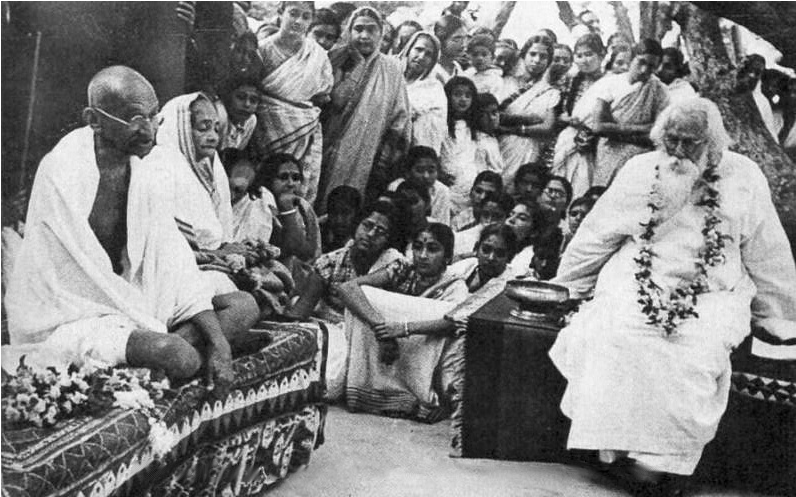
Nobel Laureate Rabindranath Tagore founded Shanti Niketan (meaning an Abode of Peace) laying the foundation for what is today known as Vishva-Bharati University, home of one of the best art colleges in the world. In 1922 Mohandas Karamchand Gandhi visited Santiniketan and met Sushen Mukherjee, a young man inspired by the movement for Indian Independence. The meeting influenced Mukherjee to set up Amar Kutir “my cottage” in 1927, establishing a rudimentary cottage industry for sari printing, handloom, and leather craft production 15 miles away from Santineketan on the banks of the Kopai River near West Bengal.
 After India gained her independence, Amar Kutir became a cooperative to revitalize and develop rural handicrafts, reflecting the ideals of self–help and sustainable rural development advocated by Gandhi. The Amar Kutir Society for Rural Development was formally registered in 1978, benefiting the local population in both the form of a cooperative where local people bring their artisanal work to sell, as well as a cooperative unit that produces leather goods, kantha stitched saris, bamboo crafts and batik. Its leather-craft unit employs mostly women doing the intricate painting, while men do the die-cut and gluing of the leather pieces.
The leather is hand panted with vegetable dyes either directly by hand in geometrical patterns or through a delicate batik wax resist process. At times the designs are inspired by traditional religious mandalas.
I was so excited to find this video showing the production of some of the exact items I just purchased for our Cardamom County shop!
 Organikos
Pingback: Collective Roots | Raxa Collective