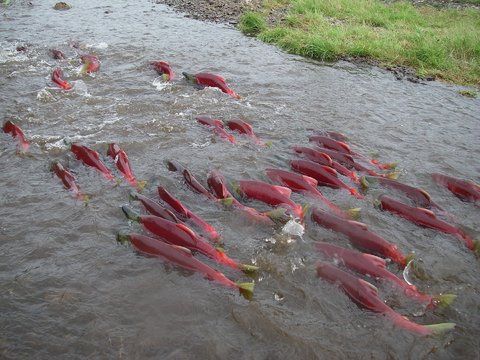
Tom Quinn/University of Washington. Sockeye salmon migrating from saltwater to fresh water.
More and more stories addressing the understanding scientists are developing about internal guidance systems:
Every summer, millions of sockeye salmon flood into the Fraser River in British Columbia, clogging its shivering waters with their brilliant blushing bodies.
Scientists and spectators alike have long been awed by the sockeye’s audacious struggle to swim upstream to spawn. And while it has been known for years that a salmon can smell its way up the river to find its natal stream, no one has been able to explain just how these beautiful and economically vital fish find their way back from the open ocean, 4,000 or 5,000 miles away, to the right river mouth.
Now, research from Oregon State University provides the first evidence that sockeye are guided home after two years at sea by a memory of the magnetic landscape of the river. The results of the study appear in the latest issue of Current Biology.
Many animals including seals, sea turtles and some migratory birds have all been shown to use magnetic fields to navigate. Just last summer, scientists discovered tiny iron crystals in the nose of rainbow trout, a close relative of the sockeye, that allow the fish to detect the changes in the earth’s magnetic field.
Nathan Putman, a postdoctoral researcher at Oregon State and the lead author on the study, took advantage of 56 years of fishery data and the unique geography of the coastline of British Columbia to show that sockeye recognize what home should look like, at least, magnetically speaking.
Read the rest of the story here.
 Organikos