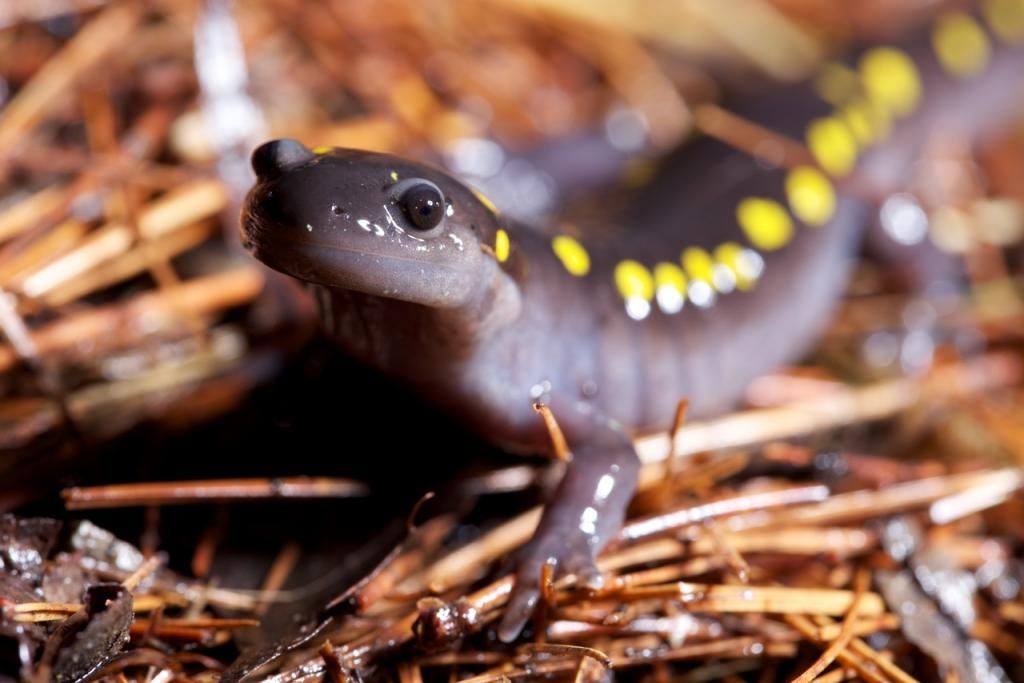
Spotted Salamander by Brian Magnier
Last night, at forty-odd degrees Fahrenheit and under a light drizzle, the salamanders of Ithaca’s Bull Pasture Pond signalled that spring has come. Before I explain, let me tell you a little bit about salamanders:
“The Americas have far more kinds of salamanders than all the rest of the world put together,” the Conant and Collins Field Guide to Reptiles and Amphibians reads in its introductory passage to the order Caudata. Species in eastern and central North America range from barely two inches to nearly four feet long, and some species are practically fully aquatic while others prefer only damp environments. Most of them are active at night and hide during the day, which is an easy way to differentiate them from lizards (except for the gecko family of lizards, which is primarily nocturnal). Other key differences are that lizards have scales on their bodies and claws on their toes, while salamanders have smooth or warty skin (just look at the slime in these photos) and no claws.
Now that you hopefully have a clearer idea of what a salamander is, we can discuss the creatures on a more detailed level of families and species. The photo that you see above is a member of the Ambystomatidae family. Ambystomatids are sometimes referred to as Mole Salamanders because they spend most of their lives underground, but are not to be confused with the actual species whose common name is the Mole Salamander, Ambystoma talpoideum. The Spotted Salamander, Ambystoma maculatum, and the Jefferson Salamander, Ambystoma jeffersonianum, are both noted as early spring breeders in the aforementioned field guide, and also both have resident populations at the Bull Pasture Ponds of Bluegrass Lane Natural Areas, part of the Cornell Plantations.
When my friends and I got to the Bull Pasture Ponds at 10:30 or so last night, these salamanders were behaving just as the textbook said they would: “under stimulus of warm rains, sometimes makes mass migrations to woodland ponds,” write Conant and Collins about the Spotted Salamander. We (including Brian, the fellow Cornell student who took these photos) saw dozens of Spotted Salamanders that ranged from about 4.5in to 7in, and a handful of Jefferson Salamanders, which according to the guide is “Named for Jefferson College, Canonsburg, Pa., hence indirectly for the excellent naturalist who attained the Presidency — Thomas Jefferson.”
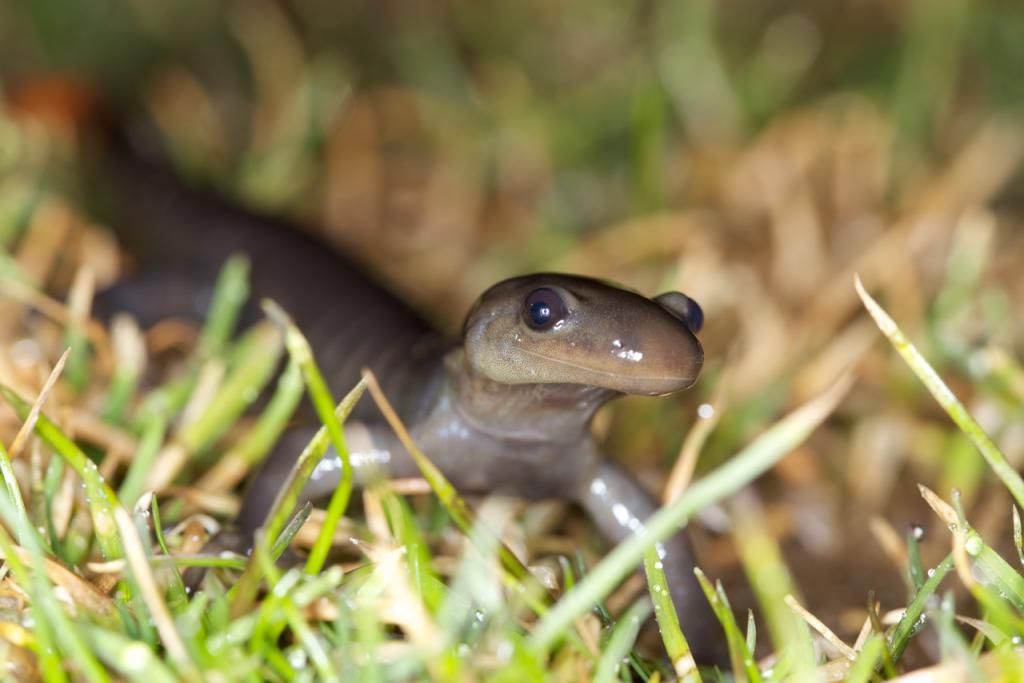
Jefferson Salamander by Brian Magnier
More exciting were our findings of two Red-spotted Newts, which are in the family Salamandridae (newts). Most newts are aquatic, but Eastern Newts (the species viridescens and perstriatus) have a land stage, called an eft, that is between the larvae and the adult stages. Efts remain ashore for one to three years, and in the case of the Red-spotted Newt (Notophthalmus viridescens viridescens), the Red Eft stage is often bright orange-red, as we saw it, with little orange spots along the back [click here for a great image of a Red Eft that I found on Flickr]. The other eft we saw was in the process of transforming to adult aquatic form, as we could tell by its almost black brown color and its slightly larger size than the Red Eft, which was between two and three inches long.
The Bull Pasture Ponds are in the northeast corner of Cornell’s Robert Trent Jones Golf Course. Our blog has touched on the issue of wildlife in golf courses before, and last night I was reminded of this as I watched a couple salamanders fighting their way through abrasive sand traps to get to the water’s edge. One of my professors, Dr. Kelly Zamudio, has looked into the question of how a golf course and its maintenance can potentially alter the local population of Spotted Salamanders, as this 2002 article from the Cornell Chronicle and one of the original 2002 scientific papers show.
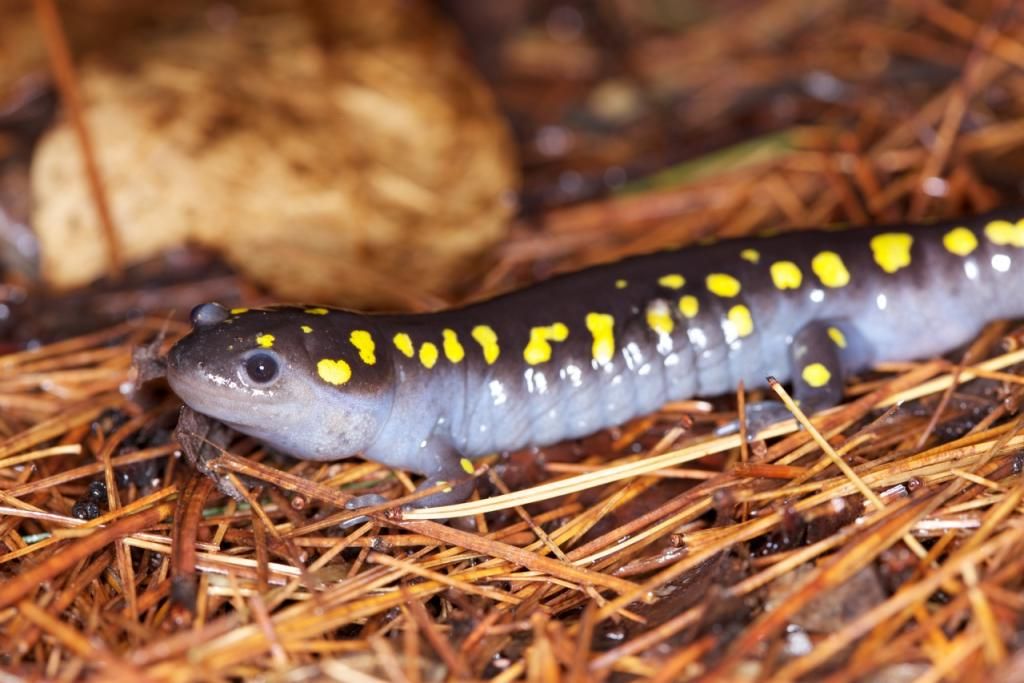
Spotted Salamander by Brian Magnier
I was also struck by the very clear signs of intensive landscaping machinery use, where mud and great mounds of earth had been churned up right between parts of the golf course and the water. I’m told that this has been the state of the area for at least three weeks now, and I am curious as to whether Cornell groundskeeping took the known spring migrations (Cornell students and professors have been observing and collecting specimens of these very same salamander populations for over a century) into account before tearing up the land and making it harder for the salamanders to reach their breeding grounds. Hopefully everyone will still get to their desired place and members of the opposite gender!
If you happen to be in the Ithaca area, there should still be a number of salamanders to see, just make sure you keep a wary eye out and watch your step, because these guys won’t scuttle out from under your feet! A good flashlight and rubber boots are highly recommended.
Update 4/2: It got a bit colder and drier in the last 24 hours! Local experts–i.e. my Cornell professor–recommends looking for resumed salamander activity on the next evening that has warm and moist conditions.
 Organikos
Reblogged this on Ann Novek–With the Sky as the Ceiling and the Heart Outdoors.
Pingback: Map the Herps You Spot | Raxa Collective