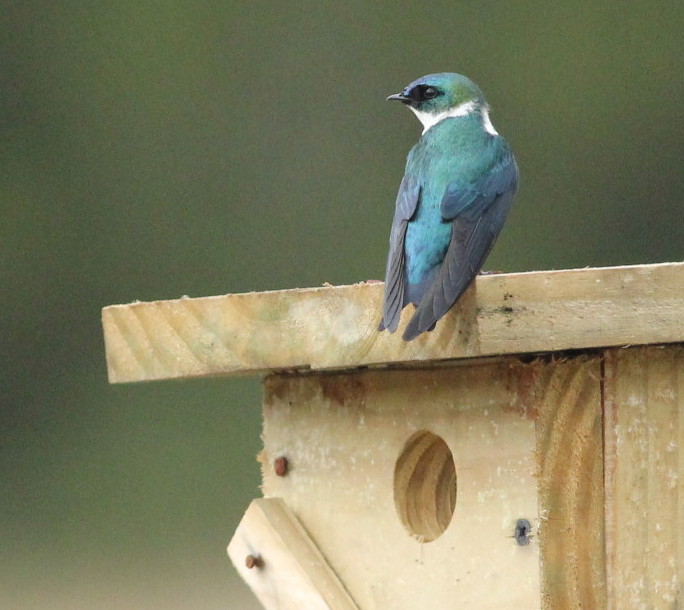
We couldn’t believe it either, but an ASY female (an ASY is a bird known to have hatched earlier than the calendar year preceeding the year of banding) that we banded last year has returned to the same box at the same site, built a nest and laid her first egg on the same ordinal date as last year. (In 2012, February had 29 days and the first egg arrived on April 30th, this year February has 28 days and the first egg arrived on May 1st.) We celebrated how any other field biologists in the middle of nowhere would – a hot cup of tea and an invigorating game of cribbage.
As I mentioned in the previous post, the swallows are really taking to the new boxes and affording us some incredible photo opportunities. The new behavior in which the GOSW spend more time perched out in the open will also allow birders, tourists, and school groups to get a much more prolonged view of this beautiful bird. Already this field season we’ve had the pleasure of meeting and bringing to our field site several members of the Peregrine Fund. The group was visiting Valle Nuevo in order to scope out potential “hack-sites” (natural surroundings suitable for reintroduction of a species) for the endangered Ridgway’s Hawk, currently found almost exclusively in Los Limones.
In other news, it does appear that the introduced Indian Mongoose has made it into the upper altitudes of our National Park. Eladio Fernandez, sitting motionless while photographing some of the GOSW, was approached by a mongoose that was making its way through the thick pajon grass. Marisol and I have now confirmed that indeed it was a mongoose that we saw crossing the road up here last year. We’ll have to be vigilant in assessing whether or not this animal has the potential to reach inside our small nest boxes. Let’s hope they stay busy by eating the invasive rats.

Thunderclouds forming to the east of Cordillera Central – Dominican Republic
It appears as though the GOSW is not as timid as we once thought. They also appear to be quite adaptable. Marisol and I bushwacked our way down into an area known as Nizaito Abajo where we had hiked around a bit last year. The area consists of a rolling valley floor once used for agriculture but now abandoned. We noticed that there has been an extensive effort to reforest the area with Hispaniolan Pine. The valley is incredibly quiet and remote, and furthermore, there are GOSW. We decided to erect 8 boxes on posts down there to see whether or not we’d have any luck. Within 5 minutes (actually 3), there was a pair of GOSW landing at and entering each of the boxes we had put up! I’ve never seen anything like this. This behavior really hammers home the idea that this species, here in Valle Nuevo, is incredibly cavity deprived. Another pair of GOSW was seen alarm calling around an old brick building and is likely nesting within one of the walls.
Our birding walks have afforded us with many Red-legged thrushes, Palm and Pine Warblers, Green-tailed Ground Tanagers, two Hispaniolan Woodpeckers, Antillean Siskins, Hispaniolan Emeralds, Black Swifts, American Kestrels, Rufous-collared Sparrows, Gray Kingbird, Killdeer, and the chatter of Hispaniolan Crossbills. We’ve now seen two Antillean Palm Swifts near the Visitor Center, nearly 1000m in altitude higher than the maximum altitude recorded in the DR Bird Guide. (Stay tuned to the Bird of the Day series on these pages for some more of these birds…)
Much more to come,
– Justin
 Organikos
The plumage is beautiful!!! 🙂 💖
Pingback: Golden Swallows, Jamaica Expedition | Raxa Collective