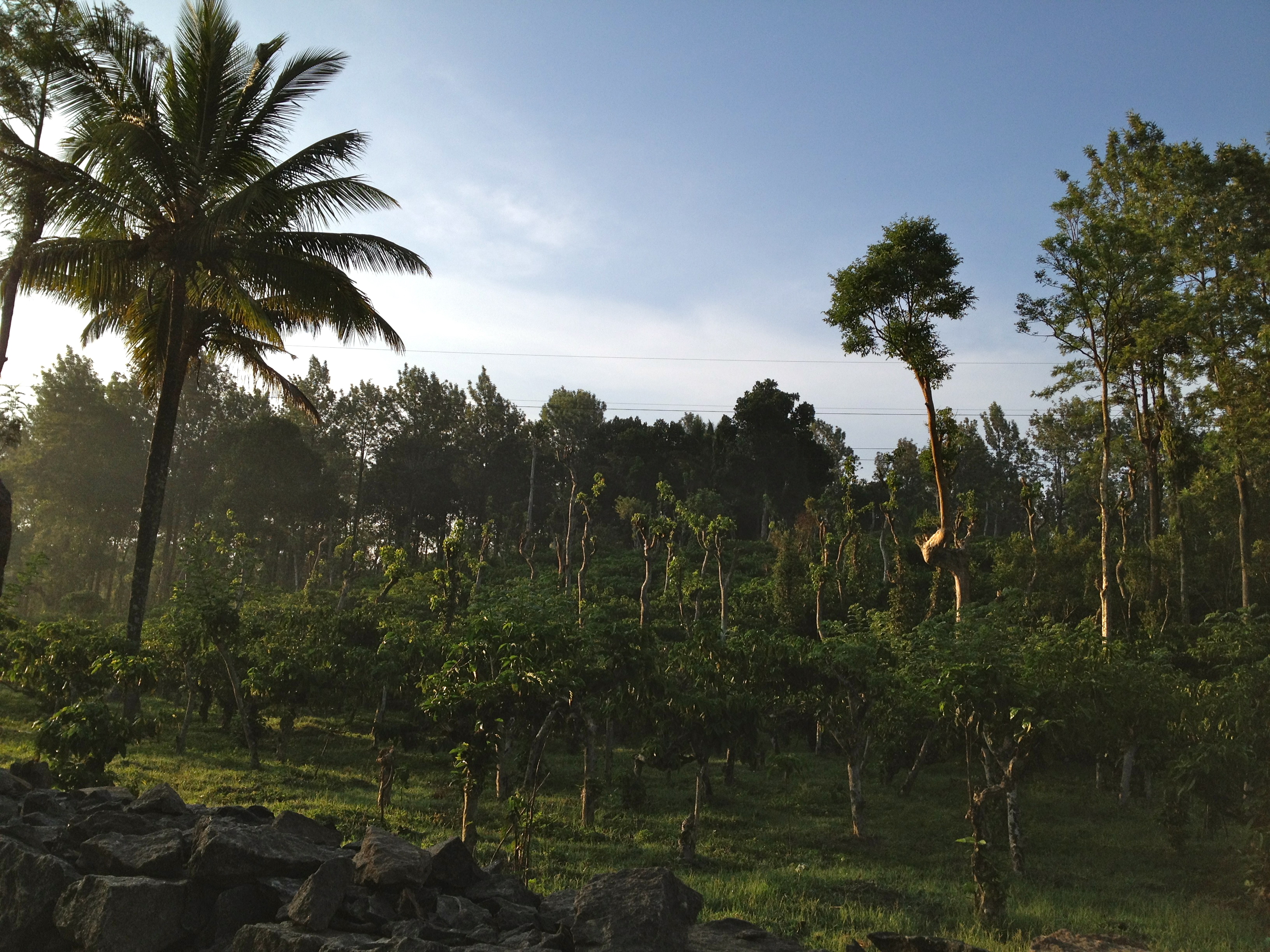
I’ve grown addicted to my colleague Anitha’s cold coffee since I got here (sorry guys but hers is just perfection). Ice cold, 70% arabica/30% robusta, locally grown coffee. India may not be known for its coffee, but in the Western Ghats of Southern India, you’ll find coffee plantations on hills and misty mountains between 800m and 1500m above sea level. One of the challenges here has been to integrate biodiversity conservation and sustainable livelihoods for farmers.
The cultivation of coffee has been introduced by the British in the 19th century. Traditional methods of cultivation involved placing young coffee plants under a canopy provided by other tree species and many coffee plantations could be considered as managed forests. Within the last decade though, following the rise in coffee prices, areas of cultivation were extended at the cost of natural forested ecosystems. Although there is potential for biodiversity conservation in coffee plantations, the silver oak is however favored by agroforesters due to its relative growth rate and lack of competition with crops.
One of the big challenges of small coffee farmers and agroforesters for the future is to expand while maintaining existing native forests and to plant native species thus preserving the ecosystem. And our job as consumers will be to support them.
 Organikos
We bought some south Indian coffee back to Hong Kong with us and enjoyed brewing it at home – its awesome and has a really different flavour profile to beans from the Americas and Africa. There’s an awesome, teeny, little roastery in Kochi we were lucky enough to stumble upon one day 🙂 Love it!
Pingback: Robusta, Liberian, Arabica | Raxa Collective