
What strange growths protrude from this tree? Photo by Seth Inman.
There are birds around the world that use strands of different materials to craft marvelous woven nests that hang from tree branches — if you’re lucky enough to see them!

Yellow-rumped Cacique in Avian Architecture by Peter Goodfellow © Princeton University Press 2011. p95
Of course, in some circumstances it is not hard to find these pendent, or hanging, nests, as with many species of caciques and oropendolas in Central and South America (birds related to the North American blackbirds, orioles, and cowbirds). That’s right, the photo above isn’t of some weird fruit tree, but a tree-wide colony of oropendolas at Las Isletas, in Nicaragua!
Caciques, close relatives of Oropendolas, often nest beside wasp nests; orioles, only slightly more distant relatives, frequently nest near Eastern Kingbirds and Great Kiskadees. Wasps and these large flycatchers all help defend against nest predators. Yellow-rumped Caciques like the one pictured on the right start their nest building with a loop in a tangled mass of fibers that surrounds the end of a branch.

Diagram of pensile nest in Avian Architecture by Peter Goodfellow © Princeton University Press 2011. p97
The female sits in this loop and weaves new strands into a sleeve flowing downwards from the branch, often working upside-down inside the sleeve. She only leaves her construction through the original top loop, probably to tighten her weave through the stress of stretching, and to not compromise the looser new strands at the bottom of the sleeve.
The Montezuma Oropendola, which ranges from Mexico to Panama, mostly uses banana leaves for its pendent nests, supplemented by palm fronds and vines. The female finds a large banana leaf with a tear in the strong supporting rib or stem, and pulls off strands as long as two feet (60cm) long, making trips back and forth to her chosen nesting location with a few of these streamers trailing behind her. The nests take an average of ten days to complete, and are between three and four feet (90-120cm) long and seven to nine inches (18-23cm) in diameter near the bottom. The interior is lined with dead leaves, which help incubate the eggs with their heat and also shelters them from violent rocking during high winds. Below are some examples of loops and weaves that have been found in nests around the world. In the case of the birds mentioned here, females instinctively know how to weave their nests, though they do appear to grow more experienced over time.
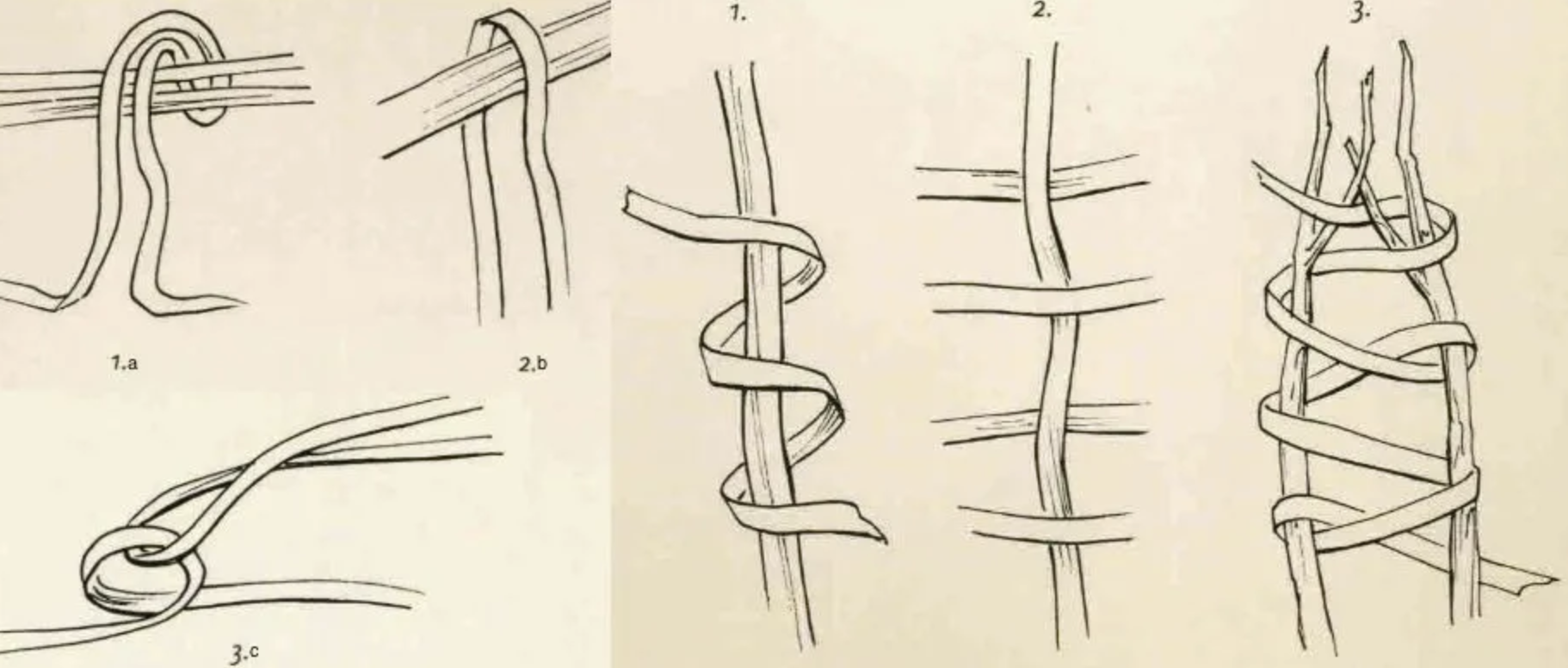
1a. Loop tuck, 2b. Simple loop. 3c. Interlocking loop, 1. Spiral coil, 2. Simple weave, 3. Alternately reversed winding. In Avian Architecture by Peter Goodfellow © Princeton University Press 2011. p101
Orioles, such as the Baltimore and Bullock’s, use materials like horse hair, bits of cloth, and string in addition to the more usual long and flexible fibers from stems and leaves. These two species make pouches or shallow cups that can hang up to eight inches (20cm) long, and if there is Spanish moss in the area you’ll probably see it camouflaging the exterior of their nest. The interior is lined with down from plants, wool from sheep, and other fine materials. Although male Orchard and Baltimore Orioles have been reported to help in nest building, almost always it is the female who weaves the close to ten thousand stitches in a typical nest.
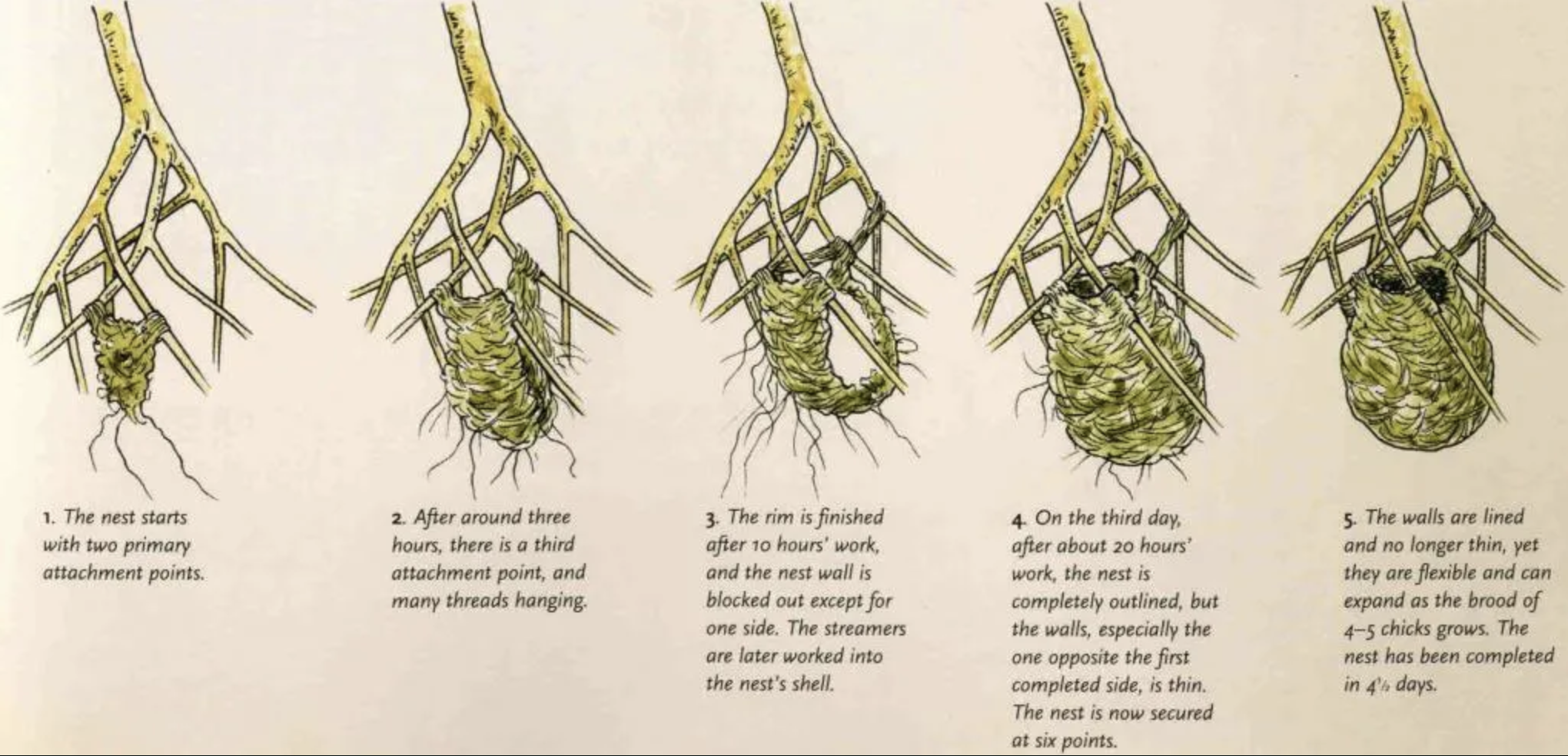
Representation of the process of Baltimore Oriole nest construction in Avian Architecture by Peter Goodfellow © Princeton University Press 2011. p103
My nest post will include a slideshow of many woven nests, particularly of the North American orioles, so stay tuned! Also, if you haven’t already, check out Chi-Chi’s post about architecture and the Baya Weaver.
 Organikos
Reblogged this on hxgreensoul and commented:
A great example of birds as nature’s weavers and architects.
great post! thanks for all the detail. One of my Design professors at UC Davis mentioned how birds use basketry and weaving techniques to build their homes in a Sustainable Design class. Great to see such great detailing! Reblogged on my blog! excited to see chi-chi’s post
Thanks Helen, glad you liked it! If you’re interested in design and birds I would definitely have a look at the book by Goodfellow that I cited here — some of the information in my post is from there, the rest is from biology papers!
Pingback: Woven Nests | Raxa Collective
Pingback: The Montezuma Oropendola | Raxa Collective