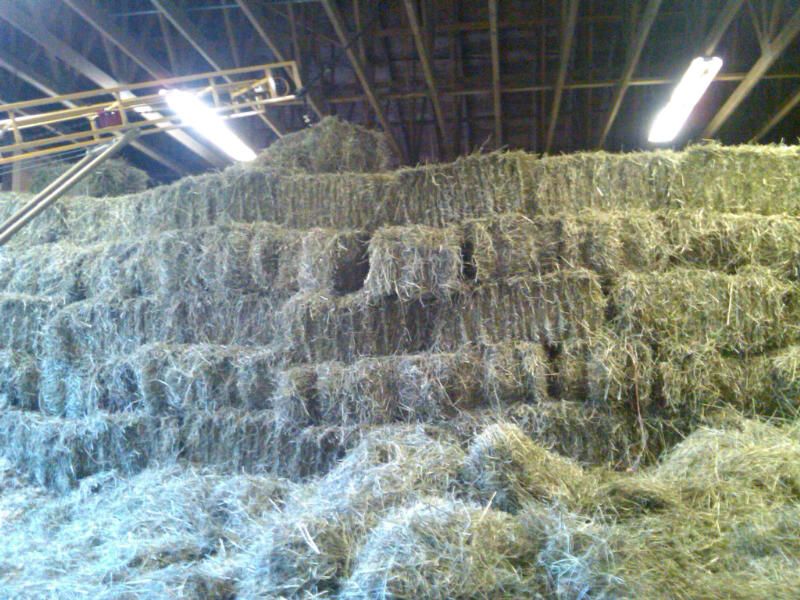
We ended up filling this barn up to the rafters the next day.
I took this past weekend away from Cornell to help a friend with the hay harvest at a farm in rural NY where she works. Although I had been duly forewarned that haying is pretty hard and uncomfortable work, I had expected the bales to be relatively easy to lift and move around, and was wrong for a number of reasons.
First of all, the bales were pretty tightly packed. This meant that they were heavier than your average bale, and also put more pressure on the two pieces of twine that keep the flakes (segments of hay in a bale analogous to slices of bread in a loaf) compressed together. The twine, which unless you have a prodigious wingspan is the most efficient way to grab hold of the bales for throwing or carrying quickly, pinches your fingers against the bale when it is too tight, making it painful and difficult to get your hands on and off the bale. Add to these inconvenient factors the heat at the top of the barn and the need to crouch to avoid rafters and lightbulbs while carrying or tossing the bales (or, as I did, hit your head too often), and you have some pretty exhausting work to do with the 2,600 bales that we–me, my friend, and four workers from around Central America–stacked up over the course of the weekend.
Having read a couple books by travelers to Iceland in the late 1800s, however, I knew that we had it comparatively easy. In our case the farm owner was out in his tractor attached to a hay baler, which could fling bales directly into a trailer-cart, and we could use a hay elevator (see also top left in my photo) to unload bales straight from that trailer-cart up to the top of the hay stack where others of the team stood. For the better part of two millennia, on the other hand, humans have had to harvest hay with far simpler tools and procedures. Even before I got to the farm, the hay had already been cut and fluffed, steps that were taken with scythes and rakes during the time of William Watts’ and Captain Richard Burton’s expeditions in Iceland, when the two of them often had to lament the dearth of horses and men available for hire due to the greater need of the hay season.
As you can see from the photos above, even in the early 20th century the Icelandic hay harvest was rough going. Given the country’s windy, wet and cold climate, regions where hay grew well were scarce, and almost all Icelanders needed fodder for the horses that they used to travel everywhere, not to mention for their cows and sheep. Hay is also best harvested and packed in dry, sunny conditions, so that little or no moisture is trapped inside to later rot the hay or ferment it too much. Icelanders rarely had adequate structures for hay storage in the 18th and 19th centuries, and more often had to resort to the practically useless layers of peat or sod as seen above, which likely served better as a weight against the raging winds than a barrier against the rain and snow.
So even though I haven’t enjoyed the hard-to-open-and-close hands from tight twine; sore back from bending and lifting; hoarse throat and stuffy nose from hay dust; and the hay rash along the inside of my arms from cradling bales, I was happy to sleep for twelve hours when the weekend was over, and know that I didn’t face as toilsome a harvest as the Icelanders of centuries past.
 Organikos