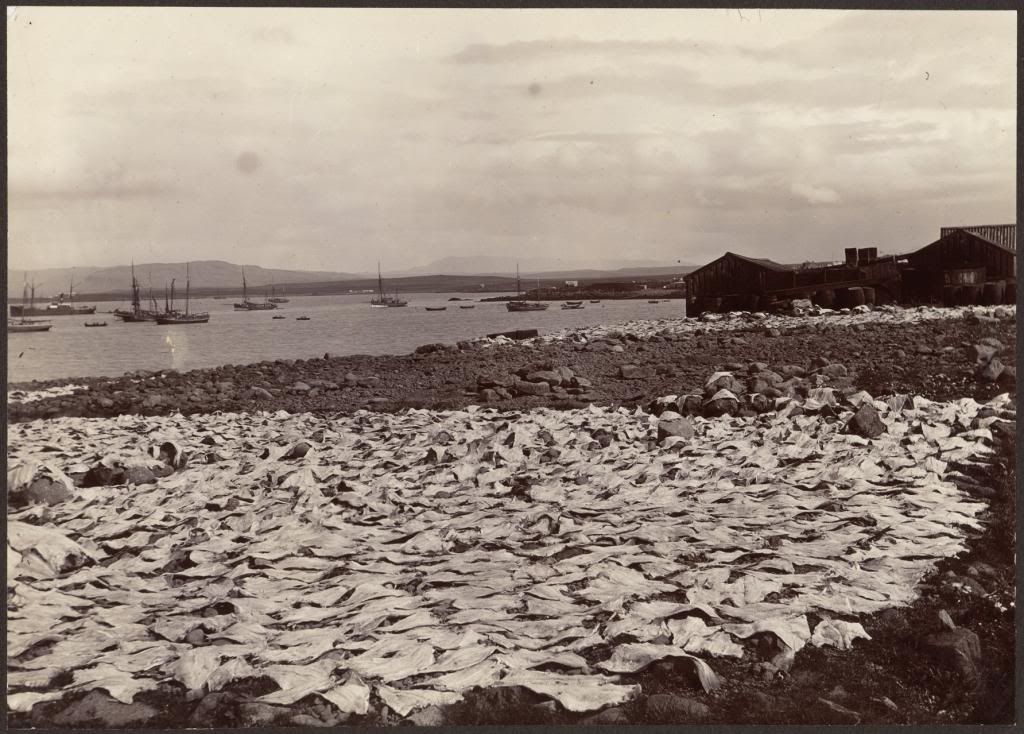
Reykjavík, Fish drying and shark oil station. Collodion print by Frederick Howell ca 1900. Bequest of Daniel Willard Fiske; compilation by Halldór Hermannsson; Cornell University Library Rare & Manuscript Collections.
Every account of travel in Iceland will cover the national meals in some fashion, but normally they are portrayed as quaint and disgusting. Many of the travelers of the period address the ‘unhealthy penchant for putrefied foods’ that revolved around stockfish. This included salmon and some other species but mostly meant cod, which was quite abundant in the oceans around the island. The fish would be cleaned and dried, and sometimes smoked, to provide food throughout the year, and the same applied for mutton. Dairy products from cattle, namely butter and cream, was often allowed to go rancid, much to the dismay of continental Europeans. Here is a paragraph I’ve translated from Jules-Joseph LeClercq, the Belgian who I referred to in my last post about Icelandic equitation, in his book Terre de Glace (1883):
I do not know how I can still respect those who are able to digest the horrible dishes to which my host introduced me, in particular dried shark-meat and whale fat. Overcoming my repugnance, I wanted to taste these incredibly novel delicacies, and was rewarded with an upset stomach for eight days. Icelanders have choice foods that are simply hair-raising; they do not eat shark-meat until it has aged for a year, pretending that it improves with time like whiskey. I left to the natives these villainous dishes to satisfy myself with eider duck eggs, which were excellent despite their fairly strange aftertaste that takes getting used to. These eggs, of a green-grey color, are double the volume of a chicken’s. My host also offered black bread, butter that was a little rancid, cheese that was very much so, and even some Danish beer.
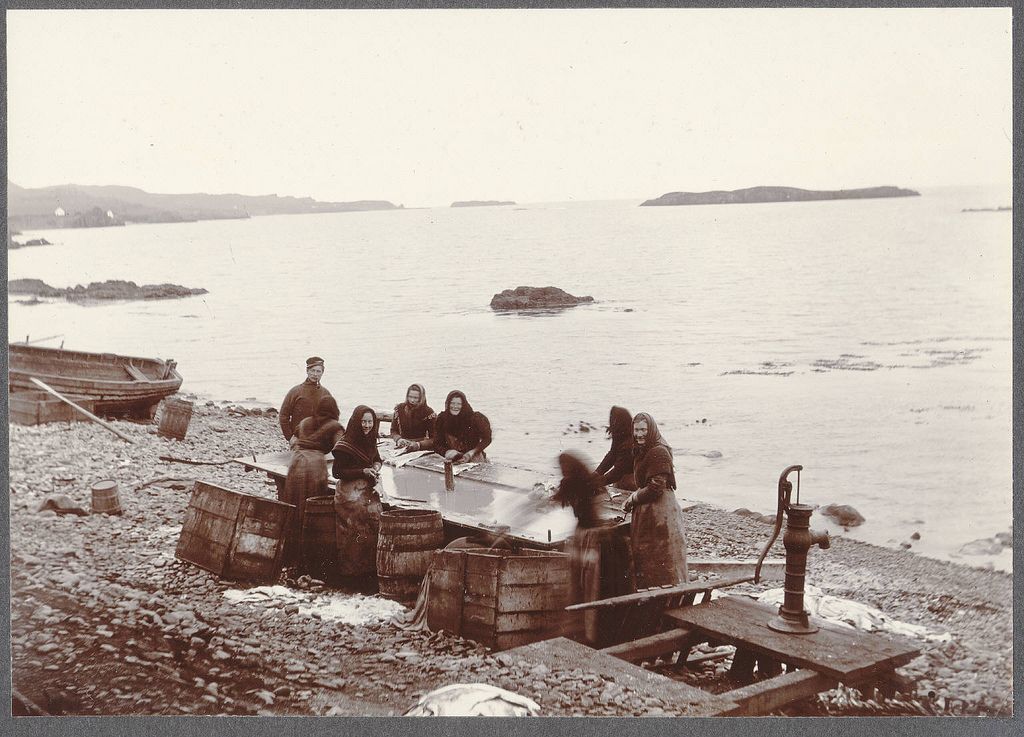
Vopnafjörður. Fish washing. Collodion print by Frederick Howell ca 1900. Bequest of Daniel Willard Fiske; compilation by Halldór Hermannsson; Cornell University Library Rare & Manuscript Collections.
LeClercq and the Englishman William Watts, who I’ve also cited before, both visited a shark-liver oil refinery in the north of Iceland and were repulsed by the smell. LeClercq complained of the nauseating smell of half-decomposed shark-livers, and wrote that the memory alone of the boiling vats and their effluvia still horrified him. He also claimed that the oil was sold in Europe under the name of cod-liver oil, just as in California they sold seal-liver oil under the same pretension. This is what Watts had to say on the matter in Across the Vatna Jökull (1876):
A short distance to the north of the town we found a cluster of black sheds, a filthy smell from which informed us at once of the odoriferous business carried on there, which was at full swing. I had often smelt from afar this same disgusting effluvium, and found it to arise from the profitable but revolting work of extracting oil from sharks’ livers. Accompanied by Paul, I determined to inspect this manufacture, so, passing through an avenue of vats full of sharks’ putrid livers, reeking and sweltering in the sun, we thrust our pocket-handkerchiefs into our mouths and plunged into the boiling-house. Here about half-a-dozen cauldrons of sharks’ livers were simmering, and slowly ‘frying out’ the filthy but valuable shark-oil, exhaling the foulest stench imaginable. Three grimy oleaginous men and a boy, who seemed to thrive amid their abominable surroundings, were engaged in stoking the fires, stirring up the stewing livers and baling out the oil, as it accumulated, into a long trough, which discharged itself into a large iron tank outside, whence it was drawn off again into barrels ready for shipment to the various parts of the world where there is a demand for such a very unpleasant lubricator. The men seemed quite surprised that we found anything disagreeable in the smell of the oil, and seemed quite to enjoy giving the cauldrons an extra stir on our account, which was a pleasure we could have dispensed with.
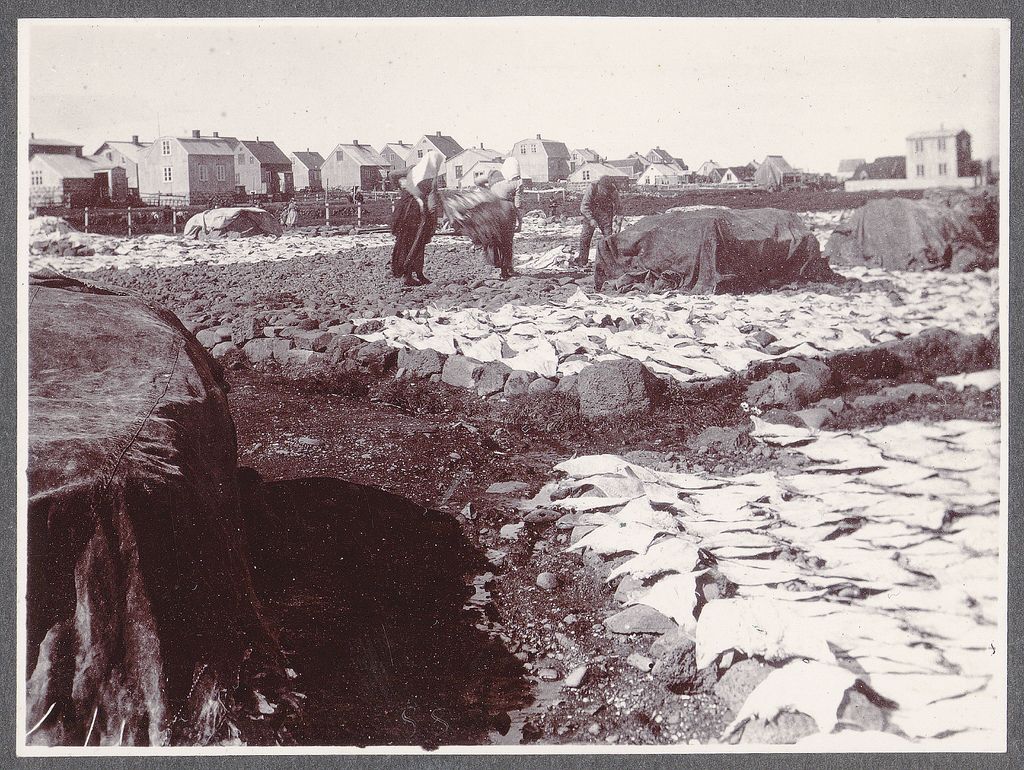
Fish drying. Reykjavík. Collodion print by Frederick Howell ca 1900. Bequest of Daniel Willard Fiske; compilation by Halldór Hermannsson; Cornell University Library Rare & Manuscript Collections.
Over time, visitors to Iceland traversing the country often found themselves refusing Icelanders’ offers of rotten fish and mutton, preferring to fire up their lamp-burners to eat broth and chocolate packed from Europe or purchased from Danish merchants. Many use their concluding remarks to suggest a change in the national tradition of ichthyophagy so as to promote better health, emphasizing the need for better fruit and vegetable growth or importation to prevent scurvy and the like.
 Organikos
Pingback: Journey to the Center of the Earth, Via Iceland |
Pingback: If You Happen To Be In Denmark |