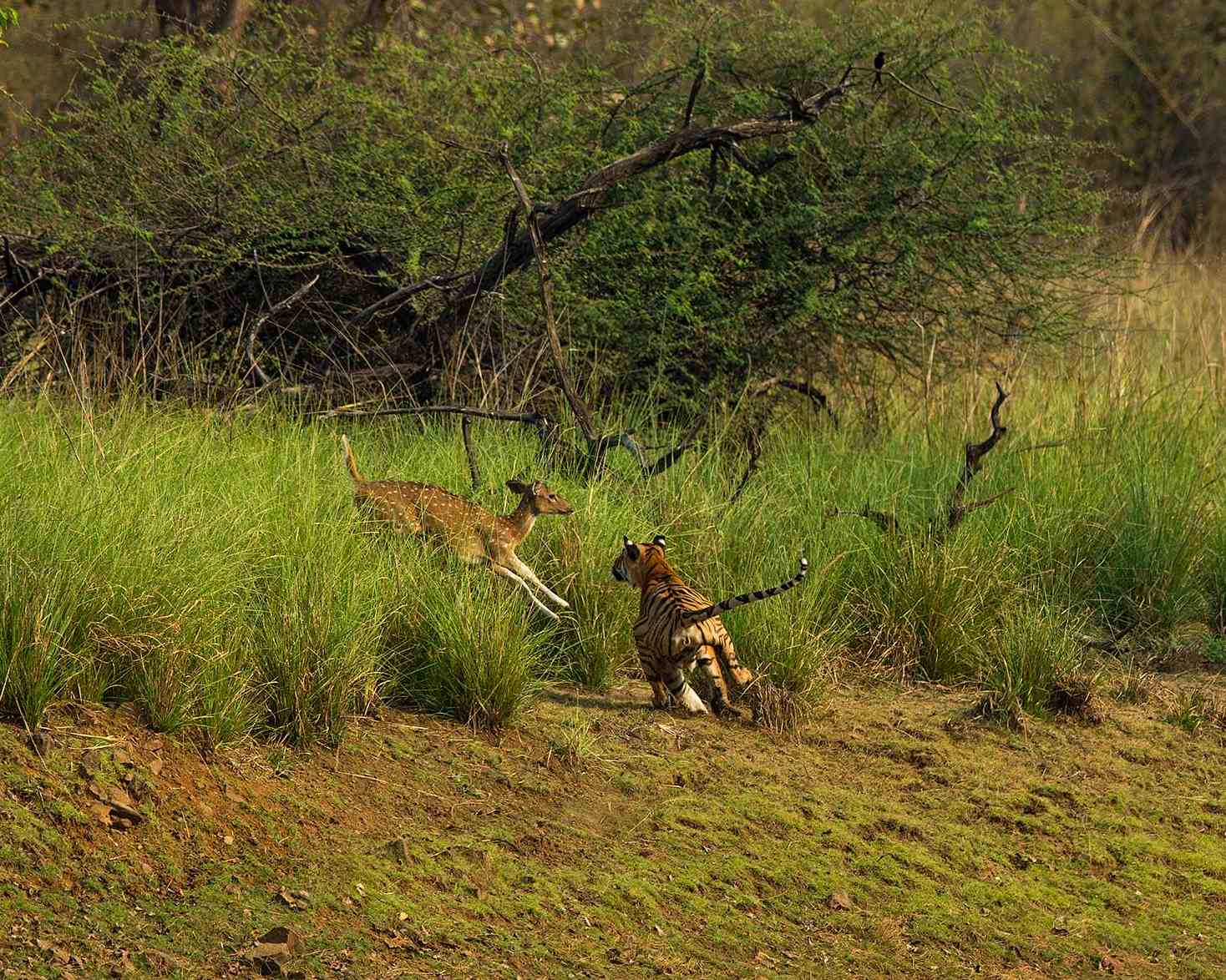
As a part of celebrating World Wildlife Week I will be sharing information about the importance of saving our Natural Heritage, hopefully trying to create awareness among the growing population of nature lovers and wildlife photographers. My first post makes the correlation between a healthy tiger habitat with our own well-being.
Now let me talk about the importance of deer in our forests.
One of the primary reasons why large areas of forest in India no longer have tigers is because local people have hunted and eaten away most of the prey animals. While the direct poaching of tigers is contributing to their rapid decline now, it is the steady erosion of the tiger’s prey base that has resulted in low numbers of tigers to start with.
An adult tiger needs about 3000 kg of food a year. This translates roughly into one deer-sized animal every week.
A large deer like the Sambar is by far the tiger’s preferred prey. The meat from an adult sambar can provide a tiger with enough food for several days. A tiger will return to feed on a large kill again and again until virtually nothing is left.
The key to a healthy tiger population is a healthy prey animal population (or prey base, as it is called by scientists). The larger the prey base in a forest, the more tigers it can support.
In order to get its quota of roughly 50 large-sized prey animals a year, a tiger needs a ‘food bank’ comprising a breeding prey population of at least 500 animals that produce a surplus for the tiger to eat each year. If the prey animal population dips below this optimum level, the tiger will be forced to eat away it’s ‘capital’, and will not be able to survive for long or be able to raise cubs successfully.
So in continuation of the previous post:
Large Prey Base = More Tigers = Good Forest = Water = Mankind’s Survival.
Of course, the equation is not so simple, more Tigers means larger forest area as Tigers need territories! More on that in next post.
(Text Courtesy http://www.truthabouttigers.org/ )
Feel free to share and help spread the awareness. Let us together learn about the importance of saving our natural history.
#SaveTheTiger
 Organikos
Reblogged this on Ann Novek–With the Sky as the Ceiling and the Heart Outdoors.
Impressionnant shot! Wonderful!
Pingback: World Wildlife Week: Tigers & Territories! | Raxa Collective