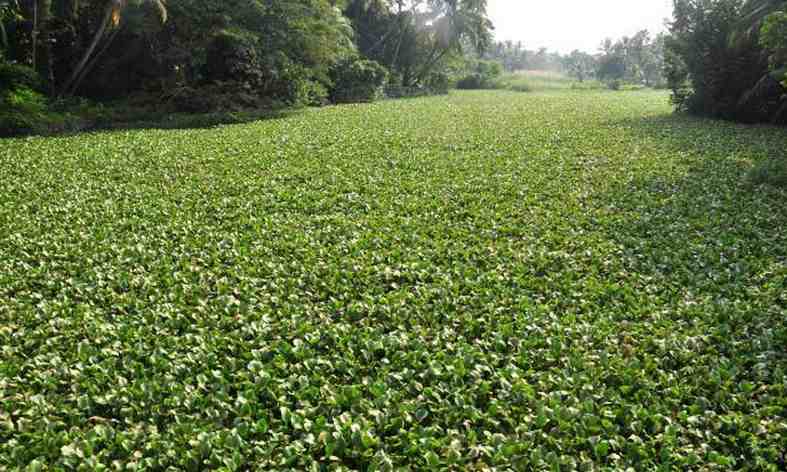
Water hyacinths choke the Poorna river at Tripunithura. Photo: Vipin Chandran; The Hindu
There are many similarities between Indian and Thai river life; watching villagers and people on barges going about their daily lives on the water is one, and the flora and fauna of river life is another. While traveling on the Chao Phraya River it only took a moment to see how the water hyacinths have the potential to choke river traffic. My excitement was piqued when Chananya from Asian Oasis told me that there was an established industry to use the plant for decorative, household and furniture purposes.

Dried water hyacinth stems – the raw material used for weaving beautiful objects, both decorative and useful
On our second day in Thailand we planned a quick visit to the Bang Sai Arts & Crafts Center, an initiative of Queen Sirikit with the objective of promoting and protecting traditional Thai crafts. One of the units is working with water hyacinth as a medium for woven products. The centre is enormous, so unfortunately we didn’t have time to fully explore, but I plan to do my best to learn more about the process to see if we can introduce some of this craft to Kerala. Many of the weaves are similar to those used in the Vimalayalam Convent School with banana fibre, so maybe working with the new material wouldn’t be that foreign, and the fact that this work was being done by people with different levels of mobility makes it all the more interesting as a cottage industry or special needs school initiative.
The range of products was interesting. My personal favorite was the hedgehog “boot brush”.

Hedgehog Boot Brush
But here’s a collage of weave patterns, process photos and product to whet your imagination on what can be done with this invasive water weed!


 Organikos
Pingback: The Sweeping View, For Historians And Non-Historians Alike | Raxa Collective
Reblogged this on Ann Novek( Luure)–With the Sky as the Ceiling and the Heart Outdoors.
Pingback: Gifts That Give Back, Often In More Ways Than One | Raxa Collective
Pingback: Seed to Cup Tea Experience | Raxa Collective
Pingback: Menacing Weed or Wonder Plant? | Raxa Collective