
Captive lesula from the DRC. Photograph: Maurice Emetshu/AFP/Getty Images
Thanks to the Guardian for this article on the discovery that there is a primate that had not yet been named:
It all started with Georgette’s pet monkey. Deep in the Democratic Republic of Congo (DRC) rainforest, in the remote village of Opala, a team of researchers noticed a little girl with a strange-looking monkey on a leash in 2007. The girl, Georgette, told the scientists it was called ‘lesula,’ but no one had heard of it nor did the animal look like anything found in the DRC. They snapped a photo.
Five years – and tonnes of research – later, the world officially met Africa’s newest monkey via a paper published in the journal PLOS ONE. The news made headlines around the world, aided by a portrait so soulful the Guardian’s art critic compared it to a Rembrandt painting. The media soon moved on – as it is apt to do – but that was really only the beginning of the story.
Half-way across the world in Florida, prospective student Steven McPhee, then a bartender with a penchant for solo globe-trotting, met with anthropology professor, Kate Detwiler at Florida Atlantic University.
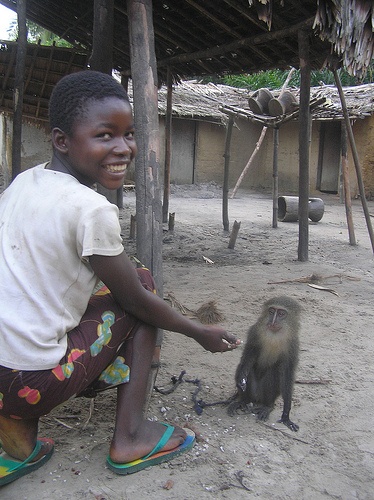
Georgette with her unusual pet, a juvenile lesula. Photograph: TL2 Project
“I basically walk into her office and said, ‘Hi. My name is Steven. I have a degree in biology, extensive travel experience, and I want to study primates in the Congo,’” McPhee said.
Fortunately for him, Detwiler had started collaborating with the TL2 project, which was behind the discovery of the lesula (Cercopithecus lomamiensis). Run by the Lukuru Foundation, the TL2 Project is a conservation and research programme focusing on a vast area between three rivers in the Congo: the Tshuapa, the Lomami, and the Lualaba.
The project is headed by the indefatigable husband-and-wife team of John and Terese Hart, who have made Congo their home for 40 years. Their work not only resulted in the discovery of lesula but also in the creation of two regional parks protecting around half of the new species’ habitat, as well as bonobos, forest elephants, leopards, and thousands of other lesser-known species.
Detwiler, who had visited the Harts’ project and co-authored the paper, was on the look out for a student who would not only jump at the chance of studying the lesula, but could also handle the rigours of fieldwork in one of the world’s least-explored forests.
“I think we were both a little surprised that day,” McPhee said of his first meeting with Detwiler, “but the excitement was palatable, and by the end of the day Kate had already unofficially incorporated me into the project.”…
Read the whole article here.
 Organikos