
Sonya Noskowiak, Calla Lily, 1932. (Courtesy Center for Creative Photography)
Thanks to KQED (Public Media for Northern California, including National Public Radio and Public Broadcasting System, both of which would have the Raxa Collective seal of approval, if such a thing existed, for their excellent service to their communities) for this story of a not well enough known photographer:
Sonya Noskowiak: A Groundbreaking but Forgotten Photographer
By
…Another photograph, Calla Lily(1932), also possibly shown at the de Young, demonstrates Noskowiak’s thoughtful treatment of light. The flower’s milky white spathe is set against a vacuous black background. The flower appears as if floating, but the light falls on the veins of the leaves, grounding the luminous spathe.
A work titled Sand Pattern (1932) looks like aerial photographs of the Sahara or a satellite image of some uncharted Martian desert. Tentacles of sand stretch out in all directions as if they’re grasping for a nearby oasis. The sand resembles the aluminum powder found in an Etch A Sketch, almost shimmering. In actuality, the patterns might cover an area no larger than a footprint, possibly on a Carmel beach.
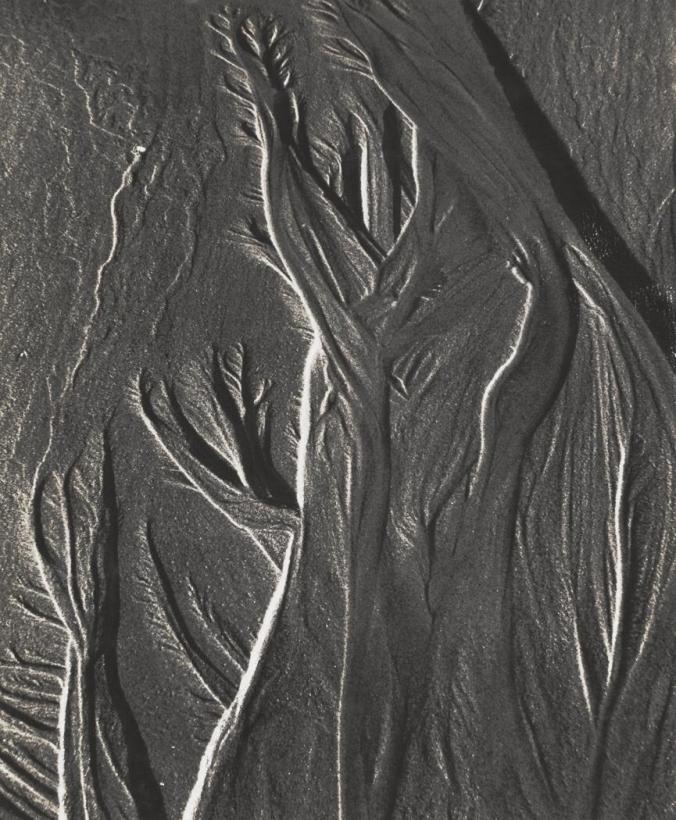
Sonya Noskowiak, Sand Pattern, 1932. (Courtesy Center for Creative Photography)
In her recent book Group f.64, Mary Street Alinder, a scholar and former assistant to Adams, concludes that the de Young show was considered unimportant by the news media. More press was given at the time to the de Young’s concurrentHorse Show, which included paintings by Édouard Manet, bronze horses from Persia and vases from Greece. Group f.64’s exhibition was nonetheless reviewed by the San Francisco Chronicle, The Argonaut, the San Francisco Call-Bulletin, Camera Craft and The Wasp News-Letter. These reviews ranged from negative to tempered to positive. Writing for The Argonaut, Junius Cravens called out Noskowiak’s Palm Blossom as among the stronger works in the show. In his unforgiving review in Camera Craft, Sigismund Blumann remarked, “Perhaps a generation or two of nothing else and a latter-day Soviet training will inure us to this novelty.”
Early Success
Ovens, Taos Pueblo, New Mexico(1933) is an even starker change from Noskowiak’s previous work. Of her dated photographs, this is among the earliest to focus on human material culture. Shot at the ancient Taos Pueblo, three adobe horno ovens foreground the image. Noskowiak may have struggled with the awkward and alternating natural light on the adobe house in the background, but she would eventually master the angles and planes of architectural structures.In the summer of 1933, Noskowiak, Weston and Van Dyke traveled to New Mexico to shoot the scenery. At least two of her photographs can be attributed to this trip. In both, Noskowiak pulls a bit away from her subjects and, if not landscapes, creates something approaching landscapes.Cottonwood Tree – Taos, New Mexico pictures a bare cottonwood tree cropped close, but not nearly as intimate as Kelpand other early works…
Read the whole article here.
 Organikos