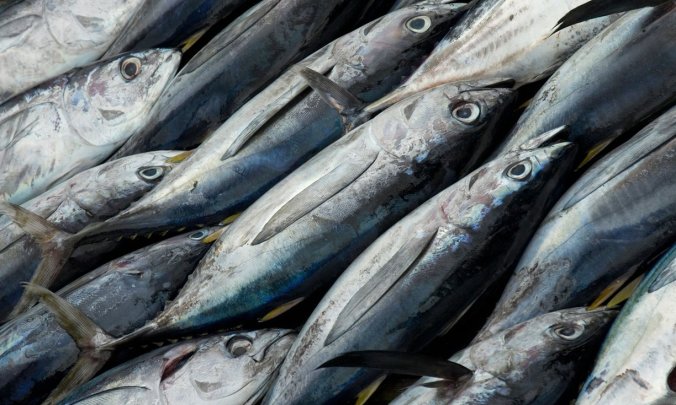
More than 40% of popular species such as tuna are being caught unsustainably, UN FAO says. Photograph: Alamy
Articles like this have me thinking about the meal I had last night, which had not one bit of animal protein in it, and wondering whether I could happily resist adding my own weight to the immensity of the food problem, especially with regard to fish:
Global fish production approaching sustainable limit, UN warns
Around 90% of the world’s stocks are now fully or overfished and production is set to increase further by 2025, according to report from UN’s food body
Global fish production is approaching its sustainable limit, with around 90% of the world’s stocks now fully or overfished and a 17% increase in production forecast by 2025, according to the UN Food and Agriculture Organisation (FAO).
Overexploitation of the planet’s fish has more than tripled since the 1970s, with 40% of popular species like tuna now being caught unsustainably, the UN FAO’s biannual State of the world’s fisheries report says.
Manuel Barange, the UN FAO’s fisheries director, told the Guardian that overfishing rates of around 60% in the Mediterranean and Black Sea regions were “particularly worrying”.
He said: “There is an absolute limit to what we can extract from the sea and it is possibly very close to current production levels, which have stabilised over last few years. They have grown a little in recent years but we don’t expect much more growth because of the rampant increase in aquaculture production.”
Aquaculture is now forecast to overtake wild-caught fish as the source of most fish consumption in 2021, for the first time.
The rise of aquaculture has also benefitted trade, employment and diets in the developing world, with global per capita fish consumption estimated at a record 20 kilograms.
“My personal view is that it is quite momentous to have reached this level of production,” Barange said. “In the struggle to make sure we have enough food to feed more than 9 billion people in 2050, any source of nutrients and micronutrients is welcome.”
Some campaign groups though fear that aquaculture may introduce invasive species, diseases and parasites. The potential for chemical pollution and use of transgenic species are also causes for concern, as are the impacts on wild fisheries and natural habitats.
Shrimp farming is thought to have led to the destruction of 3m hectares of coastal wetlands, including many mangrove forests, and the UN FAO is currently drawing up guidelines to reduce such environmental footprints.
Lasse Gustavssin, the director of Oceana, a marine conservation body, said that sustainable fisheries management should be prioritised instead…
Read the whole article here.
 Organikos
This is just one of the many reasons I stopped eating fish. Fish suffer too, not just farm animals; one also needs to realize the loss of marine life caught via by-catch, along with the fish as they pull in huge drift nets trapping the victims inside–most likely to suffer by asphyxiation. Commercial fishing (as well as farm raised) is ugly and destructive to our environment, I would say it is just as bad as factory farming. All we need to sustain a quality life for all is a plant-based lifestyle – just maybe we could solve the world hunger issue! There are more mock substitutes today than ever, many of which have improved greatly in quality and taste.
Pingback: Retaining Fish! – UNITED VETERANS PARTNERSHIP, INC.
I also want to share these links: http://fishfeel.org & https://en.m.wikipedia.org/wiki/Trawling