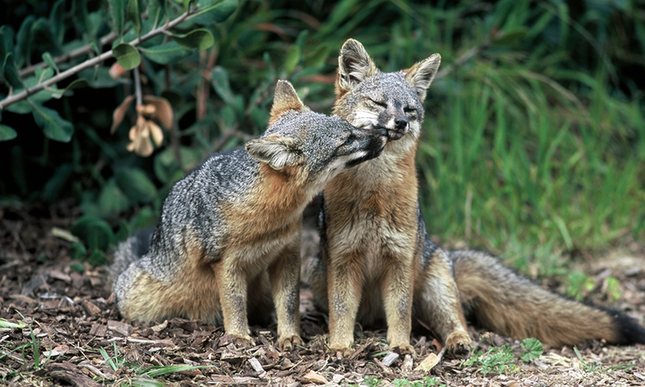
Island Foxes. Source: The Guardian
We are happy to share another win for wildlife conservation. One of America’s rarest mammals, the island fox, has experienced a record-breaking recovery twelve years after the species was declared endangered. Here’s the story from The Guardian:
The US Fish and Wildlife Service (FWS) has delisted three subspecies of island fox – endemic to the San Miguel, Santa Rosa and Santa Cruz islands – just 12 years after they were granted endangered species protections due to a catastrophic 90% population loss.
The island fox is one of the smallest canids in the world, around the size of a domesticated cat. They are thought to have evolved on the channel islands, located off southern California, over the past 6,000 years and initially thrived due to a lack of predators, feasting on mice, crickets and the occasional crab.
However, the island fox suffered badly during the late 1990s after use of the pesticide DDT wiped out bald eagles on the islands. Golden eagles, which prey on the foxes, quickly replaced the fish-loving bald eagles, leading to numerous fox deaths.
This change, combined with a viral disease that swept through the fox population, led to a crash in numbers. At one point, Santa Rosa island had just 15 foxes, with another 55 on Santa Cruz.
Following federal listing in 2004, island foxes were bred in captivity and a new vaccination was given to the remaining population to protect them from disease. Golden eagles were relocated, feral pigs were dispatched and bald eagles were reintroduced. As a result, fox numbers have rebounded – there are now about 700 of them on San Miguel island, 1,200 on Santa Rosa island and 2,100 on Santa Cruz.
Federal officials said the effort, which involved conservation groups including the Nature Conservancy and Institute for Wildlife Studies, is the most rapid delisting of a mammal in the 43-year history of the Endangered Species Act. The Santa Catalina Island fox will remain on the list, although is now considered threatened rather than endangered.
Read the full story here.
 Organikos