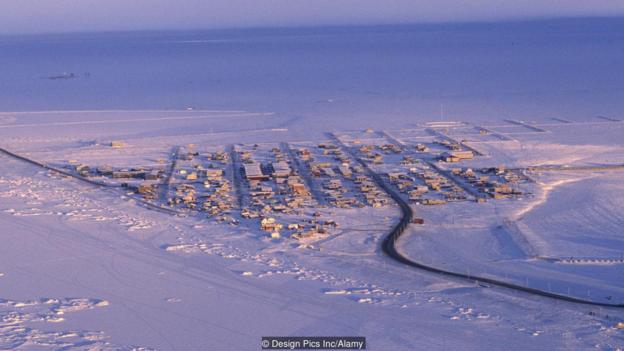
Barrow, Alaska. All photos from: BBC Earth
There is plenty of news on the alarming reduction of polar ice caps and the detrimental effect it has on polar bear populations. However, there is another, hidden problem that is hurting a different community just as much as these giant bears, and it is affecting the humans living in the northernmost town in the United States: Barrow, Alaska.
The big unspoken worry in the north is that large deposits of chemical pollutants are trapped within the ice.
For decades that was not a problem. But now rising temperatures are causing the ice to melt faster than ever. The area of summer sea ice has shrunk by 10% per decade since 1979, and in May 2016 the ice extent was the smallest in 38 years.
That means trapped chemicals like polychlorinated biphenyls (PCBs) are escaping and infecting animals like seals, the prey of choice for everything from polar bears to people.
Many of these chemicals have been banned for decades. They have been confined deep in the ice all this time and are perfectly preserved, like the sap-stuck mosquitos in Jurassic Park.
A study published in 2015 followed subsistence hunts from 1987 to 2007 and found significant amounts of PCBs in the internal organs and blubber of locally-harvested seals. The researchers concluded that, while levels of older banned contaminants are dropping, modern pollutants are rising.
That is problematic, because native Alaskans’ diets are largely comprised of seal.

Northern fur seal pick up harmful contaminants.
The trouble is, even if scientists did definitely establish a link between eating PCB-laced seal products and illness, Alaskans would be deeply reluctant to change their diets.
Alaskans are by nature individualists, Arctic Alaskans even more so. Their habits have been established by thousands of years of tradition.
What’s more, the combination of limited store-bought options and an abundance of available game means that harvested meat is integral to locals’ diet. About 44 million pounds of wild foods are taken annually,according to Alaska’s Division of Subsistence. That is about 375 pounds per person.
A sizeable fraction of this meat comes from a different source. One that, unlike the seals, may well pose minimal risks to health.
But this meat has different problems associated with it. In the wider world it is deeply controversial, because it comes from bowhead whales. And the threat of climate change may mean it will soon be much harder to obtain.
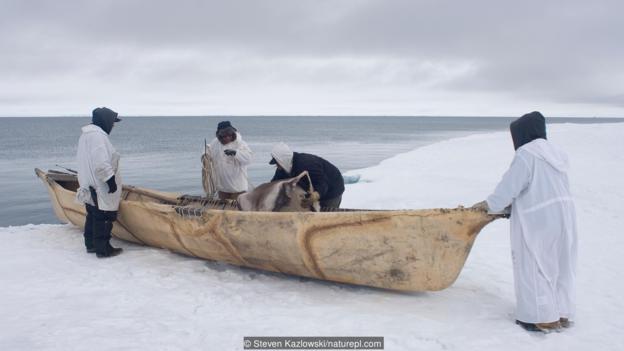
Whaling crew preparing to head out.
Alaskans hunt bowheads twice a year, in spring and fall, going out in the same sealskin boats they have used for centuries. The hunt is part of the rhythm of the seasons. It gives meaning to people’s lives, and food to last them through lean winters.
In order to take the bowheads, whaling crews need to live, camp and hunt by the shore. That means permanent settlement on the coast. Bowheads regularly swim close to shore ice, a behaviour many here describe as whales “giving themselves” in tribute.
But as the ice diminishes, it becomes harder to get those whales before they move to open water. Worse, once hunters snag a whale, pulling it ashore becomes even more challenging when there is no ice to go out on.
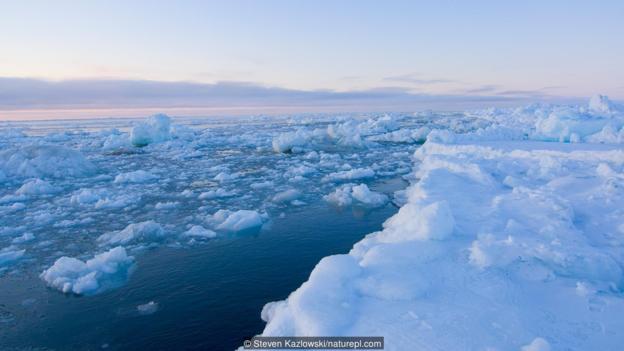
Melting Arctic sea ice.
Ironically, the breakup of the ice might actually be good for bowheads, according to a 2015 study by George and his colleagues. The retreating ice allows more light to penetrate the ocean, which means more plankton and crustaceans for the whales to eat.
In theory, this could mean the community can safely harvest more whales – but not if the retreating ice and eroding land prevents them from reaching the animals.
Alternatively, once the sea ice is gone the whales could leave the area altogether. If they do, it could have an even worse impact than the most severe climate change. After all, what is a whaling community without whales?
Read the full article here.
 Organikos