
Nature Conservancy biologist Sophie Parker in the Glendale Narrows section of the Lost Angeles River. Source: Yale E360
It might be hard to believe, but at one point in time the Los Angeles River was characterized by perennial and seasonal wetland, seeps, springs, swamps, riparian forests, and mud and alkali flats. Starting in 1938 and until 1960, however, the river underwent a radical transformation, as it was enclosed by a concrete straitjacket for 51 miles to funnel the water through a channel that prevents flooding.
In its natural state [the L.A. River] was often little more than a trickle for nine months of the year. During the rainy season, however, the small, braided stream would turn into a powerful, churning river. It behaved like a dropped firehose, wildly lashing the Los Angeles valley, scouring gravel and soil across a seven-mile-wide floodplain, and carving a new course with every deluge. When the waters receded, a mosaic of fertile marshes, ponds, and other wetlands remained.
Now the L.A. River will undergo another profound change in the near future that will release parts of the river from its man-made confines and allow for the water to transgress more naturally. The U.S. Army Corps of Engineers, in collaboration with the City of L.A. and conservation groups, completed a plan to remove three miles of concrete, enhance an 11-mile run through the Elysian Valley called the Glendale Narrows, and restore lost habitat.
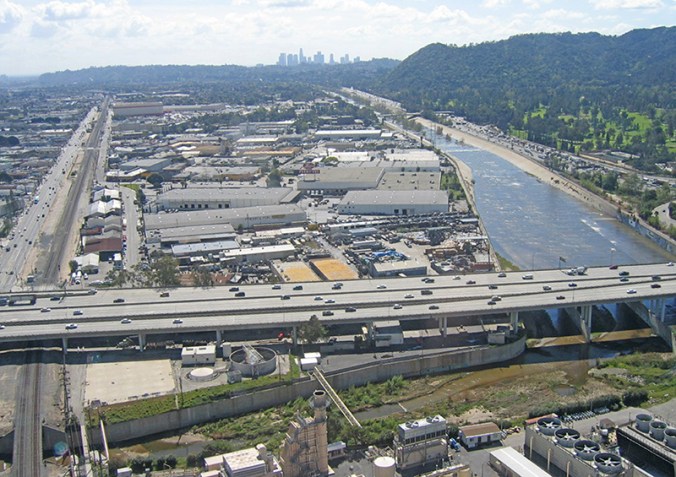
Present day view of Verdugo Wash Confluence. Source: LA Times
This will not be the original L.A. River — trying to restore some semblance of naturalness to such a waterway faces major limitations. The river is no longer connected to groundwater and can’t be until toxic waste from a number of U.S. Defense Department facilities in the region — including the Santa Susana Field Station, a former rocket engine test center — are cleaned up.
With full restoration out of the picture, a different tangle of philosophical and practical questions remain. How far do you go to create a natural environment in a city? Is it enough just to make a concrete drainage ditch prettier? How much of the project should focus on removing concrete and creating some semblance of a functioning riverine ecosystem? And in a city with an estimated 47,000 homeless people (including many who live on islands in the L.A. River), gang problems, and a range of environmental threats — from wildfires to toxic waste sites — is the expense of $100 million per river-mile a wise use of taxpayer dollars?
Los Angeles is far from the only place addressing these kinds of issues. Many urban areas in the U.S. and around the world have realized that returning at least some nature to cities is vital, whether for green infrastructure that handles storm runoff, making cities cooler with trees and green space as the climate warms, or simply because more and more people live in urban areas and increasingly want more nature in their lives.
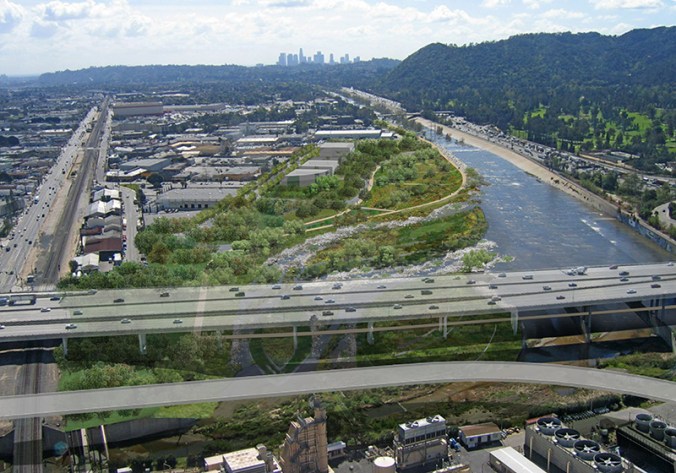
Expected view of Verdugo Wash Confluence post project transformation. Source: LA Times
“It’s a new ecosystem type,” says [Sophie Parker, a biologist with the Nature Conservancy]. “That’s why we don’t call it restoration. We call it habitat enhancement.” The Corps plan would recreate 719 acres of wetlands, remove three miles of concrete to create new riparian habitat, and re-establish a confluence with a stream called Verdugo Wash.
More than 300 species of birds still visit what’s left of the river, flying between fragments of habitat. Two endangered species, the Southwestern willow flycatcher and the least Bell’s vireo, will benefit from the removal of a towering invasive plant from Asia known as giant reed (Arundo donax). It has taken over much of the riverbanks, and birds can’t nest in it. The arundo will be replaced with native plants, including several species of willow, sedge, and wild rye.
“This is one of the places where birds can make a comeback,” says Parker. “You need a bundle of different habitats.”
No matter how the Los Angeles River is restored, thinking about the river differently and embracing its presence — rather than dismissing it as a drainage ditch — is a teachable moment for Southern California. Even a partially restored river will provide an escape from Los Angeles’ overwhelming urbanism and will perform some important ecological functions.
Read the full article here.
 Organikos