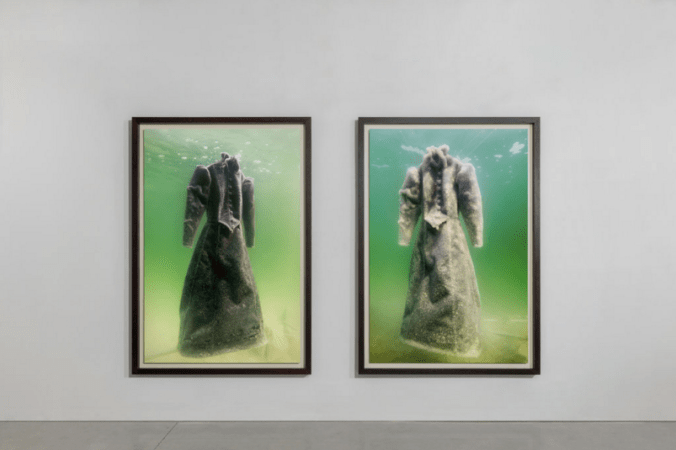
“Salt Crystal Bridal Gown III” (left) and “Salt Crystal Bridal Gown VI,” both 2014.
Courtesy of the artist and Marlborough Contemporary
It starts with a story. Written by Russian playwright S. Ansky in the early 20th century, The Dybbuk is an expressionistic drama about a young bride possessed by the malicious spirit of a dead suitor, and subsequently exorcised.
Jerusalem-born artist Sigalit Landau took inspiration from the story and her powerful connection to the Dead Sea, an otherworldly place she grew up visiting frequently with her family, and that she has incorporated into her art for years. Her “Salt Bride” installation at London’s Malborough Contemporary, enlists the work of the sea itself, in which a traditional black Hasidic gown (a replica of the costume worn by the bride in The Dybbuk, as portrayed by legendary actress Hanna Rovina) is submerged into the sea’s hypersaline waters. The salt crystals accumulated naturally over the net-like weave of the dress, left submerged over a period of 3 months, during which the process was photographed as an organic time-lapse. “Over time, the sea’s alchemy transforms the plain garment from a symbol associated with death and madness into the wedding dress it was always intended to be.”
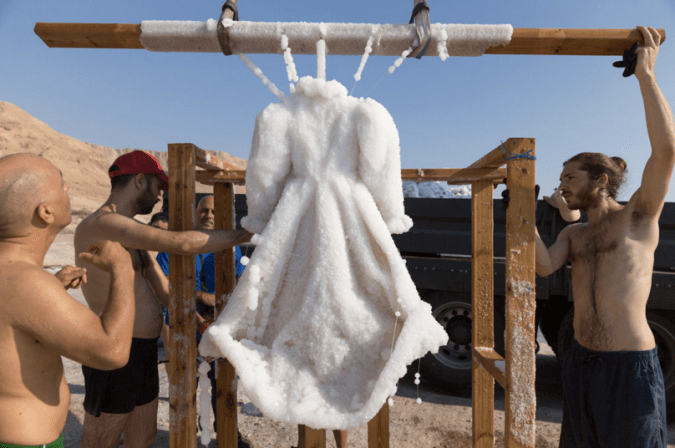
The salt added hundreds of pounds of extra weight over the course of three months.
photo credit: Matanya Tausig
The collaborative project with her partner Yotam From was extremely challenging. The dress had to be
held underwater in a structure that could support the gown as it accrued hundreds of pounds of extra weight. Landau’s partner, From, had to dive with about 150 pounds of weights strapped to his body to allow him to stabilize more than 15 feet underwater while he photographed and filmed the gown as it transformed. By the time the metamorphosis was complete, the dress itself was too heavy to lift out of the water, so fragments of it still remain there.
Life-size underwater photos charting this metamorphosis are currently on view at the Malborough Contemporary through 3 September, 2016. More photos, as well as a short video of the process can be viewed via the New York Times.
 Organikos