We are all used to looking at guidebooks to learn more about a country before we visit – but how often do we stop and think about the things we can’t see there anymore? We’ve created Unknown Tourism, a series of vintage-style travel posters to commemorate some of the wonderful creatures we’ve lost, and are in danger of forgetting.
We try to be glass half full, so we will wait and see where this campaign (click the banner above) is going. I am drawn to anything that raises awareness of the need for conservation. It helps that the illustrations are evocative. Bravo to Expedia UK for thinking outside the box and making it look good.
But a travel company highlighting extinction to encourage travel is certainly going to strike some as problematic. Even there, I say bravo to them for taking a step in an unusual direction, and I hope it leads somewhere meaningful (as opposed to just attractively intriguing).
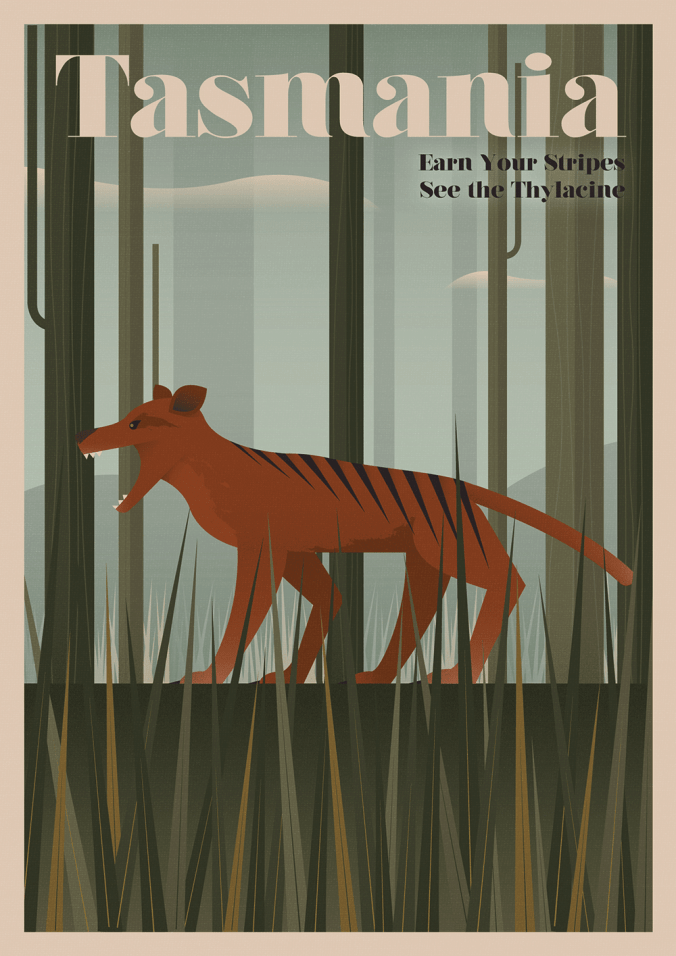
Tasmania: The Thylacine
The Thylacine will be well known to antipodeans, as it has long been the symbol of the island of Tasmania, featuring on their coat of arms, number plate, and as the official mascot of the cricket team. Able to extend their jaw to 80 degrees, the ‘Tasmanian Tiger’ was an apex predator of the Australasian continent until it was hunted to extinction in 1936.
This one is my personal favorite of those so far. I hope there will be more.
I was drawn to this by a short item in the Guardian by Cynthia Nzeh about the origins of this initiative, and hope she will keep us posted on the evolution and (hopefully emergent) mission of this campaign:
When travelling in New Zealand, Matt Lindley, a London-based marketeer, started thinking about the flightless moa bird, which was endemic there until it became extinct around 1300AD. This gave him the idea for the series Unknown Tourism, which commemorates lost wildlife with vintage-style posters inspired by 30s to 50s air travel ads. The project, commissioned by the travel site Expedia UK and illustrated by Jon Barmby, includes the dodo as well as bringing to light the unfamiliar galliwasp. “Hopefully these posters are a fun, visual way to convey that information to a lot of people,” says Lindley. “We felt many of these animals weren’t getting the attention they deserved, so this was a way of paying tribute to them.”
 Organikos