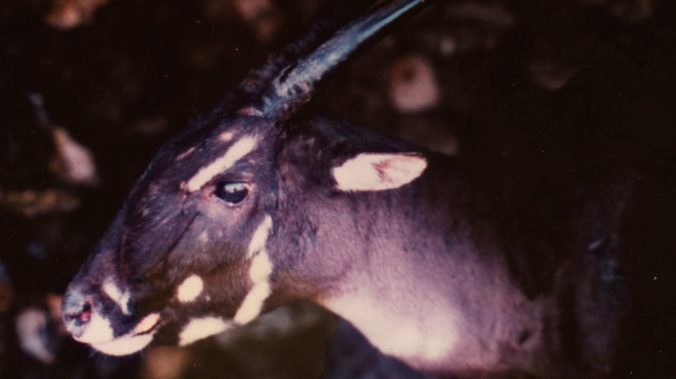
Saola. Photo © Bill Robichaud
Still so much to learn, and sometimes it seems like there is so little time to do so:
The Largest Mammal That No Scientist Has Ever Seen in the Wild
BY MATT MILLER
The saola is the largest terrestrial mammal never seen alive in the wild by a biologist. This is not a Bigfoot story. The saola undeniably exists. It roams only in the Annamite Mountains of Laos and Vietnam.
Biologists know very little about the saola. But one thing is clear: They are in big trouble. A poaching crisis in the Annamite Mountains is hammering wildlife, and a rare species like saola stands little chance in a landscape literally covered in snares.
But how do conservationists protect a species that scientists have not even seen in its native habitat? The challenge is monumental. It is, essentially, trying to save a unicorn.
The Remarkable Story of the Saola
Bill Robichaud, is one of the world’s experts on saola. At a lecture he gave at Zoo Boise – a funder of saola conservation – he began by attesting that being a saola expert should come with a bit of qualification.
“This could be a short talk,” he said. “We do not know much. There are no dumb questions when it comes to saola.”
But what is known is astonishing enough. In 1992, a joint biological expedition by the Vietnam Ministry of Forestry and the World Wide Fund for Nature conducted a survey in the Annamite Mountains, a global biodiversity hotspot. When a biologist visited a local village to pick up vegetables, he noticed horns hanging in a hunter’s house of an animal he didn’t recognize.
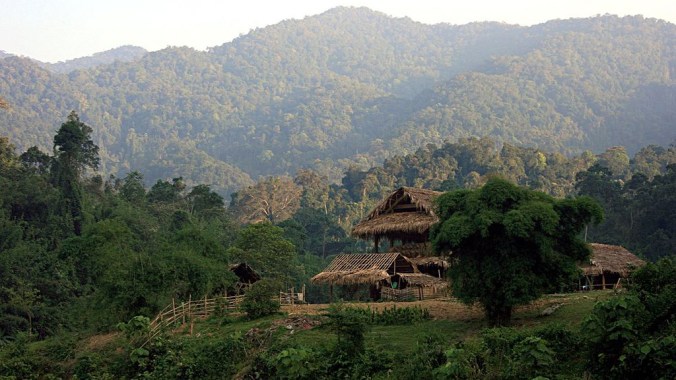
It proved not only to be a new species but a new genus. While it looks superficially like an antelope or perhaps a wild ox, there really are no comparisons. “This is not like a new species of deer or new species of wild goat. The saola was something entirely new,” says Robichaud, who works for the organization Global Wildlife Conservation and now heads the IUCN’s Saola Working Group.
The Annamite Mountains proved to be a biological treasure trove, with other major wildlife discoveries including the bare-faced bulbul, large-antlered muntjac and Annamite striped rabbit. “The saola is the most spectacular chapter of what is a remarkable story,” says Robichaud.
And the saola chapter has continued. They have since been documented on camera traps. One has been seen alive by outside biologists, but it was captured by a hunter and confined to a general’s menagerie. Robichaud, who has now made significant expeditions to the Annamites, was able to spend time with that animal, but unfortunately it died after only 18 days in captivity…
 Organikos