
Agronomist Caterina Luppa watches black soldier flies reproduce at Bugslife, a firm in Perugia, Italy, that is turning fly larvae into animal feed. LUIGI AVANTAGGIATO
We have featured this subject a few times over the years, especially once we started showcasing one such product. I acknowledge I am still not a total convert to an insect-centric diet, but every story like this draws me in, however slowly:
Edible Insects: In Europe, a Growing Push for Bug-Based Food
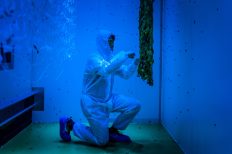
Marco Meneguz, an entomologist with BEF Biosystems in Casalnoceto, monitors black soldier flies as they mate. During mating, “the males gather in a courtship ritual characterized by fights and competitive displays,” he says. The blue light helps the flies see each other better. LUIGI AVANTAGGIATO
To rein in emissions, the E.U. is looking to insects as an alternate source of protein for livestock and people and is easing regulations and subsidizing makers of insect-derived food. In a photo essay, Luigi Avantaggiato explores the emerging bug food industry in northern Italy.
The European Union recognizes it has a meat problem. The bloc has no easy way to curb the climate impact of its livestock, which eat soybeans grown on deforested lands and belch heat-trapping gas. According to one estimate, Europe’s farm animals have a bigger carbon footprint than its cars.
Trent Barber, a technician at BEF Biosystems, vacuums up 200 pounds of fly larvae that are plump after two weeks of feeding on food scraps. The remaining food waste, now rich in excrement, will be sold as compost to farms. LUIGI AVANTAGGIATO
In this photo essay, Luigi Avantaggiato explores an unusual solution to this dilemma that is now gaining traction — feeding insects to livestock and, potentially, people. The European Commission says that insects could replace soy-based animal feed, helping to slow deforestation, or even supply an alternate source of protein for humans. Studies show that insects can furnish the same amount of protein as livestock while using as little as 10 percent of the land and producing as little as 1 percent of the emissions.
In 2021, the E.U. approved feeding insect protein to chickens and pigs, a practice already allowed for farmed fish. And it has since cleared the way for selling yellow mealworms, lesser mealworms, migratory locusts, and house crickets to humans, either to be eaten whole or reduced to protein for pasta, cereal bars, and other foods.
As regulatory hurdles fall, dozens of startups in Europe, some supported by E.U. grants, are betting on a growing market for edible insects. By 2030, their trade group claims, European companies will be churning out 1 million tons of insect-based animal feed yearly, and 390 million Europeans will be munching on some form of bug-based fare.
In these photos, Avantaggiato provides a look inside the nascent bug food industry in Northern Italy, focusing on efforts to raise house crickets and soldier flies and research into how livestock manage on insect-based food. Bugs have long been a staple of human diets in parts of Asia and Africa, Avantaggiato says. Now, in the West, “the role of insects is changing, and bugs have been invested with new potential.”…

See all the photos here.
 Organikos