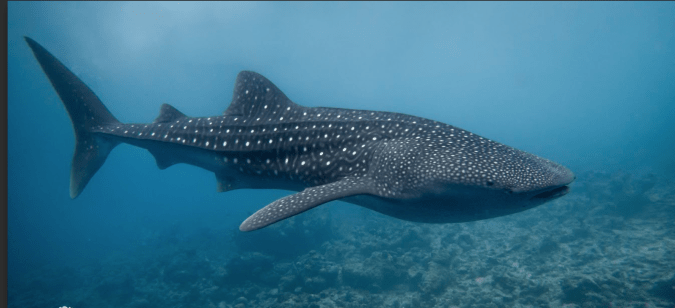
Photo credit: Maldives Whale Shark Research Programme (MWSRP).
In honor of International Whale Shark Day, which is August 30…
I have posted previously about whale shark encounter tourism and its role in conservation of this enigmatic species. I recently had an opportunity to experience this personally via a 10-day volunteer gig with the Maldives Whale Shark Research Programme (MWSRP). Established in 2006, MWSRP undertakes research and monitoring of whale sharks and other marine megafauna in the Maldives and uses the associated findings and data to advocate for sound conservation policy in the country.
Throughout the year, the MWSRP team, together with volunteers, undertakes patrols along the reef in the South Ari Atoll Marine Protected Area and other locations in the Maldives to record sightings of whale sharks and other marine megafauna and to gather data on vessel traffic and behavior. Whale shark encounters are documented via photos and video along with data on location, behavior, and ocean conditions. Encounters are entered into the “BIG FISH network” database, an online citizen science platform developed by MWSRP as a monitoring network for awareness raising and stewardship of whale sharks in Maldives. Photos and video of manta rays are submitted to Manta Trust, a MWSRP partner which maintains a similar database on this other iconic species.
To date, MWSRP has identified more than 725 individual whale sharks in the Maldives, documenting over 8000 encounters. Their research has helped immensely in increasing understanding of whale shark biology and behavior and has contributed to a number of journal articles. They have found that the vast majority of individuals encountered are adolescent males who maintain a high degree of site fidelity for several years but are then not seen again once they reach a length of 8 meters (corresponding with sexual maturity). This suggests that South Ari Atoll serves as an important “secondary nursery” for whale sharks that have grown beyond their juvenile stage. It is believed that the sharks feed in the deep waters outside the reef and then use the warm surface water along or on top of the reef for thermoregulation.
In addition to its research and monitoring activity, the MWSRP team also undertakes community outreach and education about the marine environment and its ecological, economic and social contributions, delivering lectures at schools, community centers and tourist resorts. Many of the volunteers who join MWSRP expeditions come from local communities.
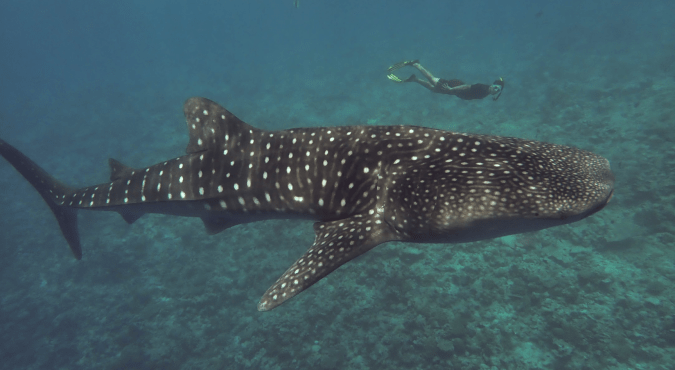
Photo credit: Maldives Whale Shark Research Programme (MWSRP).
During my stay we undertook daily surveys in the South Ari Marine Protected Area which was established in 2009 and is the largest MPA in the country. Surveys involved cruising along the reef from 9am to 4pm and recording sitings of marine megafauna as well as vessel traffic. The resident whale sharks proved to be elusive, but we did see numerous turtles, two species of dolphins, and a number of manta rays. It was disappointing to see how many vessels ignored the 10-knot speed limit in place within the MPA, further evidenced by the large number of resident whale sharks with scars from boat or propeller strikes. I was doubly disappointed to learn that foreign-owned liveaboard dive boats are among the biggest offenders; another stain on this segment of the dive tourism industry which is already criticized for its limited contributions to local economies, as compared to land-based dive operations. I believe it is incumbent on divers to put pressure on liveaboard operators to be more conscious of their impact.
On a more positive note, I learned that many tour operators are regularly contributing to the BIG FISH Network database and have been the source of many new whale shark IDs. Some are even abiding by a voluntary code of conduct for megafauna encounters developed by MWSRP in consultation with the country’s environmental ministry. Most notably, this code of conduct includes a pledge not to join ongoing encounters in order to avoid the all-too-frequent scenario of up to a dozen vessels and fifty or more snorkelers “mobbing” a single whale shark, causing it to stop feeding or to dive before it has finished thermoregulating.
Another discouraged activity is “light pooling”, wherein tour vessels shine bright flood lights for several hours at night in order to give their clients a chance to swim with the whale sharks and manta rays that are attracted by the lights. Once again, liveaboard dive boats are among the biggest offenders. The impact of this practice on whale sharks is unclear, but there is some evidence that it disrupts their normal feeding behavior. As such, MWSRP and other conservation groups have advocated for a precautionary approach involving limiting, if not banning, the practice.
The environmental ministry seems to agree and is reportedly expected to restrict or ban light pooling, at least within MPAs. They are also expected to enshrine many of the rules included in MWSRP’s code of conduct into official regulations. In addition, they have announced that they will be posting a team of rangers to the South Ari Atoll MPA in December. The MWSRP team has already provided training to the designated rangers and expects to undertake joint research and monitoring once they are in place.
Let’s hope that these measures will help to enhance the sustainability of whale shark encounter tourism in the area along with its important contributions to the local economy.
 Organikos