Green Backlash

My course load this semester throws some very interesting subject matter my way. In one of my classes, Marketing Research for Decision-Makers, the professor was asking the class to brainstorm a specific hospitality-related topic to research. The professor said that last year the class had looked into sustainable hospitality, and in passing, he mentioned that he and a colleague had put together a report on the class’s findings.

The report, titled Reversing the Green Backlash: Why Large Hospitality Companies Should Welcome “Credibly Green” Competitors, was written by Michael Giebelhausen and Helen Chun. It addressed a very interesting issue: how consumers would view a company if it introduced green initiatives. One of the steps consisted of in-depth interviews in order get people’s opinions on such initiatives. Results showed that interviewees distrusted company motivations for implementing sustainability programs. That is, the interviewees doubted that companies actually cared about the environment; they assumed they were instead implementing green practices for the marketing appeal and cost savings.

Greenwashing, the use of deceptive marketing to promote a company's sustainability, has exploded among hospitality firms.

Continue reading

A Brief Overview of Sustainable Guestroom Attributes

A recent article from the Cornell Hospitality Quarterly, titled “Hotel Guests’ Preferences for Green Guestroom Attributes,” caught my eye just a couple days ago. Written by Michelle Millar and Seyhmus Baloglu of the University of San Francisco and the University of Las Vegas, respectively (both institutions have well established programs in hospitality), the study analyzed a set of hotel room amenities/features and attempted to find out which ones guests thought were the most important. I was especially interested in this study—among the many studies on guestroom attributes—because I have some pretty strong opinions about the best things that hotels can do in their guestrooms to enhance sustainability.

Respondents ranked sustainable shampoo amenities among the most important attributes. Refillable shampoo dispensers, shown above, are widely used in cruise ships but have not yet gained traction in the majority of American hotels.

Continue reading

Carbon Emissions Series: Vacationers’ Diets

The hospitality industry is, by nature, one that encourages indulgence. I have seen this mindset manifested through many examples: travelers insisting on using a new towel every day, taking more than they can possibly eat at buffet lines, and drinking ungodly amounts of alcohol at hotel and restaurant bars. Today, tourists excuse themselves from their diets—and some, their environmental principles—when they go on vacation. They expect opulence and excess (a quick look at Las Vegas will confirm all of this). Firms that strive for sustainability are therefore in a hard spot, as they must meet the expectations of guests while providing products and services that do not degrade the environment.

This crude energy pyramid shows that only approximately 10% of energy is transferred between upward steps in the food chain. The higher up you eat, the more energy your diet requires.

I thought it appropriate to look at this paradox more in depth by explaining the findings of an interesting report that the Environmental Working Group (EWG) released recently. Titled Meat Eater’s Guide to Climate Change and Health, this study conducts life cycle analyses

Continue reading

Valuating Rainforest Ecotourism in Costa Rica

In my last post, I claimed that only a small number of studies have been done on valuating eco-tourism as an ecosystem service. I was wrong. After some more digging around, I’ve discovered that a fair number of studies address this topic, though only a small number of studies actually evaluate specific regions of the world. One of the most interesting reports I stumbled upon was from the Journal of Environmental Management. In 1998, Susan Menkhaus and Douglas Lober, two researchers from Duke University, published a paper that focused on Costa Rican rainforests and their ecotourism value. If you’d like to read the whole thing, it’s titled “International Ecotourism and the Valuation of Tropical Rainforests in Costa Rica.

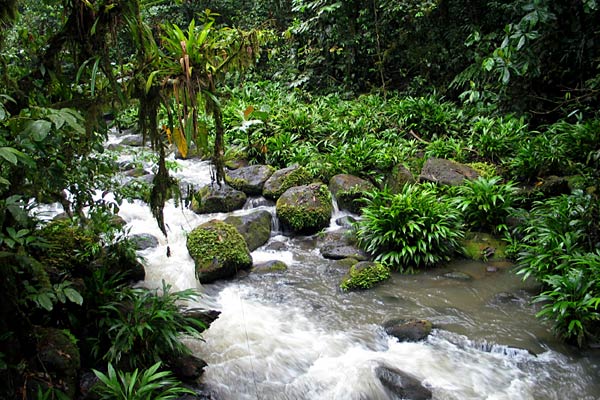
Rainforests provide dozens of ecosystem services. In Costa Rica, they serve the booming eco-tourism industry.

By way of background, Costa Rica is a textbook example of effective management of natural resources, tourism, and integrated public policy. It is widely recognized as the greenest country in the world, and it remains the most visited Central American country. Covering less than 0.05% of Earth’s landmass, Costa Rica contains a whopping 5% of the world’s biodiversity, has 12 different life zones, and boasts one of the highest land protection rates in the world. Nearly half of the tourists that come to Costa Rica engage in some sort of eco-tourism activities. Needless to say, Costa Rica is the best nation to take as an example for this study, which attempts to quantify the value of Costa Rica’s rainforests from a tourism standpoint. Keep in mind, however, that the authors only sought to calculate the eco-tourism value of the rainforests—not anything else related to the forests’ medicinal, timber, or biodiversity value. Continue reading

Ecotourism as an Ecosystem Service

A good friend of mine has been working on developing a curriculum for sustainability lessons in Utica, and she asked me just a couple days ago for some help with the topic of ecosystem services. I thought it strange that she came to me (a hotelie, no less) for help on such a scientific topic, and I had to admit to her that my knowledge of the topic was shallow. Nonetheless, I pointed her to the UN’s 2005 Millennium Ecosystem Assessment (MA), the four-year study that is considered by the environmentalist community as the go-to resource on ecosystem services. I had skimmed the hefty 155-page synthesis report a few months earlier—I’d only initially did it because Eric Ricaurte, my research adviser, had recommended it to me—and I didn’t remember much from it. So after recommending the MA, I decided to read through some sections of it again.

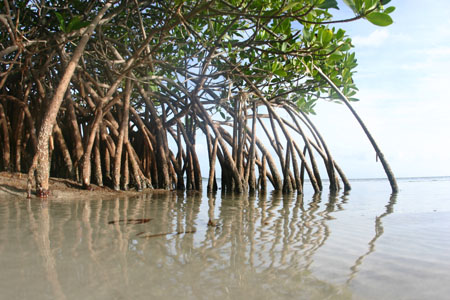
Mangroves are a recognized source of ecosystem services. They buffer against storms, prevent erosion, and filter out toxins.

By way of background, ecosystem services are resources and processes that the natural environment provides for us. For example, trees provide oxygen for us to breathe, fish in the ocean serve as food, and earthworms help decompose our waste. But what caught my eye immediately from the Millennium Ecosystem Assessment was how it recognized ecotourism and recreation as important ecosystem services for humans. I couldn’t help but smile: while attempting to preserve their surrounding environments, eco-resorts around the world are also drawing upon this valuable ecosystem service by deriving revenue from it. Continue reading

Carbon Emissions Series: Air Travel Efficiency

One of the more interesting responsibilities of my current internship here in DC is to peruse news articles and company/NGO reports that relate to corporate social responsibility. Last week, one particular report caught my eye because of its relevance to travel and tourism. Brighter Planet, a sustainability research and reporting company, recently published a white paper on airline efficiency. The paper, titled “Air Travel: Carbon and Energy Efficiency,” struck me as ironic. Air travel is a highly emissions-intensive mode of transportation and seemingly incompatible with sustainability. It accounts for 2% of global greenhouse gas emissions, a large number for a single industry.

Brighter Planet’s report, however, did not seek to justify flying. It instead analyzed a decade’s worth of data on a host of fuel consumption metrics on all major airlines. What the research found was intriguing and useful. The efficiency of a flight that you take is influenced by countless factors, but there are five main “efficiency drivers” that most significantly impact the GHG emissions of a flight: aircraft model, seat density, load factor, freight share, and distance. I’ll do my best to explain each of these briefly. Continue reading