Healthy Hybrids In Vivid Living Color

Kalettes, BrusselKale, Lollipop Kale and Flower Sprout: This little vegetable, a cross of kale and Brussels sprouts, goes by a lot of names. Rain Rabbit/Flickr

Kalettes, BrusselKale, Lollipop Kale and Flower Sprout: This little vegetable, a cross of kale and Brussels sprouts, goes by a lot of names. Rain Rabbit/Flickr

Our farm to table program in support of 51‘s Malabar Soul Food menu, in which Kayal Villa‘s acreage is serving double duty as beautiful and bountiful, is in full swing, so National Public Radio (USA)’s story here catches our attention:

Does a cross between Brussels sprouts and kale sounds like your vegetable dream come true? Maybe so, if you’re someone who’s crazy for cruciferous vegetables and all the fiber and nutrients they pack in.

Meet Kalettes, a hybrid of the two that looks like a small head of purple kale. It arrived in U.S. supermarkets like Trader Joe’s and Whole Foods this fall, and is being marketed as “a fresh fusion of sweet and nutty.” Continue reading
From Our Amazing Planet

Twilley-Truffle-690

PHOTOGRAPH BY TIMOTHY A. CLARY / AFP / GETTY

In other news:

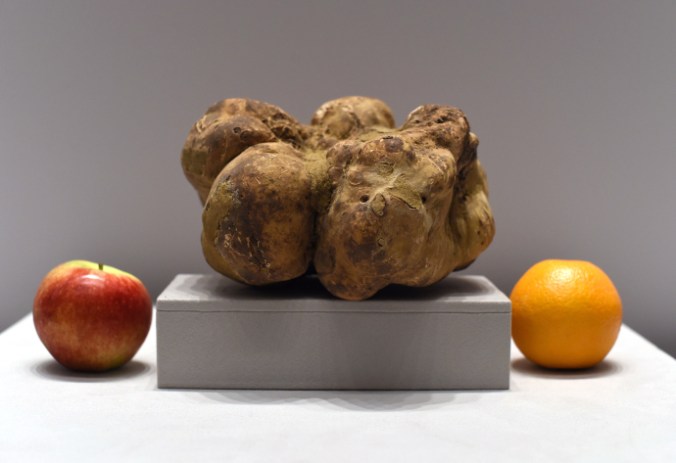
A few minutes after 9 A.M. on Saturday morning, at Sotheby’s, on the Upper East Side of Manhattan, a small group of people huddled around a knobbly, dirt-smudged tuber sitting on a white china cake stand. Federico Balestra, the C.E.O. of the North American branch of his family’s company, Sabatino Tartufi, put on a pair of white gloves, squeezed past a rack of oil paintings, and rotated the tuber a few degrees—“for showing its good side” to the in-house photographer, Balestra said. “To be honest, we really didn’t know what to expect,” Dan Abernethy, a Sotheby’s representative, said apologetically. It was the auction house’s first experience with selling a truffle. Continue reading

Who’s Got Your Back, Long Term?

Stewartjp-mediumThreeByTwo210We read both publications regularly, and find that both cover environmental issues well, as such; but the difference between this New York Times article and the New Yorker post we started the day with speaks for itself. We understand the purpose of the article below meeting current needs, but do we really need our news to be so parochial? Sorry, Times. You will have to work harder for your subscription money.

Steep Slide in Oil Prices Is Blessing for Most

If history is any guide, it’s hard to see falling oil prices as anything but good news for everyone whose fortunes aren’t tied to oil.

Gifts That Give Back, Often In More Ways Than One

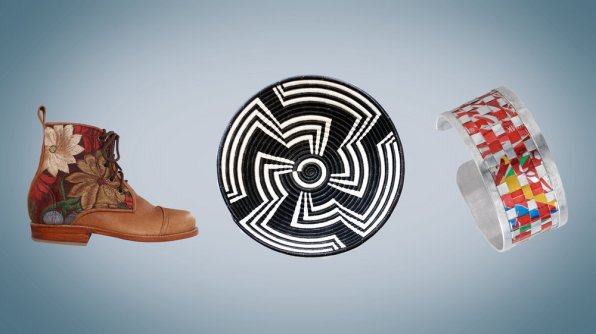
Each item, including boots from Guatemala, a basket from Rwanda and a soda can cuff from Kenya, are handmade. And when people buy these gifts, the profits go back to the artisans and their community. Courtesy of Teysha; Indego Africa; Serrv

Each item, including boots from Guatemala, a basket from Rwanda and a soda can cuff from Kenya, are handmade. And when people buy these gifts, the profits go back to the artisans and their community. Courtesy of Teysha; Indego Africa; Serrv

Thanks to National Public Radio (USA) for this coverage of artisanal products that use materials that might otherwise be called waste, all of which channel resources to where they are most needed, a topic we never tire of reading about:

After you’ve seized all the deals on Black Friday, Small Business Saturday and Cyber Monday, it’s giveback time.

Today is Giving Tuesday, the day that asks people to donate to a good cause. This online campaign was created three years ago by the 92nd Street Y, a cultural and community center in New York, with the support of a slew of partners, including entrepreneurs, philanthropists and the United Nations. The idea is that you can kick off the holiday season by donating your money or time. At least $32.3 million was donated on Giving Tuesday 2013, according to a survey by the trade publication NonProfit Times.

But if you’re still in an acquisitive mood, there are ways to shop altruistically. There are nonprofits and even companies that sell handmade products whose profits go back to artisans and toward community projects in poorer countries. Continue reading

An Art Brand, A Big Bubble

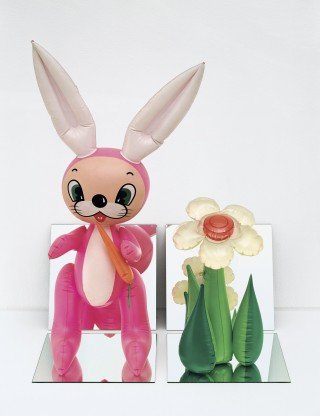
Koons’s “Inflatable Flower and Bunny (Tall White, Pink Bunny),” 1979. BROAD ART FOUNDATION, SANTA MONICA

Koons’s “Inflatable Flower and Bunny (Tall White, Pink Bunny),” 1979. BROAD ART FOUNDATION, SANTA MONICA

Because we are not experts in any sense of the subject, contemporary art is only rarely a topic of interest on this blog. But as readers of media far and wide related to the cultures we operate in, we cannot help noticing what experts say about it. We have once or twice linked out to articles that reflect our concern about the overwhelming sense of art and commerce overlapping more than seems right. Jeff Koons, on show in Paris currently, offers an other prime example of our concern.  A review of the New York retrospective of Koons earlier this year had this respectful insight:

…Koons’s smiley mien and a line of patter that is part huckster and part self-esteem guru—“Everybody’s cultural history is perfect”—call to mind Degas’s remark to Whistler: “You behave as though you had no talent.” But Koons has no end of talent and, within his range, mastery, marked by an obsessive perfectionism, and wound tightly around some core emotion, perhaps rage, which impels and concentrates his ambition. It’s really the quality of his work, interlocking with economic and social trends, that makes him the signal artist of today’s world. If you don’t like that, take it up with the world… Continue reading

Illegal Wildlife Trade, Quantified

9f71b8b7-4c32-4afe-86e7-2d27c9f6b728-620x372

Photograph: James Morgan/WWF/AFP/Getty Images

The Guardian’s coverage of one of our least favorite but critically important topics is appreciated, as always:

Continue reading

Around The World Of Coffee In One Hour

Screen Shot 2014-11-18 at 11.47.40 AM

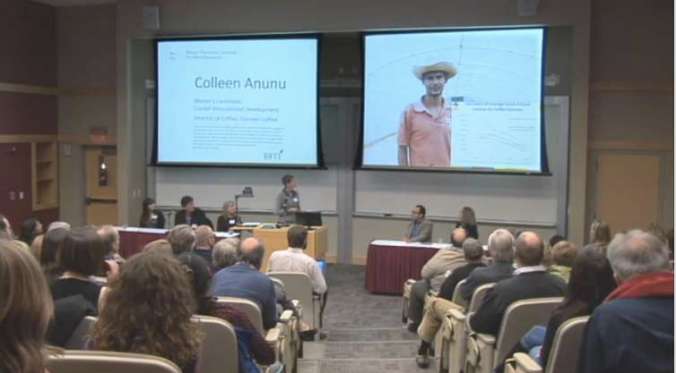
Click the image above, or title below, to go to the video:

Coffee: From Gene to Bean to Global Scene

Six researchers from the Boyce Thompson Institute for Plant Research, Cornell University’s Lab of Ornithology, Dyson School of Applied Economics and Management, School of Hotel Administration, and College of Agriculture and Life Sciences investigate the culture of coffee, including: consumer tastes and choices, the social impact of development and production, the ecological impacts of coffee farms, and how the plant’s genome sequence can provide insight into this popular beverage.

Redefining Benefits And Welfare, With Fresh Fruits And Vegetables

These wooden tokens are handed out to shoppers who use SNAP benefits to purchase fresh produce at the Crossroads Farmers Market near Takoma Park, Md. Customers receive tokens worth twice the amount of money withdrawn from their SNAP benefits card — in other words, they get "double bucks." Dan Charles/NPR

These wooden tokens are handed out to shoppers who use SNAP benefits to purchase fresh produce at the Crossroads Farmers Market near Takoma Park, Md. Customers receive tokens worth twice the amount of money withdrawn from their SNAP benefits card — in other words, they get “double bucks.” Dan Charles/NPR

Thanks to the salt, a food-specialized segment on National Public Radio (USA), for this story of one country’s expanding definition and innovative rethinking of welfare, and of the various benefits associated with welfare:

The federal government is about to put $100 million behind a simple idea: doubling the value of SNAP benefits — what used to be called food stamps — when people use them to buy local fruits and vegetables.

This idea did not start on Capitol Hill. It began as a local innovation at a few farmers’ markets. But it proved remarkably popular and spread across the country.

“It’s so simple, but it has such profound effects both for SNAP recipients and for local farmers,” says Mike Appell, a vegetable farmer who sells his produce at a market in Tulsa, Okla.

The idea first surfaced in 2005 among workers at the New York City Department of Health and Mental Hygiene. They were starting a campaign to get people to eat more fresh produce. Continue reading

Amazon, Thinking Of Our Future

LINES ARE DRAWN A battle over pricing may have been the Sarajevo moment. But the war is really about the future of publishing—and maybe of culture.

LINES ARE DRAWN A battle over pricing may have been the Sarajevo moment. But the war is really about the future of publishing—and maybe of culture.

I never tire of “think pieces” on Amazon because it is about our cultural future:

The War of the Words

Amazon’s war with publishing giant Hachette over e-book pricing has earned it a black eye in the media, with the likes of Philip Roth, James Patterson, and Stephen Colbert demanding that the online mega-store stand down. How did Amazon—which was once seen as the book industry’s savior—end up as Literary Enemy Number One? And how much of this fight is even about money? Keith Gessen reports.

By Keith Gessen  Photo Illustrations by Stephen Doyle Continue reading

Be Careful What You Wish For

You can’t always get what you want. Sometimes you can, but the law of unintended consequences never ceases to surprise us. Thanks to this week’s Science section of the New York Times for a marine/culinary example:

A New Bounty of Oysters in Maryland, but There Is a Snag

Recent changes to state policy and a growing national affection for the shellfish have led to an oyster farming boom that is hampering the traditional fishing ways of the watermen.

Bravo To Our Friends At EARTH, Thanks To Our Friends At Whole Foods

141029Bananas-300x194

Bananas from EARTH University are available at over 400 Whole Foods locations in Canada and the U.S. (Courtesy of EARTH University)

The Tico Times, in Costa Rica, reports on the the growth of sustainably grown banana cultivation, and their distribution in North America:

The supermarket chain’s new “Responsibly Grown” produce rating system was launched earlier in October and divides fruits, flowers and vegetables into three categories: Good, Better and Best, based on suppliers’ farming practices.

Continue reading

End The Exotic Pet Trade

31salamander-1-thumbStandard

Thanks to the New York Times‘ weekly Science section for a reminder of all the reasons why wild animals should not be traded as pets across regions of the world:

Infection That Devastates Amphibians, Already in Europe, Could Spread to U.S.

Fire-bellied newts imported from Asia through the pet trade may be spreading a fungal disease that is killing off fire salamanders in Europe, according to researchers.

Food Packaging, Counterintuitive Proposition

broccoli

Staying informed about best practices to reduce your carbon and other footprints is one of our objectives on this blog. When we see something we had not known, and which seems worthy of consideration, we pass it along here. Thanks to Professor Tyler, and Conservation, for this one:

And when can packaging actually be good for the environment?

If you’re like me, you probably get a bit annoyed when you discover that an item you bought in the grocery store uses too much packaging. It seems like such a waste of plastic and cardboard. From an environmental perspective, wouldn’t it be better to conserve resources and use less packaging material?

Not necessarily—it depends on the type of food.

Continue reading

Learning Laboratories, Museums, And Art’s Future Venues

Jon Chase/Harvard Staff Photographer. Harvard Art Museums Director Tom Lentz (from left) moderated a discussion with MoMA Director Glenn Lowry, A.M. '78, Ph.D. '82, Elizabeth Cary Agassiz Professor of the Humanities Jennifer Roberts, and Paul Ha, director, List Visual Arts Center at MIT.

Jon Chase/Harvard Staff Photographer. Harvard Art Museums Director Tom Lentz (from left) moderated a discussion with MoMA Director Glenn Lowry, A.M. ’78, Ph.D. ’82, Elizabeth Cary Agassiz Professor of the Humanities Jennifer Roberts, and Paul Ha, director, List Visual Arts Center at MIT.

Thanks to the Harvard Gazette for this story about museums functioning as inclusive, modern learning laboratories:

In the 1970s, the Italian architect Renzo Piano was a young upstart with immense talent and brazen daring. It was then, still fairly early in his career, that Piano and his partner, the architect Richard Rogers, redefined the architectural landscape with their groundbreaking Pompidou Center in Paris. Continue reading

Plastic Bags Going, Going, Gone

Marks and Spencer carrier bag

Marks and Spencer is one of the retailers that has agreed to donate the extra money from carrier bag sales to good causes in Scotland. Photograph: Stefan Rousseau/PA

Small local moves here and there add up, on occasion, to major change. We are amazed to learn of the scale of the success in the Celtic region with the program to ensure consumers and vendors share in the cost of the environmental mess that plastic bags create. Thanks to the Guardian for this coverage:

Scottish shops start charging for bags

Charge of at least 5p a carrier bag introduced in bid to emulate 70% fall in usage in Wales and Northern Ireland

Scotland is joining Wales and Northern Ireland in charging shoppers for carrier bags , in an attempt to encourage sustainable behaviour among shoppers. Last year, shoppers at Scotland’s main supermarket chains alone used 800m single-use bags, most of which end up as litter, landfill or polluting the country’s marine and natural environments.

Continue reading

Bookstores As Cultural Icons

Eckstein_books_07_Shakespeare

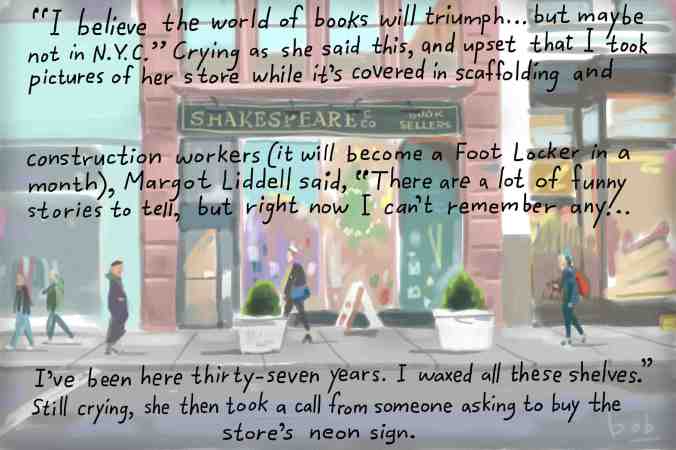
Many hope that these are not merely icons of an earlier time, but an essential asset of any culture. Click the image above to go to this exhibition on the New Yorker’s website:

The Endangered Bookstores of New York

BY

Recently, I was browsing for books at Powerhouse Arena, in Dumbo, and noticed a sign asking people not to snap photos of the books on display. What a thing to have to ask!  Continue reading

Book Covers, Storytelling, And The Mind’s Eye

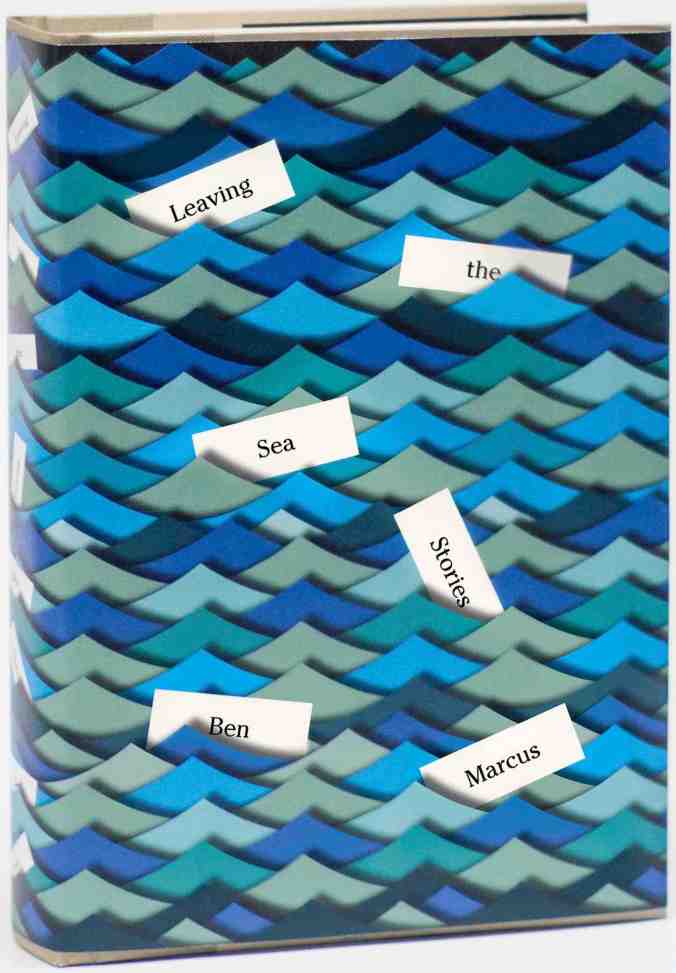
Author Ben Marcus described Peter Mendelsund's cover for his story collection Leaving the Sea as "sumptuous, playful and gorgeous to look at."

Author Ben Marcus described Peter Mendelsund’s cover for his story collection Leaving the Sea as “sumptuous, playful and gorgeous to look at.”

We are most of the time sharing stories, told by our own contributors or chosen by them from other sources, that say something relevant about community, about collaboration, and/or about conservation.  And many of us are involved day to day in hospitality that offers authentic experiences of immersion in “faraway places” relative to where the traveler comes from. We frequently share stories about books and libraries because they are the building blocks of preparation for appreciating what one finds on a long journey away from the familiar. So, this story about a book cover designer was destined to capture our attention:

Peter Mendelsund estimates he’s designed “somewhere between 600 and 1,000 book covers,” ranging from Crime and Punishment to Girl with the Dragon Tattoo. But the self-taught, sought-after designer says he spends a lot of time reading, too. Continue reading

Reducing Demand For The Irreplacable

A black dehorned rhinoceros and its calf at a Johannesburg reserve. Photograph: Stephane De Sakutin/AFP/Getty Images

A black dehorned rhinoceros and its calf at a Johannesburg reserve. Photograph: Stephane De Sakutin/AFP/Getty Images

From the “glimmer of hope” category of news, thanks to the Guardian‘s ongoing coverage of vital environmental issues, we find this story simultaneously depressing and hopeful, somehow:

Rhino horn demand in Vietnam drops by more than 33% in one year

Information campaign successfully changes minds of people who think rhino horn has medicinal value

Efforts to curb the deadly trade in rhino horn appear to be gaining traction, with a poll finding that demand for the animal part in Vietnam has dropped by more than a third over the past year.

After a year-long public information campaign in Vietnam, only 2.6% of people in the Asian country now continue to buy and use rhino horn, a decrease of 38%. Continue reading

Mind Over Matter, Consumption, And Findings From Behavioral Economics

Northern lights over a camp north of the Arctic Circle, October 2014 (Yannis Behrakis/Reuters)

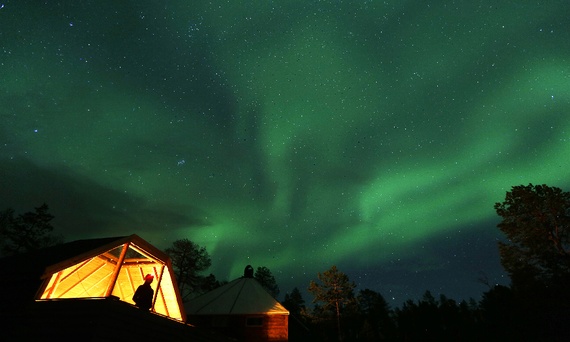
Northern lights over a camp north of the Arctic Circle, October 2014 (Yannis Behrakis/Reuters)

We may be a bit self-interested in declaring so, but this research matches what we believe from daily experience–not to say it is obvious–and so it is good to know science is helping us understand why:

Buy Experiences, Not Things

Live in anticipation, gathering stories and memories. New research builds on the vogue mantra of behavioral economics.

Forty-seven percent of the time, the average mind is wandering. It wanders about a third of the time while a person is reading, talking with other people, or taking care of children. It wanders 10 percent of the time, even, during sex. And that wandering, according to psychologist Matthew Killingsworth, is not good for well-being. A mind belongs in one place. During his training at Harvard, Killingsworth compiled those numbers and built a scientific case for every cliché about living in the moment. In a 2010 Science paper co-authored with psychology professor Daniel Gilbert, the two wrote that “a wandering mind is an unhappy mind.”

Continue reading

Watch Your Pump Jockey

shutterstock.com

shutterstock.com

Conservation‘s daily summary of an intriguing scientific finding captures our attention at least one time per week. Which is about how often, on average, some of us fill the gas tank of our vehicles. And we learn that the fuel lost during those visits can add up to massive waste. Which means, this should interest you:

First, you pull into the gas station. You open the cover to the fuel tank, unscrew the cap, insert the nozzle, and pump away. Once you’ve filled up your tank, you dislodge the nozzle and return it to its starting position. But in between – perhaps without even noticing – you spilled a few drops of gasoline onto the concrete. You were as careful as possible, and it was just a tiny bit wasted…right? A few drops here and there aren’t a big deal, are they?

Well, it might be. That’s according to new research published this week in the Journal of Contaminant Hydrology. Continue reading