Meeting with the Forest Department

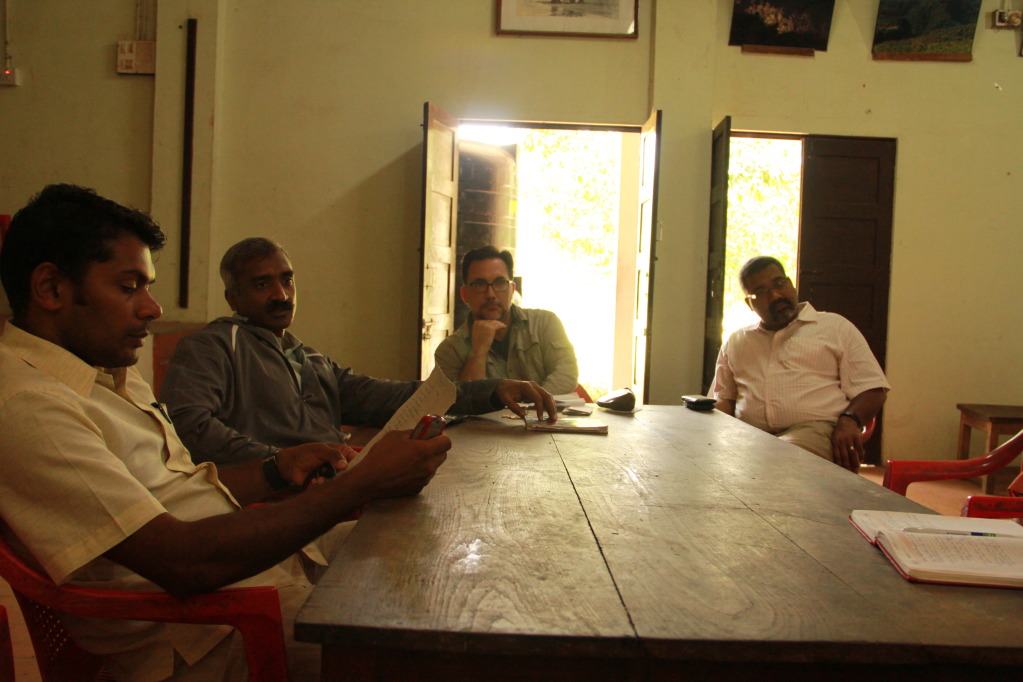
Developments in our community development initiative haven’t come easily for the past two weeks in Kumily. With our primary Forestry Dept. contact away from his office for a little more than a week, and given that the time table agreed up at our last meeting (June 26th) allowed for a ten day period during which our ‘talent scout,’ as it were, would make contact with potential producers, we at the resort were, in the meantime, left playing a bit of a waiting game. But with the distraction of staff tour revelry behind us and anticipation for the arrival of our newest intern, Sung, at a high, our idle and indolent interlude came to a happy end today when we met with several FD officials and functionaries, some of whom none of us had met previously, including a ‘Forest Guard’ (a title I hope to earn someday) who runs the protection agency focused on the tribal community.
For while we in Thekkady had been sitting on our proverbial hands, Crist and Amie had been actively ascertaining details from our sister bag-making enterprise in Kochin. Continue reading

Newspaper Bags

As I suggested in my last post, I’ve recently spent less time in the Periyar Reserve, i.e. observing and chronicling my encounters with the myriad species of plants and animals there, and more time in and with the local community. Working with resort management and Forestry Dept. officials, I’ve been trying to get off the ground a microbusiness enterprise, operated by residents of Kumily and members of the tribal communities in Periyar East, with the initial goal of producing bags from recycled newspaper. This is related to the bigger goal of eliminating the use of plastic bags.

One such bag, made from recycled newspaper

There are several aspects to this project, and as I delve deeper into them the more complex and intriguing it seems to me. I think the easiest and best way to present the full picture, to identify the difficulties and possibilities inherent to it, is to tell the whole story of my involvement in the project, and in the process to clarify the context of my previous posts.

To set the scene, I offer, in shorthand, a cultural backdrop:

What was only recently a subsistence and agricultural culture and economy, the Cardamom Hills (like all of Kerala) has undergone something of an economic and cultural revolution over the past fifteen to twenty years. Though I’m not an expert in this field, I can say, based on firsthand accounts and observations, that as education levels have risen even among the poorest people in this area (Kerala’s literacy rate is, famously, over 90%), and as the opportunity to pursue non-agricultural employment and consume newfangled products has become commonplace in this area, the demand for disposable income and new ways of attaining it has also increased. Generally, this is true of India as a whole, and as a global phenomenon it really deserves a more nuanced treatment than I’m able to give it (for more information, I suggest you go to your local library or see your neighborhood economist). But, on a microcosmic level, it is perhaps most pronounced, complicated, and—in some ways—easily tackled in the tribal communities of India’s forests. Continue reading

The Kitchen Table Connection: Following the Paper Trail

She wasn’t the creator of the newspaper bag concept, but Diwia Thomas has done her part to merge their production with the world of community development. Based on a deeply rooted desire to help women create a degree of financial independence, this lifelong resident of Cochin has used her business acumen, social network and marketing skills to advantage.

With the limited supply of paper pulp in India, newspaper printers have implemented the innovative practice of a de-inking process for recycled newsprint. Currently about a quarter of the paper the printers use is recycled material, which has both saved on paper pulp imports and driven up the price paid per kilo for old newspapers. India has a well-established history of recycling and these new developments have given more financial incentive to do so.

Diwia knows the system, her clients and her resources well. It only takes a gentle nudge to friends and family to leverage the equivalent of their daily coffee expenditures in the form of a weekly donation of their newspapers—they give them to her instead of selling them to a recycler (who would pay an amount worth a coffee at a local café). Only full, flat sheets of newspaper can be used in bag production, but with the ubiquitous use of newspaper in this culture as wrapping for everything from eggs, to vegetable market goods to crockery, there is plenty to go around for other recycling purposes. Continue reading

Newspaper Products

In the bathrooms at Morgan’s Rock, the trash cans are little green plastic bins covered in what appears to be painted wickerwork. However, closer inspection reveals that the woven material covering the bins and little caps is in fact newspaper that has been twisted into long strands and braided into shape. Despite the paint job, one can still see the letters and broken images on the baskets, and this simple artisanal craft adds a creative and rustic touch to what would otherwise be a banal bathroom fixture.

The bungalows are equipped with the above rectangular variations of newspaper bins for composting, recycling, and trash, and seeing the different colors next to each other convinces me that the unpainted version is the most attractive. Unfortunately, it is also the least common, as all the bathroom trash bins I’ve seen look like this.

I spoke to Alba, the General Manager, about the bins and asked where they were made. She answered that several towns in and around the Rivas area have handicraft shops, and that as part of community support Morgan’s Rock purchased these sorts of things for both utility and decoration. Rivas is a city and a department (sort of like a province, I think), so I will need to find out how widespread this newspaper craft actually is, because there could be an important collaboration between Nicaraguan and Indian newspaper craftspeople (Kerala in particular has been working on an utilitarian recycling over the past few years).

More Wood

The finca connected to Morgan’s Rock, part of the Agroforestal forestry business whose owners also run MR and SM, is in the process of clearing the brush covering a large swath of land where new trees will be planted. The trees are going to be more separated than in the past so that more of them can grow to full potential faster. Some of the previous plantation plots have suffered from underdevelopment as a result of too much competition between cramped trees. As a result, these confined trees grow straight up and don’t mature in width as quickly, staying thin and branching upwards to reach the sun. One of the positive effects of this growth is that the branches are very straight instead of curvy, but there is less wood. Over the years the finca has planted over 1.5 million trees for harvesting, and 100,000 for reforestation.

When I arrived at the new plot of trees, Israel, supervisor of the workers clearing the land, showed me the distance difference between saplings, marked by long wooden stakes in the ground already cleared. There would be about a meter more between each tree and row. He pointed to the plantations on our right and started saying the names of different trees interspersed in the endless rows. “Caoba Africana, roble, cedro.” African Mahogany, oak, cedar. Other semiprecious-wood trees in the plantation are teak and pochote, which is covered in stubby spines from top to bottom. Every now and then I could see a tree with a yellow line painted on it, marking it for cutting in the coming months. Israel told me that at the moment they are culling about 20% of each tree plantation to promote the growth of healthy trees and cultivate wood for Simplemente Madera. This amounts to roughly 500 trees for each plot where healthier trees are busy growing to optimum maturity. A potential project would be following one of the trees marked for culling through the steps of cutting, processing, preparing, and buying; in “The Omnivore’s Dilemma,” Michael Pollan followed a calf from youth through fattening, slaughtering, processing, and the final consumption.

Just Wood

Simplemente Madera,” which means “just wood,”  is a Nicaraguan sister company to Morgan’s Rock that primarily uses sustainable wood sources—one of them is the tree plantations at Morgan’s Rock—certified by SmartWood according to the criteria set by the Forest Stewardship Council, an international NGO that sets standards for sustainable forestry worldwide. Providing furniture and architectural services, the company helped design and furnish Morgan’s Rock, and provided most if not all of the woodwork in several Nicaraguan houses and hotels.

Collaborating with the World Wildlife Fund and International Finance Corporation, in 2005 SM worked with a Nicaraguan indigenous community to develop the inspiringly magnificent One Tree program influenced by a similar project in the UK. SM is also attempting to salvage wood felled by Hurricane Felix and provides wood and carpentry services to the eco-surfboard company Ocean Green (which now offers 15% off your surfboard if you book a stay at Morgan’s Rock).

Based on fairly thorough browsing, the SM website hasn’t been updated since 2008. Keeping the information current would help make SM a more relevant member of the online carpentry community and generate further popular publicity for Morgan’s rock.