Take Out Breakfast

This morning I joined Diwia Thomas at her proverbial kitchen table for breakfast.  After the meal Deepa arrived for a lesson in newspaper bag making.  For those with experience in origami, paper airplanes, paper boats, or paper hats, this would be a relatively easy task.  Even gift or school book wrapping experience would come in handy.  (Unfortunately very few of those skills rank highly on my CV.)  I could also see how Henry Ford’s assembly line theories could assist in this case…precision is important and that often is more easily achieved through repetitive action.
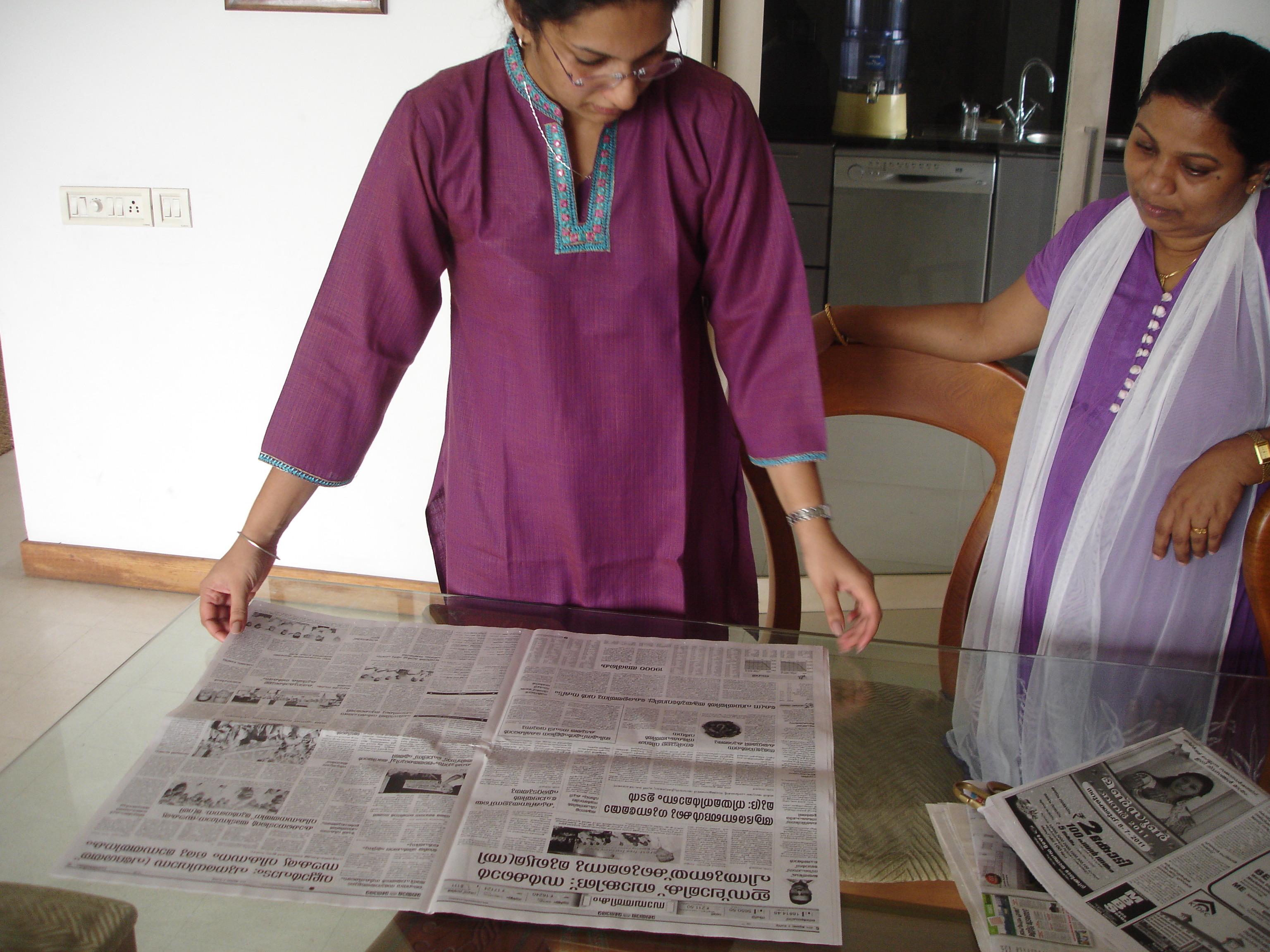
During the hands on tutorial Diwia spoke about the evolution of the bag process.  She had taken a course some years ago and then used those skills to teach others.  But like a game of telephone the process has developed, with each “generation” of folders refining the systems to work more cleanly and speedily.  Diwia commented that she stands amazed watching some of the women working so quickly in their own style with such precise results.
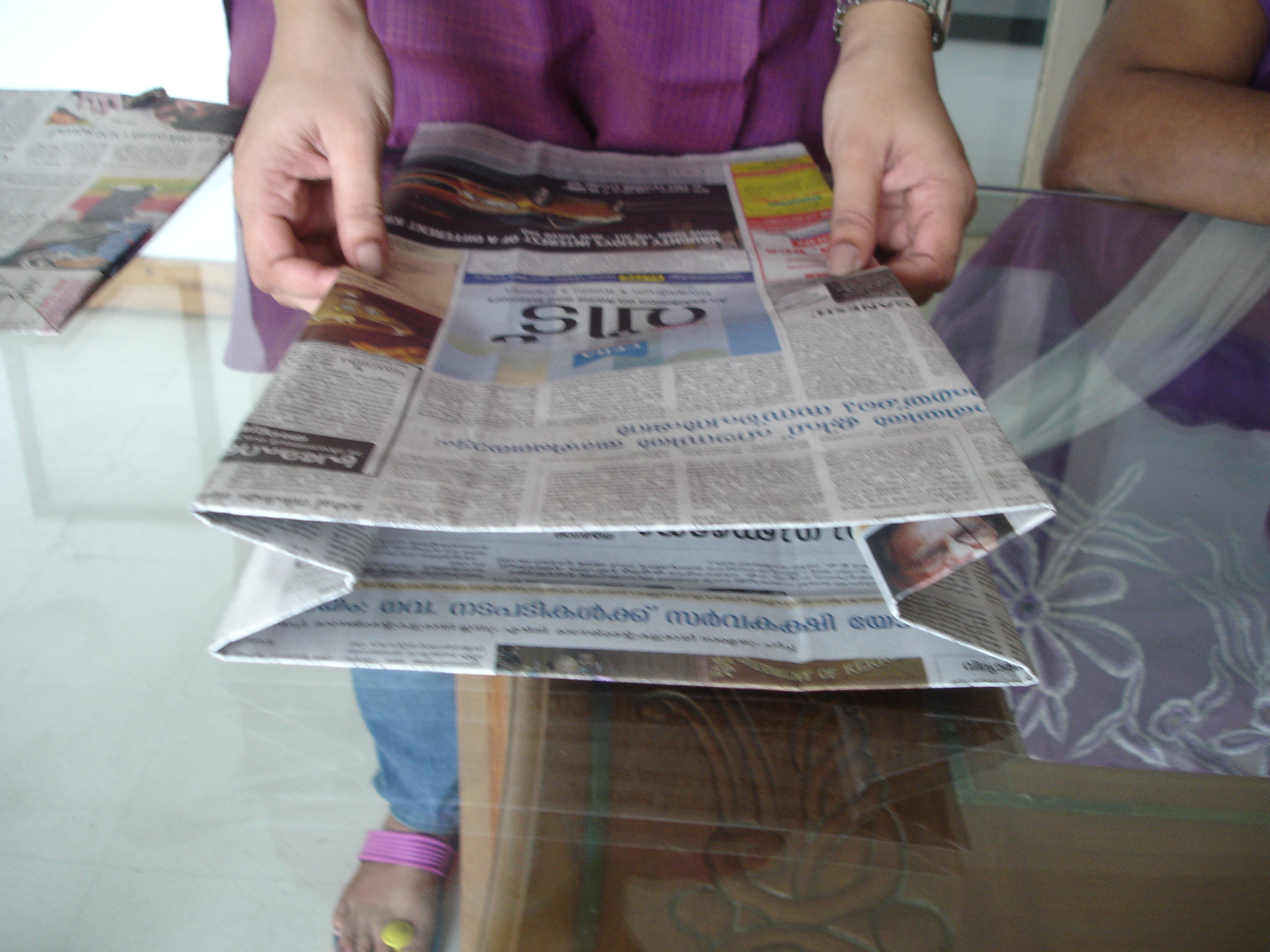
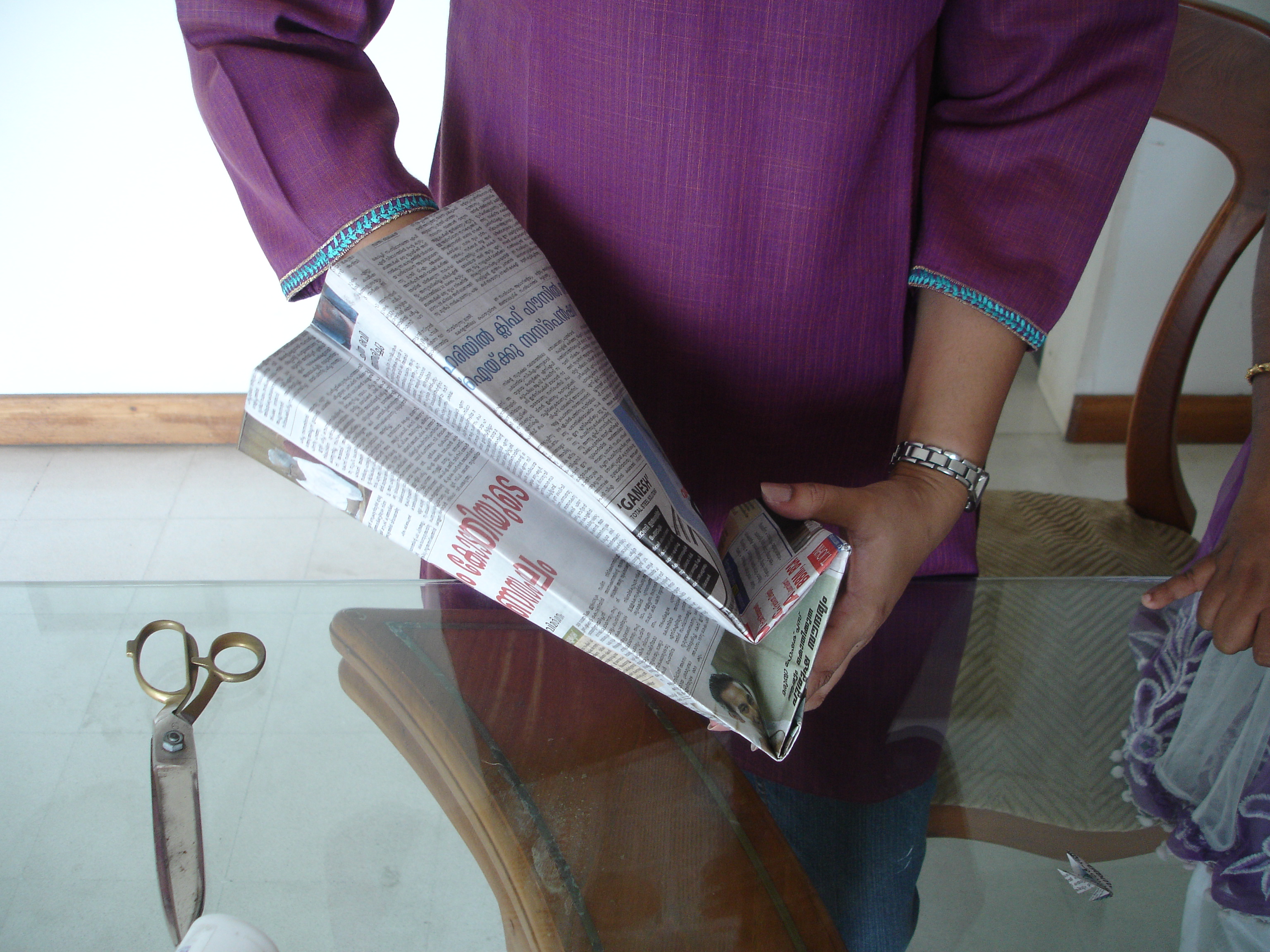
What is so wonderful about the bags is their essential simplicity.  Made from newspaper, wheat paste glue and basic hemp string, they transform items found in most home kitchens into a useful and desirable commodity.  So useful in fact, that when they’ve been taken to a meeting in South America an argument ensued as to who would get to keep the bag as a sample. So combine that simplicity with the steady piecework income they provide and one has the perfect recipe for a community development project.

Newspaper Bags

As I suggested in my last post, I’ve recently spent less time in the Periyar Reserve, i.e. observing and chronicling my encounters with the myriad species of plants and animals there, and more time in and with the local community. Working with resort management and Forestry Dept. officials, I’ve been trying to get off the ground a microbusiness enterprise, operated by residents of Kumily and members of the tribal communities in Periyar East, with the initial goal of producing bags from recycled newspaper. This is related to the bigger goal of eliminating the use of plastic bags.

One such bag, made from recycled newspaper

There are several aspects to this project, and as I delve deeper into them the more complex and intriguing it seems to me. I think the easiest and best way to present the full picture, to identify the difficulties and possibilities inherent to it, is to tell the whole story of my involvement in the project, and in the process to clarify the context of my previous posts.

To set the scene, I offer, in shorthand, a cultural backdrop:

What was only recently a subsistence and agricultural culture and economy, the Cardamom Hills (like all of Kerala) has undergone something of an economic and cultural revolution over the past fifteen to twenty years. Though I’m not an expert in this field, I can say, based on firsthand accounts and observations, that as education levels have risen even among the poorest people in this area (Kerala’s literacy rate is, famously, over 90%), and as the opportunity to pursue non-agricultural employment and consume newfangled products has become commonplace in this area, the demand for disposable income and new ways of attaining it has also increased. Generally, this is true of India as a whole, and as a global phenomenon it really deserves a more nuanced treatment than I’m able to give it (for more information, I suggest you go to your local library or see your neighborhood economist). But, on a microcosmic level, it is perhaps most pronounced, complicated, and—in some ways—easily tackled in the tribal communities of India’s forests. Continue reading

The Kitchen Table Connection: Following the Paper Trail

She wasn’t the creator of the newspaper bag concept, but Diwia Thomas has done her part to merge their production with the world of community development. Based on a deeply rooted desire to help women create a degree of financial independence, this lifelong resident of Cochin has used her business acumen, social network and marketing skills to advantage.

With the limited supply of paper pulp in India, newspaper printers have implemented the innovative practice of a de-inking process for recycled newsprint. Currently about a quarter of the paper the printers use is recycled material, which has both saved on paper pulp imports and driven up the price paid per kilo for old newspapers. India has a well-established history of recycling and these new developments have given more financial incentive to do so.

Diwia knows the system, her clients and her resources well. It only takes a gentle nudge to friends and family to leverage the equivalent of their daily coffee expenditures in the form of a weekly donation of their newspapers—they give them to her instead of selling them to a recycler (who would pay an amount worth a coffee at a local café). Only full, flat sheets of newspaper can be used in bag production, but with the ubiquitous use of newspaper in this culture as wrapping for everything from eggs, to vegetable market goods to crockery, there is plenty to go around for other recycling purposes. Continue reading