Strengthening Helpers’ High

Lately, I have been pondering altruism, one’s unselfish devotion to the well-being of others often without regard to personal well-being.  I admit I am befuddled by the concept.  It challenges theories of evolution and even caused Charles Darwin to question his own theory of natural selection—how could these acts of self-sacrifice exist in a world full of the fittest habitants, that possess only an incentive to survive and reproduce?   Regardless, I find it very encouraging to witness such selfless behaviors from my fellow mankind.    This behavior takes many forms in many aspects at many different times.
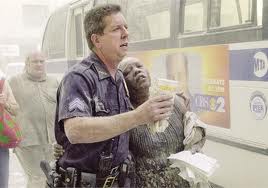
For instance, I reflect on the aftermath of September 11, 2001.  This date was one of the earliest times in my life when I acknowledged altruism’s existence.  I remember people gathering in tribute to the dead, celebrities organizing benefit concerts to raise money, and yellow ribbons streaming across nearly every home and shirt lapel signifying compassion for lost lives.  After Hurricane Katrina swept through the Gulf Coast, citizens all over the nation offered their support; my family even opened our home to refugees for a few weeks.  Similarly, this year’s September flooding of the southern tier of New York and the recent damaging snow storms of the East Coast have brought out the kindness and generosity of neighbors.  From the Flight 93 passengers to storm rescuers, altruism spurs many questions: Why are some people willing to help even at their own expense?  Why do some feel the urge to help more strongly than others?  Can altruism be learned or is it innate? Continue reading
Daily Thanksgiving Banquet

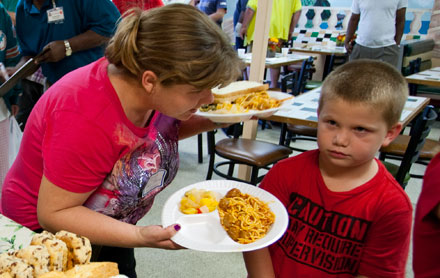
In 1621, Plymouth colonists and Native Americans gathered for an autumn harvest feast that set the precedent for today’s American Thanksgiving holiday.  Thanksgiving traditionally brings families together (in-laws and all) to give thanks to the various aspects of their lives.  Many memories are created and a cornucopia of food is shared.  In my family, the holiday lingers until only the turkey carcass remains and the stuffing is amply stuffed into our bellies…a week later.  See, we tend to err on the side of caution and over-prepare for the rare event that an extra ten people arrive to celebrate.

In one sense, Thanksgiving occurs every day in many restaurants—they over-prepare; however, restaurants are without the willing and unashamed stomachs of my family to eat their daily surpluses of food.  As I mentioned in my previous post, much of this perfectly edible food goes to a landfill.  Yet, food shelters are often unable to match their supply with their ever-increasing demand.

Increasingly, restaurants are turning to local Harvest Programs to provide an alternative to discarding surplus food.  With food donation programs, restaurants and other food service businesses have the opportunity to reach more than just their customers.  Programs provide social, environmental, and economic benefits to businesses.

Donating helps disadvantaged members of any community.  A Hunger in America study shows that one in eight American families rely on donated food. This outreach helps employees contribute to a greater good knowing that they are helping members of their community.  It also helps food pantries better match their supply and demand so restaurants can serve more than just the traditional customer. Continue reading

Building Blocks of Opportunity

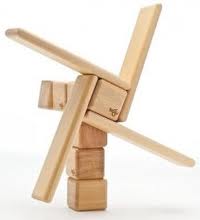
The wooden block is probably one of the simplest and most played with toys.  However, this iconic block did something unexpected: it has been promoted amongst the complex toys of this generation and sure to last for many generations.  With a little entrepreneurial conservation, Tegu has created a block that surpasses most expectations of a toy.  It is educational and stimulates children’s creativity and unscripted play (as I mentioned in one of my previous posts), is heirloom quality, helps the planet and its citizens, and is so much fun that adults sneak off and play with them.

Tegu’s magnetic blocks are built to leave a legacy.  They are complex, yet they don’t require any batteries or instruction manuals, just an imagination.  The uniqueness of this toy is not just the functional (and inaccessible to children) magnet, but the series of events that follow each block purchase, called the Tegu Effect.  Tegu gives every buyer the choice to either donate dozens of trees or donate schooldays for Honduran children.  But it is not only the environment and children that benefit; as Tegu grows, the company creates living wage jobs for the Honduran factory workers, and with 65% of the population living currently below the poverty line Tegu offers the people a great opportunity. Continue reading

Ramírez, Reading & Responsibility

The presenter introduced Sergio Ramírez with all the formal flourish that the Spanish language provides for; a laudatory salute that seems unique to places where poets serve as public servants.  The presenter mentioned the publications Ramírez has contributed to; the number of his essays, short stories, and novels; told of his political history and his creation of Nicaraguan publications and organizations of reform. The presenter was obviously very proud of having such an influential man in the room, and finally said, “I give you, author, poet, thinker, ex-president Sergio Ramírez!”

(c) Overdue Media LLC, used with permission

The man who has given talks at over forty academic institutions around the world (including Cornell University) took the podium. “Thank you for the very generous introduction,” he started.  And what he said next illustrates the difference between poets and politicians. Continue reading

Nicaraguan 1st Graders Book It to 25wpm

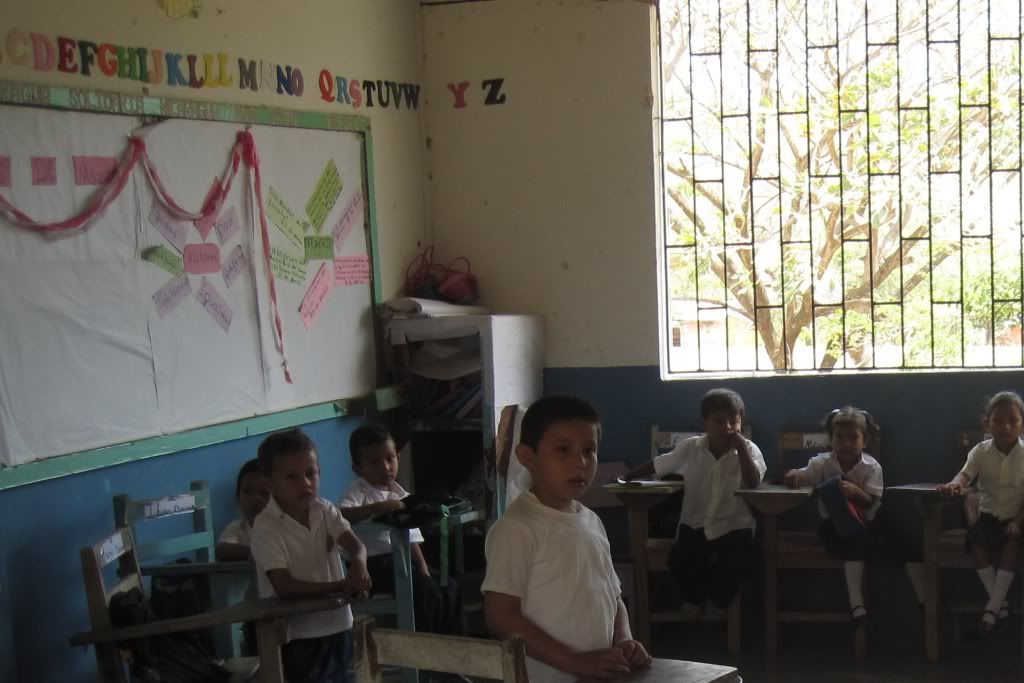
The José Dolores Estrada School, named after one of the military heroes who fought against William Walker’s army in the mid-1800s, is located only five or six kilometers away from Morgan’s Rock. JDE is a small public school with three teachers and around sixty to seventy students (the numbers vary widely each year or even by semester) that sit in mixed-grade classrooms to learn from whatever textbooks become available. On the walls, hand-made posters read, “What is a fable?” or give the definition of “traba-lenguas” (tongue-twisters) along with several examples. Cut-outs of volcanoes, whales, and ducks rest above a student’s project on “The Land of Lakes and Volcanoes.”

The three teachers responsible for the colorful and educational decorations came with José Tomás Gómez Valdivia (Nicafrance Foundation) and other teachers from La Cumplida for three days in Managua to attend the congress. I joined the delegation in their final day of sharing and learning and took notes on the conferences.

“The Situation of Reading in Nicaragua and Initiatives for Improvement” was the title of the first talk that José Tomás and I attended (the teachers went to whatever conference or workshop was most interesting or valuable to them). It was given by Vanessa Castro, a PhD from the Harvard Graduate School of Education. Dr. Castro has worked alongside the World Bank, IADB, UNESCO, and AED, and is now one of the leading investigators for the Nicaraguan group CIASES (Centro de Investigación y Acción Educativa).  Continue reading

Latin America Reads

Several hundred teachers sporting green canvas bags filled an auditorium at the Central American University (UCA) of Managua. The bags bore the Nicaragua Lee (Nicaragua Reads) and International Reading Association logos under the inscription, “Cantar Palabras, Dibujar Textos,” or, “Sing Words, Draw Texts.” A large banner across the top of the stage welcomed teachers to the eleventh Latin American and second National Congresses on Reading. The teachers were mostly from Nicaragua and Central America, but many South American countries, as well as Puerto Rico and USA, were also represented.

I was there accompanying the delegations from schools supported by Fundación Nicafrance. As I mentioned in a previous post, this foundation sponsors schools with other members of its social enterprise network: Morgan’s Rock Hacienda & Ecolodge, La Cumplida/Cafetalera Nicafrance, and Exportadora Atlantic, S.A. These are all intertwined with the Simplemente Madera Group.

The great highlight of the day’s proceedings was the eagerly-awaited arrival of Sergio Ramírez, who was vice-president of Nicaragua just after the revolution (86-90) and is probably the most celebrated poet and author of Central America since Ruben Dario, who still has a historic importance to Nicaraguan culture. Scores of teachers had copies of his latest book, La fugitiva, which they would ask him to sign at the end of his speech about the importance of reading to future generations of Nicaraguan society. This tall man and his deliberating voice, which rang across the auditorium, actually inspired me to wait in line and ask him to sign my shirt. This was the first time I’d ever asked someone for their autograph.

To find out why I had my shirt signed rather than a piece of paper or a Congress program (see the first link for an Excel sheet), stay tuned for the latter of my next two posts about this Congress and what I learned about the state of Nicaraguan literacy today.

Back to Nature

I was recently walking around in a neighborhood park, and I saw birds splashing in a pool of water.  I watched a pair of squirrels play tag up and down a large oak tree, and I admired an elderly couple walking hand-in-hand in a flower garden.  Then, I heard a car door slam and my eyes beheld children entering the park hardly lifting their gaze from their electronic devices as debris flew from their car.  As I raced to retrieve and dispose of the litter, my mind quickly volunteered pieces of itself to give to them and their parents.  How could this world’s future generation be so oblivious to the natural environment?  And especially when global climate issues are so prevalent? Continue reading

Certification of Sustainability

Unlike most of my other posts, practically all the hyperlinks in this post link to an aptly corresponding webpage instead of a picture I took. Also, please note that my previous post on the reserve at La Cumplida has been corrected. You can find the corrections in bold at the top of the post.

*

La Cumplida’s coffee farm is accredited by UTZ CERTIFIED and Rainforest Alliance. These two organizations are worldwide leaders in assessing and monitoring sustainable practices. UTZ is solely concerned with agriculture—coffee, cacao, and tea farms, mostly. The group states that through their standards, farmers see increases in productivity, efficiency, and quality:

Productivity

“In 2007, before being certified, my farm of 2.1 hectares produced 7,000 pounds of parchment. Now, in 2009, I have a productivity of 11,000 pounds. That represents an income increase.” (Cooperativa San José El Obrero, Guatemala)

Efficiency

“Before certification I fertilized 3 times a year with 80 grammes per plant, now I fertilize two times a year and apply 100 grammes per plant; with this measure I saved labor and fertilizers, while farm productivity has not been affected. Savings have been US $39 / ha”. (Cooperativa Anserma, Colombia)

Quality

The percentage of Class 3 & 4, which fetch better prices, has increased above 80% since certification, unlike 2006/2007 when they only produced 26.1% of class 4. (Rianjagi Coffee Farmers Cooperative Society (RFCS), Kenya)

Continue reading

Sustainable School Sponsoring

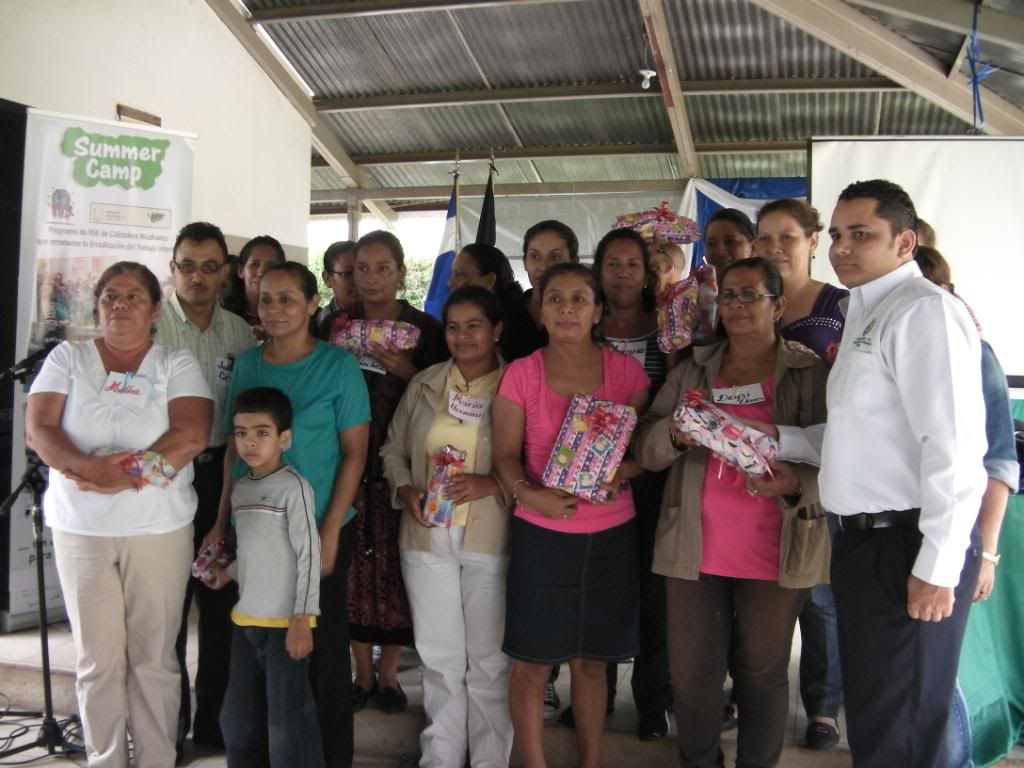
Last week, teachers from schools supported by Morgan’s Rock Hacienda & Ecolodge, Cafetalera Nicafrance, S.A., and Exportadora Atlantic S.A. met at finca La Cumplida to celebrate Teachers’ Day a little late and discuss the importance of education to Nicaragua’s future.

Morgan’s Rock sponsors six schools in the San Juan del Sur area; Cafetalera Nicafrance (essentially La Cumplida) helps eight in the Matagalpa area; and Exportadora Atlantic (EA) just recently picked up a school. In Spanish, the sponsoring is known as “godfathering/godmothering” depending on the name of the school (they are named after national heroes, martyrs, etc.). Each seat at the long tables was supplied with a folder, notepad, pen, and calendar provided by EA , as well as a schedule of the day’s activities and suggested readings printed by José Tomás Gómez Valdivia, who is in charge of the whole school sponsoring program under the Nicafrance Foundation, which all the previously mentioned companies are associated with.

Gift presentation to schoolteachers


Continue reading

Meeting with the Forest Department

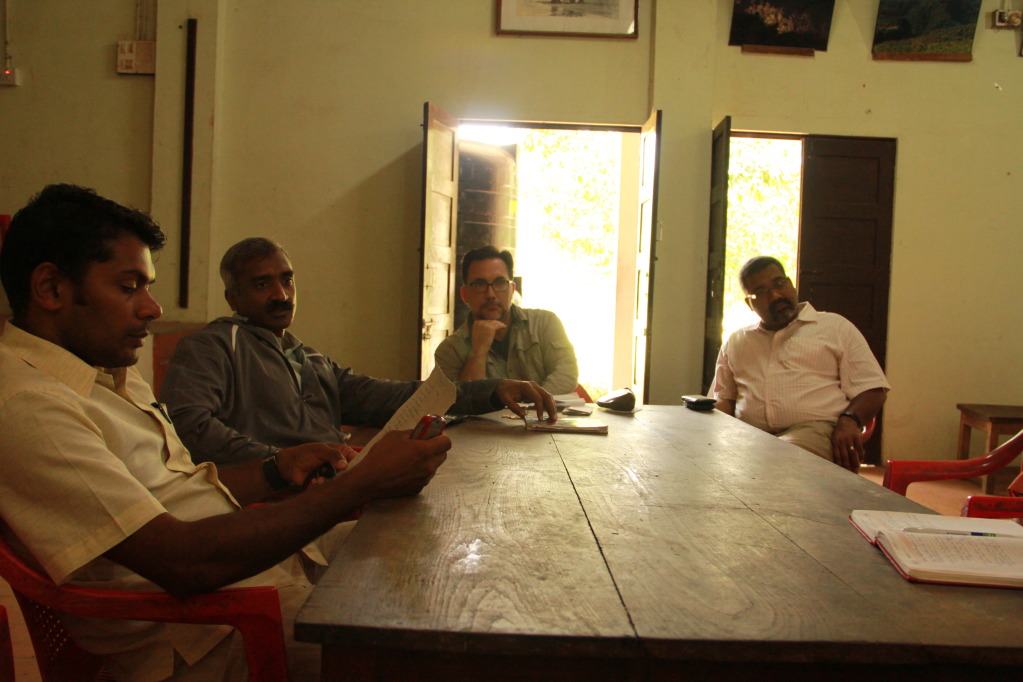
Developments in our community development initiative haven’t come easily for the past two weeks in Kumily. With our primary Forestry Dept. contact away from his office for a little more than a week, and given that the time table agreed up at our last meeting (June 26th) allowed for a ten day period during which our ‘talent scout,’ as it were, would make contact with potential producers, we at the resort were, in the meantime, left playing a bit of a waiting game. But with the distraction of staff tour revelry behind us and anticipation for the arrival of our newest intern, Sung, at a high, our idle and indolent interlude came to a happy end today when we met with several FD officials and functionaries, some of whom none of us had met previously, including a ‘Forest Guard’ (a title I hope to earn someday) who runs the protection agency focused on the tribal community.

For while we in Thekkady had been sitting on our proverbial hands, Crist and Amie had been actively ascertaining details from our sister bag-making enterprise in Kochin. Continue reading

Newspaper Bags

As I suggested in my last post, I’ve recently spent less time in the Periyar Reserve, i.e. observing and chronicling my encounters with the myriad species of plants and animals there, and more time in and with the local community. Working with resort management and Forestry Dept. officials, I’ve been trying to get off the ground a microbusiness enterprise, operated by residents of Kumily and members of the tribal communities in Periyar East, with the initial goal of producing bags from recycled newspaper. This is related to the bigger goal of eliminating the use of plastic bags.

One such bag, made from recycled newspaper

There are several aspects to this project, and as I delve deeper into them the more complex and intriguing it seems to me. I think the easiest and best way to present the full picture, to identify the difficulties and possibilities inherent to it, is to tell the whole story of my involvement in the project, and in the process to clarify the context of my previous posts.

To set the scene, I offer, in shorthand, a cultural backdrop:

What was only recently a subsistence and agricultural culture and economy, the Cardamom Hills (like all of Kerala) has undergone something of an economic and cultural revolution over the past fifteen to twenty years. Though I’m not an expert in this field, I can say, based on firsthand accounts and observations, that as education levels have risen even among the poorest people in this area (Kerala’s literacy rate is, famously, over 90%), and as the opportunity to pursue non-agricultural employment and consume newfangled products has become commonplace in this area, the demand for disposable income and new ways of attaining it has also increased. Generally, this is true of India as a whole, and as a global phenomenon it really deserves a more nuanced treatment than I’m able to give it (for more information, I suggest you go to your local library or see your neighborhood economist). But, on a microcosmic level, it is perhaps most pronounced, complicated, and—in some ways—easily tackled in the tribal communities of India’s forests. Continue reading

The Kitchen Table Connection: Following the Paper Trail

She wasn’t the creator of the newspaper bag concept, but Diwia Thomas has done her part to merge their production with the world of community development. Based on a deeply rooted desire to help women create a degree of financial independence, this lifelong resident of Cochin has used her business acumen, social network and marketing skills to advantage.

With the limited supply of paper pulp in India, newspaper printers have implemented the innovative practice of a de-inking process for recycled newsprint. Currently about a quarter of the paper the printers use is recycled material, which has both saved on paper pulp imports and driven up the price paid per kilo for old newspapers. India has a well-established history of recycling and these new developments have given more financial incentive to do so.

Diwia knows the system, her clients and her resources well. It only takes a gentle nudge to friends and family to leverage the equivalent of their daily coffee expenditures in the form of a weekly donation of their newspapers—they give them to her instead of selling them to a recycler (who would pay an amount worth a coffee at a local café). Only full, flat sheets of newspaper can be used in bag production, but with the ubiquitous use of newspaper in this culture as wrapping for everything from eggs, to vegetable market goods to crockery, there is plenty to go around for other recycling purposes. Continue reading

FRA and Periyar

In my last post, I wrote about and linked to some writing about the Forest Rights Act of 2006, legislation which gives added to protection to tribal communities with a traditional claim on protected and preserved land in India. I ended by speculating about the difference between policies and practices regarding human-animal cohabitation at other wildlife sanctuaries and the one where I’m staying, which is in the Periyar Forest.

Well, I’ve spent the past couple days learning firsthand about the tribal community in around Kumily and Thekkady, and I can now with confidence confirm that the tribal heritage development and preservation initiatives in this area are indeed succeeding, and perhaps to a greater degree than at other parks. ‘Success’ is here defined as a community gradually finding sources of income that do not require the extraction of resources from the preserved environment.

To this end, in the Periyar there are four Community Development Committees, as well as numerous agencies designed to regulate and control interactions between the tribal community and the forest, and the tribal community and the market. I guess in the past tribal community members had been treated unfairly by buyers of their agricultural product (which is mostly pepper). Part of the CDCs’ job is to ensure that farmers are made aware of fair market prices and meet only with honest middlemen.

I met with the chairman of one of the CDCs and he told me about the economic and political structure of these relationships. He also told me that, at least within the Mannan community, more young peope are going on to professional schools and receiving advaced degrees, and that close to 50% of the tribal population now makes its primary income from outside the forest.

While these may be informal indicators of change and improvement as the Forestry Dept. defines it, they do point to developments in Kumily and India in general that it seems almost like you watch happening before your eyes on the ground.

Just Wood

Simplemente Madera,” which means “just wood,”  is a Nicaraguan sister company to Morgan’s Rock that primarily uses sustainable wood sources—one of them is the tree plantations at Morgan’s Rock—certified by SmartWood according to the criteria set by the Forest Stewardship Council, an international NGO that sets standards for sustainable forestry worldwide. Providing furniture and architectural services, the company helped design and furnish Morgan’s Rock, and provided most if not all of the woodwork in several Nicaraguan houses and hotels.

Collaborating with the World Wildlife Fund and International Finance Corporation, in 2005 SM worked with a Nicaraguan indigenous community to develop the inspiringly magnificent One Tree program influenced by a similar project in the UK. SM is also attempting to salvage wood felled by Hurricane Felix and provides wood and carpentry services to the eco-surfboard company Ocean Green (which now offers 15% off your surfboard if you book a stay at Morgan’s Rock).

Based on fairly thorough browsing, the SM website hasn’t been updated since 2008. Keeping the information current would help make SM a more relevant member of the online carpentry community and generate further popular publicity for Morgan’s rock.

Reserves, the FRA, and tigers

I’m at the experience desk at Cardamom County, waiting for my first set of afternoon check-ins as a trainee. While waiting, I found some interestingly related articles about the Forest Rights Act, which is a piece of legislation passed in India in 2006. For all intents and purposes, the FRA allows tribal communities to petition the government for rights to lands they’ve historically dwelt on. The controversy surrounding this legislation is based on questions of anthropogenic cohabitation, deforestation, and the honesty with which the government handles petitions.

Here are a couple articles from India Together addressing certain of these issues.

From India Together,

“Unable to bear the hardships of leading a dignified life living cheek by jowl with wildlife, a large percentage of tribes living in forest areas crave for relocation, provided of course they get livelihood options, and are able to retain their cultural and tribal identity. Yet, anthropologists contend that tribes have been coexisting peacefully for thousands of years in wildlife reserves while the concept of wildlife and biodiversity conservation is nascent. In line with this, they say that relocation of the indigenous people will rob them of their dignity.”

“…the FRA says is that the development projects have to be appropriate; they have to be ecologically right, culturally sensitive and they should benefit people. The kind of projects which are coming up are mindlessly extracting water and forest resources on which people depend; these are not really ‘development’ projects. And if the FRA is coming in the way of such projects then it’s a good stumbling block to have.”

Of course, the Periyar Tiger Reserve (where I happen to be living) stands as a sort of counter-example to these more pessimistic perspectives on the FRA. Here’s a fairly old article (from 2007) about local, former poachers patrolling the park at night, protecting the wildlife from unauthorized exploiters.

I’m interested to find out if these policies still exist at Periyar. I’ll let you know what I find out.