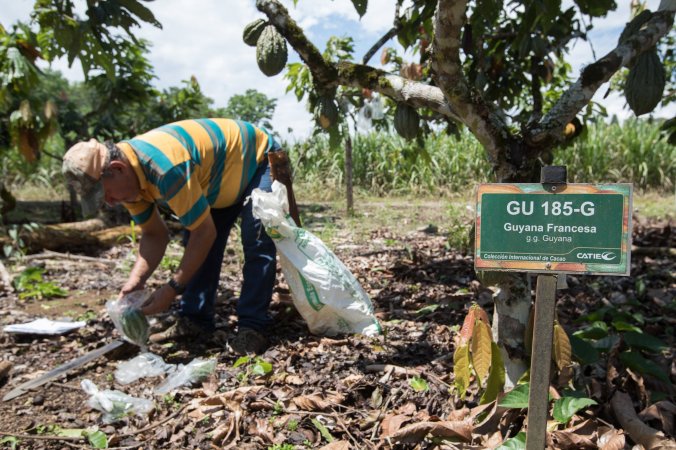
At the International Cacao Collection in Turrialba, Costa Rica, José Antonio Alfaro examined pods — which hold the seeds that make chocolate — treated to resist a devastating fungus. Only a few cacao varieties are widely cultivated, making them susceptible to outbreaks. Credit Mónica Quesada Cordero for The New York Times
As we transitioned from life in India back home to Central America this year, patrimonial foods, and the ecological considerations of food sourcing has been a primary interest. Our pages have featured stories about monoculture agriculture endangering a well loved crop: bananas and coffee have cycled through similar situations. Below is an example of experiments with hybridization probably saving a species.
A Battle to Save the World’s Favorite Treat: Chocolate
TURRIALBA, Costa Rica — The trees of the International Cacao Collection grow here in an astonishing diversity of forms, bearing skinny cacao pods with scorpion-stinger protrusions, spherical green pods that could be mistaken for tomatillos, oblong pods with bumpy skin resembling that of the horned lizard — all in colors ranging from deep purple to bright yellow.
Within each of these pods are seeds that yield something beloved by billions: chocolate.
But despite this diversity, few cacao varieties are widely cultivated, and that’s a problem: Like many other crops, cacao is under constant threat from diseases and environmental challenges exacerbated by our tendency to grow only a few varieties with similar or identical genetic traits and defects.
“Most varieties produced worldwide belong to a narrow set of clones selected in the forties,” said Wilbert Phillips-Mora, who oversees this collection of 1,235 types of cacao trees and heads the Cacao Genetic Improvement Program at C.A.T.I.E. (an acronym in Spanish for the Tropical Agricultural Research and Higher Education Center).
A narrow gene pool means that most commonly cultivated varieties of cacao are susceptible to the same diseases, and these blights can spread quickly.
Cacao production brought relative prosperity to the Caribbean coast of Costa Rica until the late 1970s, when farmers began to notice that pods on their trees were developing a fuzzy white fungal coating and eventually mummifying.
The fungus — Moniliophthora roreri, also called monilia or frosty pod rot — soon spread around the country, and by 1983 Costa Rican exports of dry cacao beans had declined by 96 percent. The industry here has never recovered.
 Organikos