Reptile of the Day – Thorny Dragon

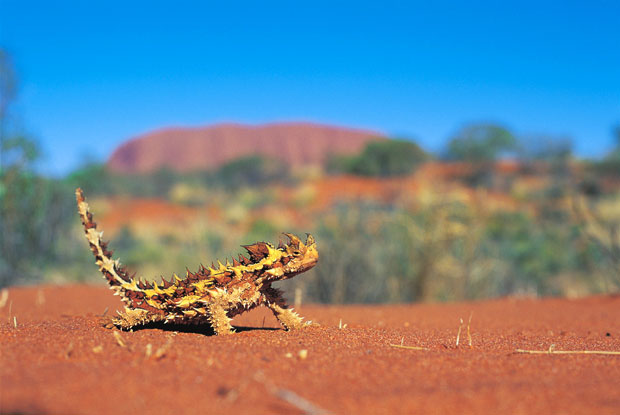
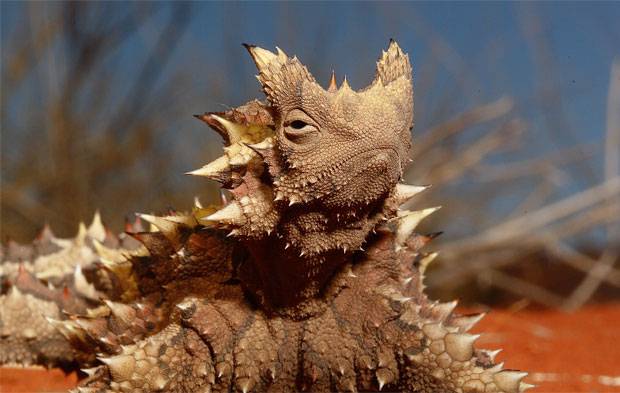
Today’s reptile is the Thorny Dragon, Moloch horridus (Australia) — as its name suggests, this Australian lizard’s body is dominated by intimidating spikes in order to look unappealing and fend off predators.

Occupying scrublands and deserts primarily, the Thorny Dragon’s coloration is perfect for blending in and feasting on ants, its main source of nutrition.

Image


Photo Courtesy: statravel.co.uk


Image

^ The face says it all ^

Photo courtesy: australiangeographic.com.au

Wildlife Sanctuaries of India–Jim Corbett National Park

Jeep Safari-Jim Corbett National Park

(Picture above is from Corbett National Park‘s official website)

I am going to be doing some brief research and write about each of the 53 Tiger Reserves in India from now on. They are governed by Project Tiger, which is administered by the National Tiger Conservation Authority of India.

Project Tiger was established in 1973 to “ensure a viable population of tiger in India for scientific, economic, aesthetic, cultural and ecological values and to preserve for all time, areas of biological importance as a natural heritage for the benefit, education and enjoyment of the people.” Continue reading

“The Upcycle”, the sequel to “Cradle to cradle”

If you’ve read “Cradle to Cradle” and you come here regularly, chances are you’ll be as excited as I am to learn about the sequel : ‘The Upcycle”.

10 years ago William McDonough and Michael Braungart published one of the most important environmental manifestos of our time.

Based on biomimetics, Cradle to Cradle design is an approach to the design of products and systems. It models human industry on nature’s processes viewing materials as nutrients circulating in healthy, safe metabolisms. The book states that:

“All products can be designed for continuous recovery and reutilization”.

Every product can and should be conceived with the reuse of its materials in mind and every material can and should be conceived to be used again. Just like in nature, nothing goes to waste.

If you have not read it, McDonough’s TED talk Cradle to Cradle design will probably make you want to give it a go.

In their newest book  The Upcycle: Beyond Sustainability – Designing for Abundance,  McDonough and Braungart go further than ‘Cradle to cradle’ saying that we should be ambitious about our role on this planet.

“Industry can do better than “do no harm”: it can actively improve everything with which it comes into contact.” Continue reading

Using Small Mammal Remains for Environmental Archaeology

Credit: Bresson Thomas

Archaeological remains of small mammals generally weighing under 1kg, or micromammals, are important as environmental indicators, partly because they tend to specialize in certain habitats and are sensitive to change. Many factors affect their ranges of distribution, including predators, food requirements, competition, fire, shifts in precipitation patterns, and shelter availability. Micromammals such as voles and mice also tend to live in dense populations and have evolved rapidly through high fecundity. Due to these diverse and interrelated factors, the interpretation of micromammal remains—bones and middens, mostly—requires a deep understanding of the rodents’ relationship with its environment. In other words, ecological information is imperative to accurate assessment of archaeological data on micromammals.

But sometimes micromammal remains have answered modern ecological questions. For example, packrat middens in arid North America offer relatively high temporal, spatial, and taxonomic resolution (i.e., small intervals with which to measure time, space, or species range), and contain what is possibly the “richest archive of dated, identified, and well-preserved plant and animal remains in the world” (Pearson & Betancourt 2002, p500). Continue reading