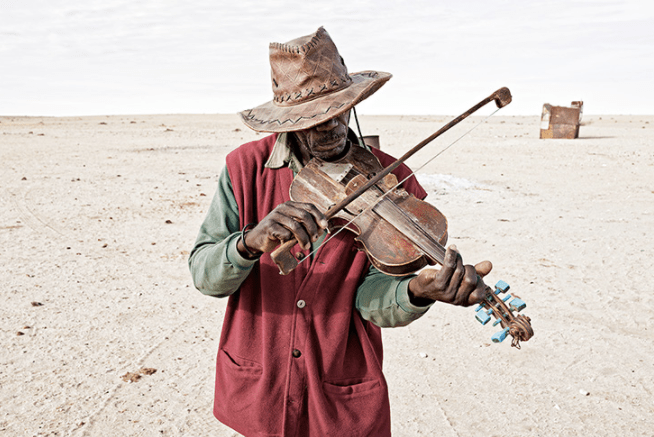
Gottlieb ǂKhatanab ǁGaseb aka Die vioolman (The Violinist) plays traditional Damara music at the funeral of Ouma Juliana ≠Û-khui ǁAreses on the family farm beneath the Dâures. Uis District, Erongo Region. December 2014
As an international company, our team tends to be spread out across the world, so more often than not many of our posts is a surprise to the rest. It was with that sense of synchronicity that I read Crist’s piece on Gerhard Steidl’s conservation work yesterday while I was in the midst of writing about this upcoming publication.
Born in Namibia, photographer Margaret Courtney-Clarke spent decades capturing life in remote places in Italy, the USA and numerous parts of Africa. Returning to Namibia after years away, she found the once familiar landscape drastically changed.
Cry Sadness Into the Coming Rain is a forthcoming publication by Steidl, Germany, 2017.
With strong memories of my formative years growing up on the edge of the Namib Desert in what was then known as South West Africa, I have returned to explore my obsession with this place and my lifelong curiosity for the notion of shelter. I have covered thousands of dusty kilometres across remote plains, through dry river beds, over sand dunes and salt pans, through conservancies and communal lands to photograph families in desperate, forgotten outposts. I try to capture the ‘transhumance’ – the search for work, forage and water – and the remnants of former habitats alongside once productive land.
In coastal towns I move with women and children across stretches of desert from one garbage dump to another – often with the loot they carry in their quest to create shelter and eke out a living. I focus on human enterprise and failure, on the bare circumstances of ordinary women and men forced to negotiate life, and of an environment in crisis. Continue reading
 Organikos