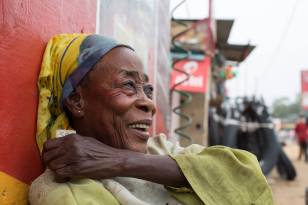
She said she’d let me take her photo if I bought some peanuts from her. Afterward, I asked if she could remember the saddest moment of her life. She laughed, and said: “You’re going to need to buy some more peanuts.” (Kasangulu, Democratic Republic of Congo) Photo Credit: Brandon Stanton
This article from the New York Times describes the recent social media phenomenon- Brandon Stanton’s Humans of New York site and facebook page. At first he was just making portraits of strangers in New York City after losing his job as a bond trader. Then it evolved into interviewing the people about their lives and using them as captions to the photos. Now, he has been commissioned by the United Nations to do a 50-day world tour doing the same thing, but in some of the areas of the world with “the most extreme headlines coming out” to document life on the streets there. The purpose of the tour is to raise awareness for the UN Millenium Development Goals and to inspire a more global perspective.
I have been a part of the 9.2 million people following him on facebook and just watching the exponential rise in followers since this UN tour has been quite incredible. There has been overwhelming support for his work. Thousands of people writing extensive comments reflecting on how the portraits capture what’s happening in the world. I’ve noticed a lot of heartfelt dialogue inspired by his work in the comments. Continue reading

 Organikos