 About a week ago, while walking the forest trails at Xandari, several resort employees and I had a great wildlife spotting. The trail we were taking leads to a seven-foot waterfall that flows into a large pool and continues as a small river with several other waterfalls in it, one of which is about a seventy-foot drop. As we were rounding a bend in the path, a member of the group looked across the river to the opposite bank and noticed an animal down by the water.
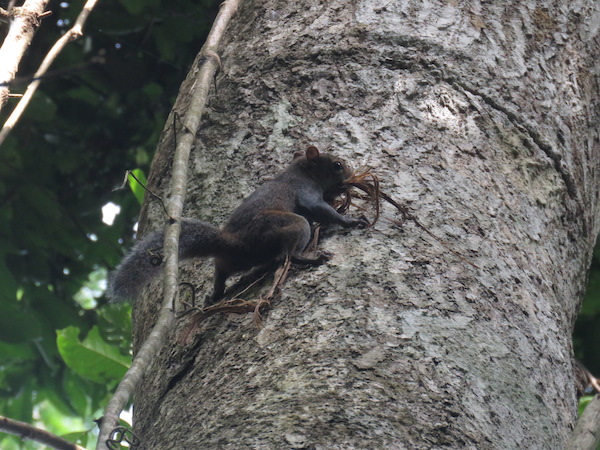
It had either been drinking or perhaps hunting for some aquatic prey, but when it heard our voices (we were a group of about six or seven) it scampered up the hill and in among the trees, where we lost sight of it. My first impression was that it was a black house cat, but it quickly became clear that it was in fact almost double the size and its tail was quite large – not bushy, but as if the bone and flesh themselves were a good deal thicker than a normal cat’s.

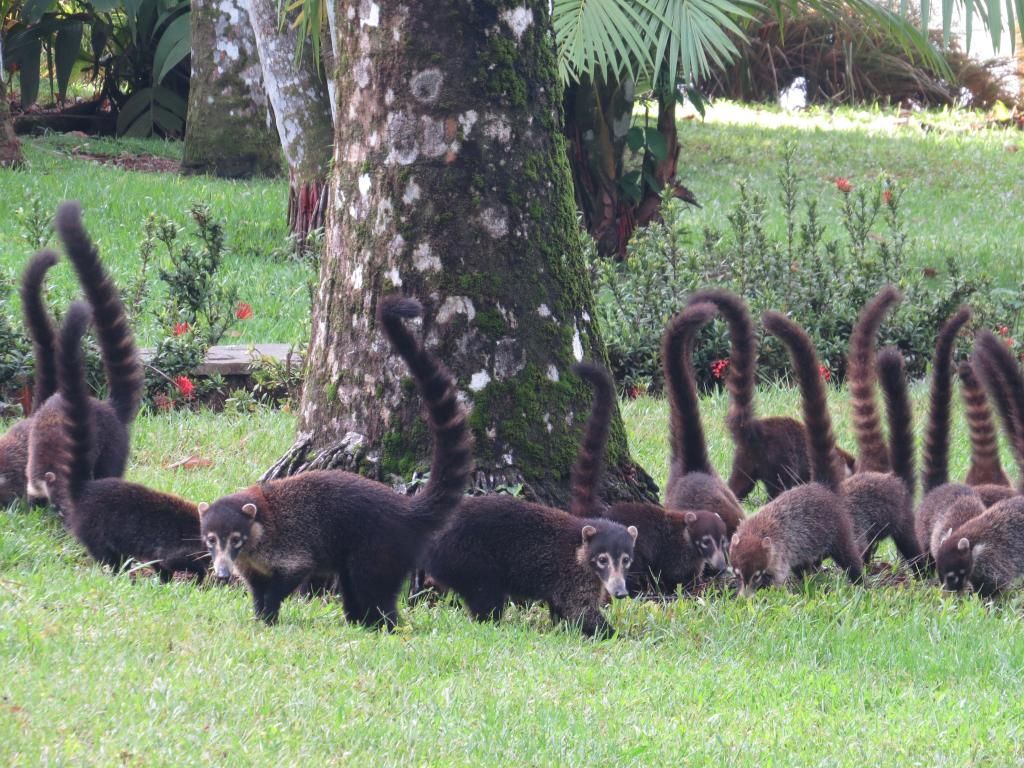
White-nosed Coatis foraging warily on the grounds of Bosque del Cabo, a nature lodge on the Osa Peninsula of Costa Rica.
The staff member who first spotted the animal voiced the hypothesis that it was a pizote, or White-nosed Coati, a member of the raccoon family that many visitors to Costa Rica have probably seen in their travels here. But as the black-furred animal briefly turned its head back to check that we were not pursuing it, I could see despite the shadows cast by the forest that its face was not pointed into a long nose but rather a normal cat’s face, and there was no hint of white there either. Continue reading →
 Organikos