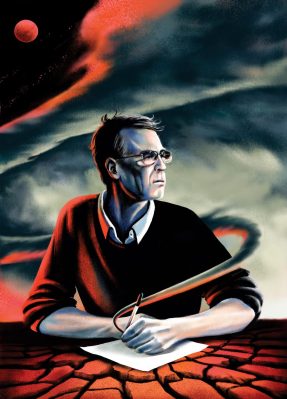
“The Ministry for the Future” displays Robinson’s anti-anti-utopianism: its prognosis is both heartening and harrowing. Illustration by Deena So’Oteh
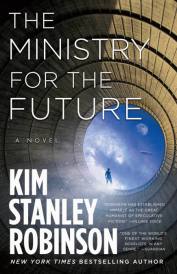
Thirteen months ago I first became aware of this author and this book. Four months ago Robinson showed up on my radar again. I still had not made time for his book. And two weeks ago, another reminder of how my time has and has not been employed, this time posed as a question: Can Science Fiction Wake Us Up to Our Climate Reality? I already feel quite awake to that reality, but the question is still of considerable interest.
Kim Stanley Robinson’s novels envision the dire problems of the future—but also their solutions.
Robinson at home in Davis, California. Much of his sci-fi could seem like nature writing, with the Sierra Nevadas—his “heart’s home”—recast as Mercury or Mars. Photograph by Jim McAuley for The New Yorker
Last summer, the science-fiction writer Kim Stanley Robinson went on a backpacking trip with some friends. They headed into the High Sierra, hiking toward Deadman Canyon—a fifty-mile walk through challenging terrain. Now sixty-nine, Robinson has been hiking and camping in the Sierras for half a century. At home, in Davis, California, he tracks his explorations on a wall-mounted map, its topography thick with ink. He is a devotee of the “ultralight” approach to backpacking and prefers to travel without water, instead gathering it along the way, from lakes and streams. Arriving at the canyon, with its broad, verdant floor cradled in smooth slopes of granite, he planned to fill his bottles with meltwater from the seven glaciers buried in its headwall. Continue reading


 Organikos