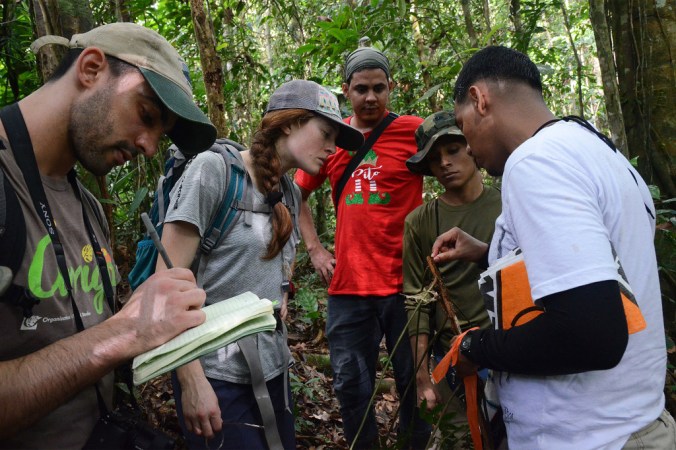
Student members of the Mamoní Valley Preserve Natural History Project, Jacob Suissa (left), Sylvia Kinosian, Brian Vergara, Jose Palacios, and Christian López examine the rhizome vasculature of a fern species during their first collection trip in the rainforest.
While most of our work between 1999 and 2019 was field work, once this platform started we distinguished field expeditions from our “regular work,” and Seth’s posts have dominated the expedition realm here. Today, with Seth in wintry New Haven in desk mode, my expeditionary imagination is instead fueled by the field expedition described below, on a topic not featured in these pages for seven years, so I am correcting the neglect:
Going where the diversity is
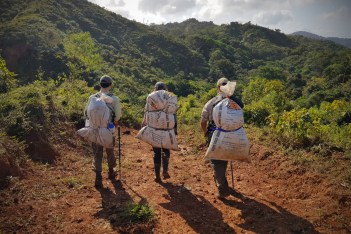
Student researchers Ben Goulet-Scott (left), Sylvia Kinosian, and Jacob Suissa, reach the crest of a hill overlooking the Mamoní Valley Preserve while carrying 90 species of ferns on their backs.
Photos by Ben Goulet-Scott/Harvard University Department of Organismic and Evolutionary BiologyLast month, two graduate students from the Arnold Arboretum of Harvard University traveled to one of the most species-rich landscapes in the world: a remote strip of tropical rainforest at the narrowest point in the Central American country of Panama.
Ben Goulet-Scott, a Ph.D. candidate in the Graduate School of Arts and Sciences’ Department of Organismic and Evolutionary Biology (OEB) and a fellow in the Arboretum’s Hopkins Lab, and Jacob Suissa, OEB Ph.D. candidate in the Friedman Lab at the Arboretum, hope their research in the Mamoní Valley Preserve in Panama will increase our understanding of how biodiversity can persevere in the face of climate change, deforestation, and human disturbance.
The 20-square-mile land conservancy on the isthmus separating Central and South America teems with life, making the condensed rainforest habitat a perfect location for their research project because of the vast number of known and potentially undiscovered species living there, Goulet-Scott said. Continue reading
 Organikos