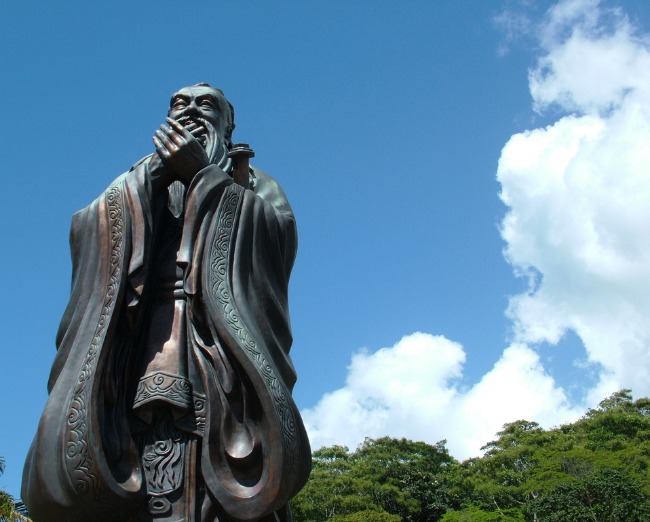
It took graduate school for me to have a life-changing experience with a course. As a literature-focused liberal arts undergraduate I had an entire curriculum of life-forming courses, but not one course that stood out as life-changing. Ironically, the Philosophy of Science course I took in graduate school, the one that set me off in a new direction, was also the one that convinced me to reconsider my commitment to an academic life. And so, while I completed my Ph.D. in part thanks to that course, my life veered toward an applied, practical use of my dissertation, which I comment on from time to time in these pages.
The Atlantic has a story about a course that reminded me of the possibility, and the value, of a life-changing course, and this is worth a few minutes’ read in the interest of continuous learning:
…Puett’s course Classical Chinese Ethical and Political Theory has become the third most popular course at the university. The only classes with higher enrollment are Intro to Economics and Intro to Computer Science. The second time Puett offered it, in 2007, so many students crowded into the assigned room that they were sitting on the stairs and stage and spilling out into the hallway. Harvard moved the class to Sanders Theater, the biggest venue on campus.
Why are so many undergraduates spending a semester poring over abstruse Chinese philosophy by scholars who lived thousands of years ago? For one thing, the class fulfills one of Harvard’s more challenging core requirements, Ethical Reasoning. It’s clear, though, that students are also lured in by Puett’s bold promise: “This course will change your life.” Continue reading
 Organikos