 My penultimate post covered the participatory monitoring workshop I attended the last week of June. Here I will describe our results in the last two days of the meetings.
When dividing the attendees into different groups with assigned topics of discussion, the workshop organizers assigned me as discussion leader of the Resident (Urban and Rural) group, where six or seven of us talked about varied approaches and types of programs.
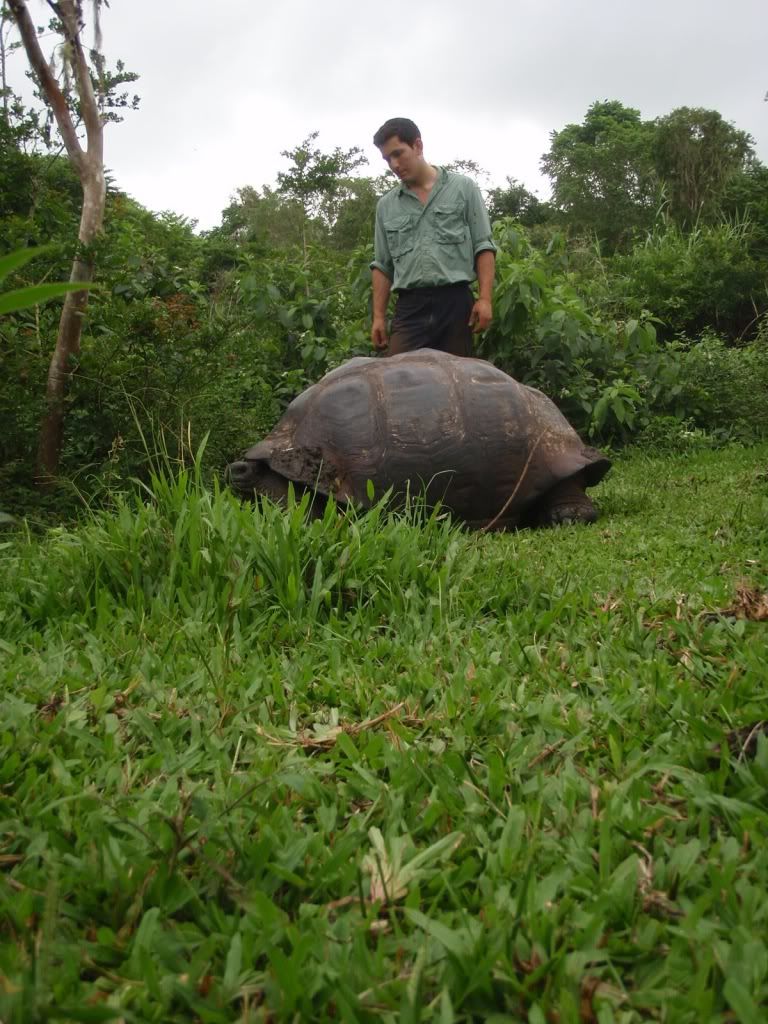
We started with the rural residents, focusing on farmers since the majority of landowners in the agricultural region of Santa Cruz fit that category, either with coffee, sugarcane, cattle, or other crops. There are countless farms in the area, and only about a dozen of them practice any tourism, but we considered this smaller group the perfect audience for a pilot project, since they should be more interested in completing periodic checklists of focal species that serve as tourist attractions. Guides from cruises or local operators often take groups of tourists up into the highlands to see wild giant tortoises and less common landbird species like the Vermilion Flycatcher, and these few farms offer not only passage in their land (as safe havens for the attractive species) but also their coffee or homebrewed sugarcane rum to the tourists. Some properties even have lava tunnels, one of which I’ve been told by a Hawaiian visitor is even more impressive than the famous Thurston lava tunnel on the other well-known volcanic archipelago of the Pacific Ocean.
 Last week, thanks to the effort of very helpful contacts on the islands, I was able to attend a Participatory Monitoring workshop in Puerto Ayora. For those of you unfamiliar with the term in the workshop title, you are not alone. Participatory monitoring, community science, public participation in scientific research, volunteer data collection–these all mean practically the same thing as citizen science, which I have briefly
  The workshop consisted of an impressive list of international expert invitees—representing Cedar Crest College/Earth Watch, SUNY (College of Environmental Science and Forestry and at Stony Brook), Stanford University, Pepperdine University/ Scripps Institution of Oceanography, the Center for Biodiversity and Conservation/American Museum of Natural History, Colorado State University/University of Wisconsin-Madison, the United States National Park Service (Joshua Tree National Park and Acadia National Park), and the Galápagos Conservancy. Additionally, the Galápagos National Park, Charles Darwin Foundation, WWF Galápagos, Conservation International, Universidad Central Sede Galápagos, and Grupo FARO were present. A very skilled interpreter, with portable headsets, helped those who didn’t speak English or Spanish. Being in the minority of non-PhD.-holders, and practically the only person with just an undergraduate education, made walking into the room slightly unnerving, but I knew that since the Cornell Lab of Ornithology didn’t have a representative in attendance there were still constructive inputs that I could contribute, seeing as the workshop was about citizen science. Another comfort was that people commonly mistake me for being older than I am. While a freshman at Cornell two years ago, many of my TAs thought I was a senior or junior for most of the semester, and when traveling, people who I tell I’m studying at Cornell tend to assume I’m in graduate studies until I correct them.
 Organikos