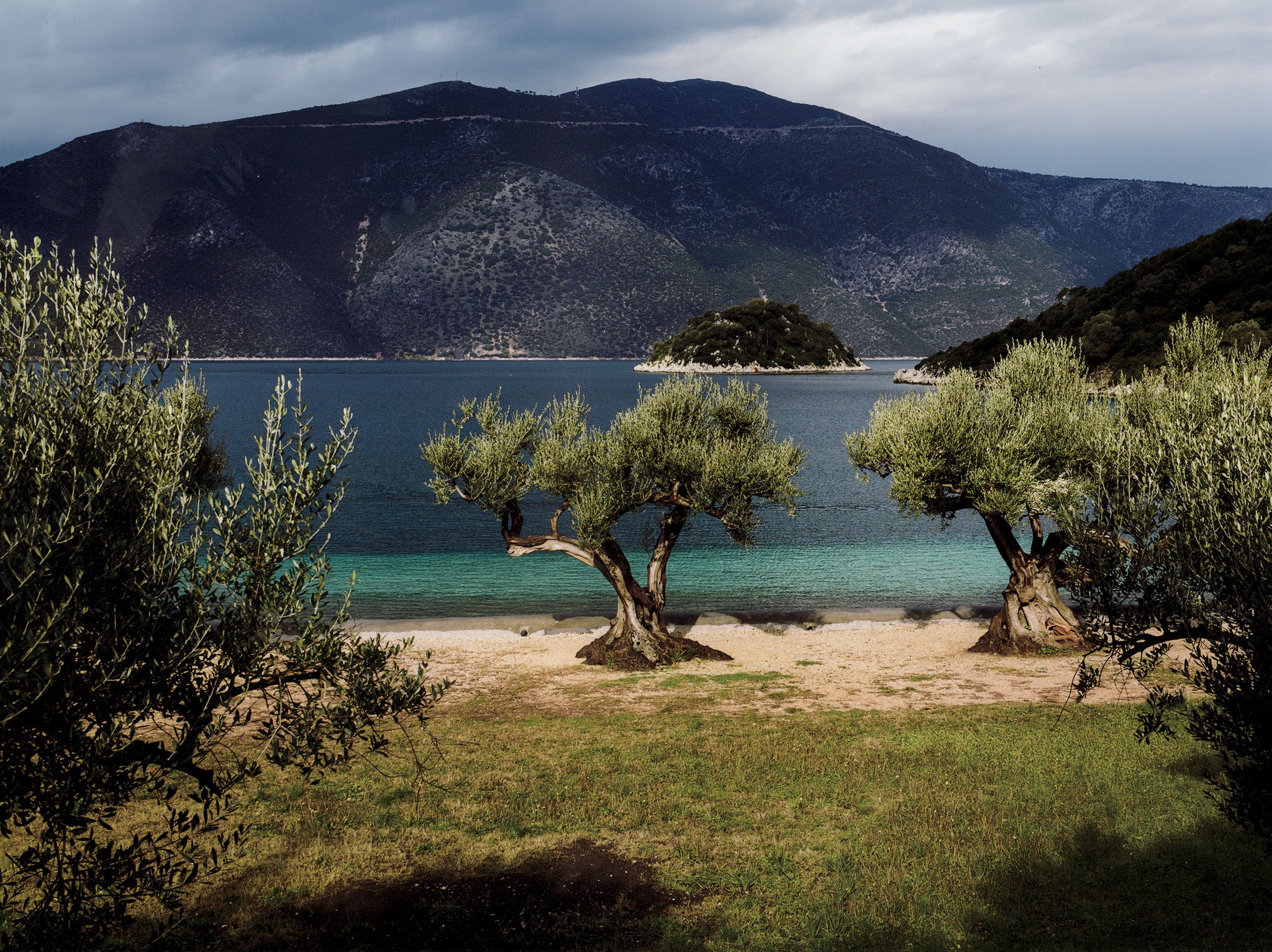
Olive trees along the shore of Dexa Beach on the Ionian island of Ithaca, thought to be Odysseus’ homeland, as told in Homer’s eighth-century B.C. epic poem “The Odyssey.” Credit Alex Majoli
Odysseys (not to mention, The Odyssey) are a fundamental aspect of our family’s peripatetic lives. Having lived in 5 countries on 4 continents, there are places that continue to draw us back with roots that run wide and deep. Greece is one of those places, for multi-generational reasons. It strikes me as strange that we’ve never been to Ithaca, at least the one that Pico Iyer writes about here.
The Ithaca we’re tethered to in many ways is the Ithaca of the new world: the birthplace of our sons, the home of Cornell University, the place that draws us back to a 3rd generation, still.
The strength of stories is as powerful as the bonds of love for family and for motherland, and I thank Pico for continuing to share his with us all.
One writer chronicles his voyage to the island of Ithaca, where Odysseus was once reputedly king.
I STEPPED INTO a taxi on my arrival in Athens and mentioned the name of one of the city’s most central five-star hotels. The driver was thrown into a frenzy, and not only because he seemed to speak no English. As we zigzagged at high speed through the jampacked streets, he tapped frantically on his smartphone and started calling friends, none of whom were any help at all. When, finally, we pulled up at the entrance, I was greeted by a wild-haired, gesticulating front-desk man who said, “We’re so sorry, sir. We have a problem, a big problem, today. So we have made a reservation for you in our other hotel. Half a block away.”
The problem, the taxi driver conveyed, was that every toilet in the hotel had flooded.
In the fancy new place where I ended up — it took us 20 minutes to go around the corner thanks to narrow, one-way streets — I walked into an elevator to be confronted by two thickly bearded Orthodox priests in full clerical dress crammed into the same small space, cellphones protruding from their pockets as they wished me, in easy English, “Good evening.” The mayhem of the little lanes I’d just come through, the sunlit dishevelment of the buildings, which seemed to be collapsing as much as rising up, the graves in the middle of the city: I felt, quite happily, as if I were not in Europe but in Beirut or Amman.
The real antiquity in Greece, I thought — and this is its enduring blessing, for a visitor — is its daily life; on this return trip, retracing a course I’d followed 35 years before, from the classical sites of the Peloponnese (ill-starred Mycenae and healing Epidaurus) all the way to Odysseus’ storied home on Ithaca, I was noticing that it’s precisely the slow, human-scaled, somewhat ramshackle nature of arrangements here that gives the country much of its human charm. Yes, you can still see Caravaggio faces around the Colosseum in Rome; along the ghats in Varanasi, India, you’re among the clamor and piety of the Vedas. But in Greece, it’s the absence of modern developments — of high-rises and high-speed technologies — that can make you feel as if you’re walking among the ancient philosophers and tragedians who gave us our sense of hubris and catharsis.
Forget the fact that the Klitemnistra hotel is down the street from Achilles Parking; what really gives Greece its sense of being changeless is that the Lonely Planet guidebook gives you a cure for the evil eye, and a man is crossing himself furiously as he attempts to double-park. The Grecian formula that keeps the place forever young — and old, and itself — has less to do with the monuments of kings and gods than simply with the rhythms of the day: Fishing boats are heading out before first light and the shepherd’s son is leading the priest’s niece under the olive trees in the early morning. Black-clad women are gossiping in the shade and donkeys clop and stop over ill-paved stones in the siesta-silent, sunlit afternoon. At night, there’s the clatter of pots from the tavernas and the sound of laughter under lights around the harbor.
All in a landscape where the deep blue sea surrounds you on every side, and the indigo and scarlet and orange flowerpots are bright with geraniums and begonias. It’s not just that you feel the presence of a rural past everywhere in Greece; it’s that, amid this elemental landscape of rock and cobalt sky and whitewashed church, you step out of the calendar altogether and into the realm of allegory.
 Organikos